Return to Previous Press Release

Enter your name and a friend's email address in the fields below and click "Submit" to email this Press Release to a friend.
Your message will look like this:
[YOUR NAME HERE] thought you might be interested in this story from the University of Rochester.
MEDIA CONTACT: Jonathan Sherwood jonathan.sherwood@rochester.edu
585.273.4726
August 24, 2006
New Lab Technique Churns out Fungus' Potential Cancer Fighter
|
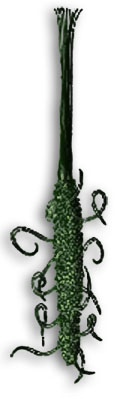
| The fungus trichurus terrophius produces a cancer-cell killing compound |
For the first time, researchers have developed a way to synthesize a cancer-killing compound called rasfonin in enough quantity to learn how it works.
Derived from a fungus discovered clinging to the walls of a New Zealand cave, the chemical tricks certain cancer cells into suicide while leaving healthy cells untouched.
"In 2000, scientists in Japan discovered that this compound might have some tremendous potential as a prototype anticancer agent, but no one has been able to study or develop it because it's so hard to get enough of it from natural sources," says Robert K. Boeckman, professor of chemistry.
"You either grow the fungus that makes it, or you go through a complicated chemical synthesis process that still yields only a minute amount," he says. "Now, after five years of effort, we've worked out a process that lets researchers finally produce enough rasfonin to really start investigating how it functions, and how we might harness it to fight cancer."
In 2000, researchers from Chiba University in Japan and the University of Tokyo simultaneously discovered a compound in certain fungi that selectively destroyed cells depending upon a gene called ras—one of the first known cancer-causing genes. They had found rasfonin, a compound that seemed tailor-made to knock out ras-dependent cancers like pancreatic cancer.
After six years, however, rasfonin's secrets remain a mystery because researchers can't make enough of it to carry out tests.
To bring about a new drug, organic chemists must produce a new chemical in enough quantity to test it under many different circumstances to tease out its modus operandi. Until now, no method existed to generate rasfonin, aside from growing more fungus—a time-consuming and terribly inefficient method.
Boeckman, the Marshall D. Gates, Jr. Professor of Chemistry at the University of Rochester, has now revealed a process that produces 67 times more rasfonin than any previous method. For the first time, scientists can obtain enough rasfonin to conduct proper biological tests on it.
"The key is to find exactly what buttons rasfonin is pushing, then... push those same buttons."
"At a guess, I'd say that rasfonin itself will not be the final compound that might come to market," says Boeckman. "But we need to figure out how it works, how it triggers the cancer cell to shut itself down. The key is to find exactly what buttons rasfonin is pushing, and then figure out if there's a way we can safely and more simply push those same buttons. But we couldn't do that until we have enough to test."
Even Boeckman's simplified process is notably complex, employing sophisticated organic reactions. Instead of the original method's 23 steps, Boeckman's has just 16—but finding them took five years of his team's hard work, skill and intuition.
Boeckman's paper, published in the Aug. 30 issue of the Journal of the American Chemical Society, outlines the sequence of steps showing how Boeckman's group inserted, removed, or altered the three-dimensional and chemical structure of their compound until they produced complete rasfonin. Diagrams of the complete process are available on the Web at pubs.acs.org.
"Very soon, researchers should be able to scale up this process rather easily to whatever volume they need," says Boeckman. "It may be a long road to a possible treatment, but at least we're now past the first hurdle."
This research was funded by the National Science Foundation.
About the University of Rochester
The University of Rochester (www.rochester.edu) is one of the nation's leading private universities. Located in Rochester, N.Y., the University gives students exceptional opportunities for interdisciplinary study and close collaboration with faculty through its unique cluster-based curriculum. Its College of Arts, Sciences, and Engineering is complemented by the Eastman School of Music, Simon School of Business, Warner School of Education, Laboratory for Laser Energetics, Schools of Medicine and Nursing, and the Memorial Art Gallery.
PR 2590, MS 1024