January 27, 2025
University of Rochester photo / J. Adam Fenster
Dear members of the Hajim School community,
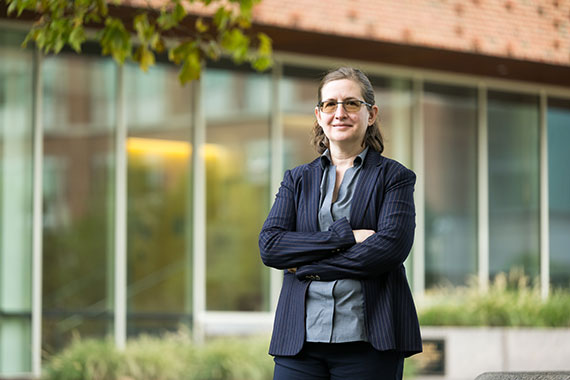
The Department of Computer Science has had an outsized impact on the development of artificial intelligence for more than 50 years, and our alumni are helping guide the future of AI as the technology rapidly advances. A standout example is Amanda Stent ’01 (PhD), who is one of the world’s leading authorities on natural language processing and has had a decorated career in both academia and industry.
As the Head of Artificial Intelligence (AI) Strategy & Research in the Office of the Chief Technology Officer (CTO) at Bloomberg, Amanda works across the company to help it break down barriers in key strategic areas related to AI. Amanda’s team works with Bloomberg’s engineers, product managers, data scientists, data analysts, legal team, and more, as well as with outside partners, including clients, regulators, and academics.
Read about Amanda’s Rochester roots, advice for current students, and vision for the future of AI.
EXPLORING HOW THE BRAIN USES VISUAL CUES TO UNDERSTAND SPEECH
University of Rochester photo / J. Adam Fenster
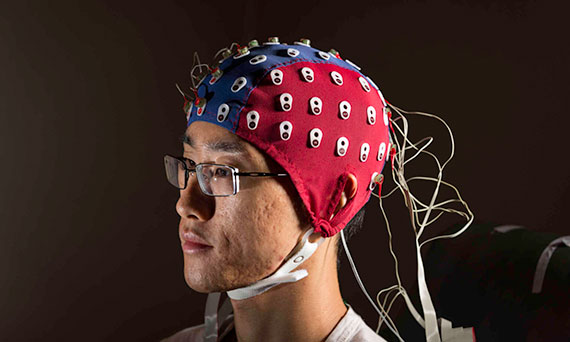
Associate Professor Ed Lalor launched a fascinating new project to understand how in a loud, crowded room, the human brain uses visual speech cues to augment muddled audio and help the listener better understand what a speaker is saying. While most people know intuitively to look at a speaker’s lip movements and gestures to help fill in the gaps in speech comprehension, scientists do not yet know how that process works physiologically.
The National Institutes of Health (NIH) is providing Ed, a faculty member of biomedical engineering and of neuroscience, an estimated $2.3 million over the next five years to pursue the research. To study the phenomena, his team will monitor the brainwaves of people for whom the auditory system is especially noisy—people who are deaf or hard of hearing and who use cochlear implants.
Learn about the project at the News Center.
ZHEN BAI DISCUSSES USING AI TO MINIMIZE LANGUAGE DEPRIVATION
University of Rochester photo / J. Adam Fenster
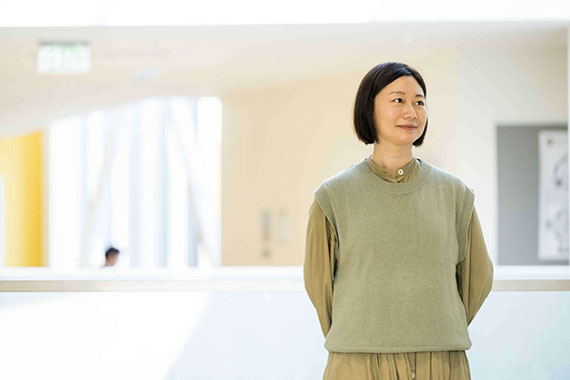
Can AI-powered tools help hearing parents learn to communicate with their children who are deaf and hard-of-hearing and reduce the risks of language deprivation? Zhen Bai, an assistant professor of computer science and the Biggar Family Fellow in Data Science at the Goergen Institute for Data Science and Artificial Intelligence, is developing a system called the Tabletop Interactive Play System (TIPS) to help parents learn American Sign Language in a natural setting.
Zhen and her collaborator Wyatte Hall, a Deaf researcher and assistant professor at the University of Rochester Medical Center’s Department of Public Health Services, recently appeared on WXXI’s Connections with Evan Dawson to discuss their project. They were joined by Karen Fisher-Malley, director of early childhood programs at the Rochester School for the Deaf, who helped provide valuable feedback about the TIPS system.
Watch the episode on YouTube, listen to it on the WXXI website, or find it wherever you get your favorite podcasts.
CENTER FOR EMERGENT COMPLEXITY IN BIOMATERIALS
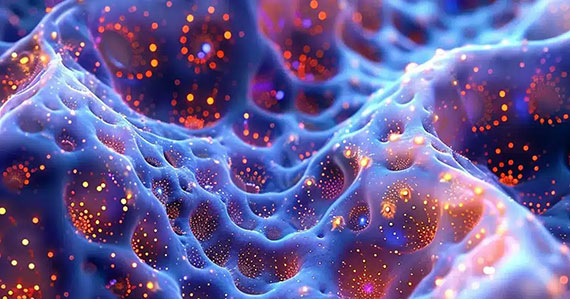
Last year, the University put out a call for proposals for new transdisciplinary centers and institutes and 42 teams of Rochester researchers submitted proposals. Ten were selected to receive planning awards and are now refining their plans for final proposals for full-scale funding.
Better Things: The Boundless Possibility blog recently provided an overview of the Center for Emergent Complexity in Biomaterials. The co-leads include Associate Professor Anne Meyer from the Department of Biology, Professor Brad Nilsson, the director of the Materials Science Program, and Associate Professor Benjamin Partridge from the Department of Chemistry.
The team aims to establish a hub dedicated to better understanding the seemingly miraculous work of natural systems. Together, they will unlock the secrets and solve the puzzles around the architecture, construction, and function of complex structures. They will then use that knowledge to create synthetic materials that benefit human health, energy, and the environment.
Learn more about their vision at the Boundless Possibility blog.
ASTRID MULLER RECEIVES UR VENTURES TECHNOLOGY DEVELOPMENT FUND AWARD
University of Rochester photo / J. Adam Fenster
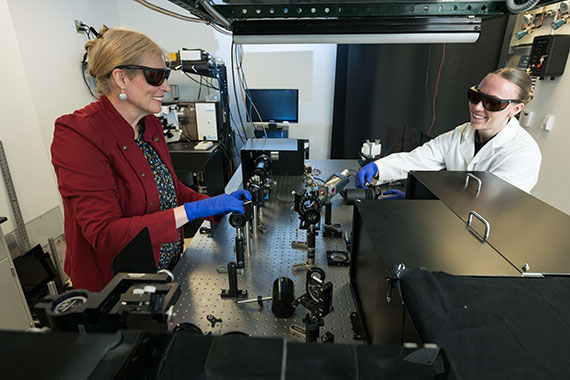
Assistant Professor Astrid Müller from the Department of Chemical Engineering is one of three researchers receiving funding through the Technology Development Fund (TDF) this year. The TDF was conceived as a tool to provide targeted funding that de-risks University-developed technologies and advances them toward commercialization.
Astrid has been awarded funding to advance development of her electrocatalytic technology that removes fluorinated “Forever Chemicals” from drinking water. Her approach significantly lowers the cost of PFAS removal, works in water, and uses only nonprecious materials as anodes to in-situ generate active PFAS destruction catalysts.
Read more about Astrid’s project and the other awardees on the UR Ventures website.
NEWLY FUNDED RESEARCH
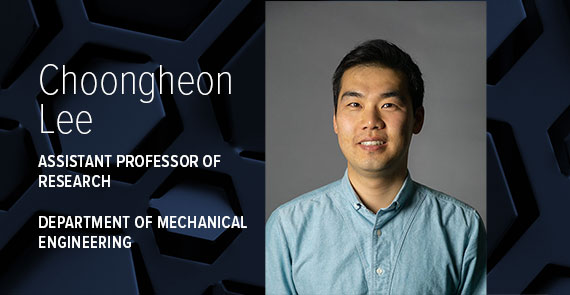
Congratulations to Assistant Professor of Research Choongheon Lee from the Department of Mechanical Engineering, who is receiving $75,000 from the American Hearing Research Foundation for a study titled, “Translational Research in Vestibular Diagnostics: Direct Assessment of Human Gravity Receptors.”
Have a great week!
Your dean,
Wendi Heinzelman