December 1, 2025
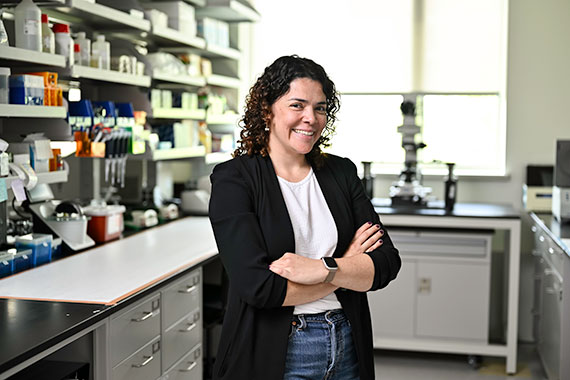
University of Rochester photo / J. Adam Fenster
Growing from a single cell into a complex organism with specialized tissues and organs requires a complex and coordinated process. But the mechanical signals that guide tissue and organ development—cells pushing, pulling, compressing, and swelling against one another and their environment—remain mysterious.
Assistant Professor Marisol Herrera-Perez from the Department of Biomedical Engineering will shed new light on tissue and organ development by studying how cells interact mechanically with the extracellular matrix, a biological polymer produced by cells that acts like scaffolding for building more complicated structures. She received more than $2 million through a competitive Maximizing Investigators’ Research Award (MIRA) from the National Institute of General Medical Sciences (NIGMS), part of the National Institutes of Health (NIH), to examine how cells and the extracellular matrix work together.
Read about this exciting project at the News Center.
31 STUDENTS INDUCTED INTO TAU BETA PI
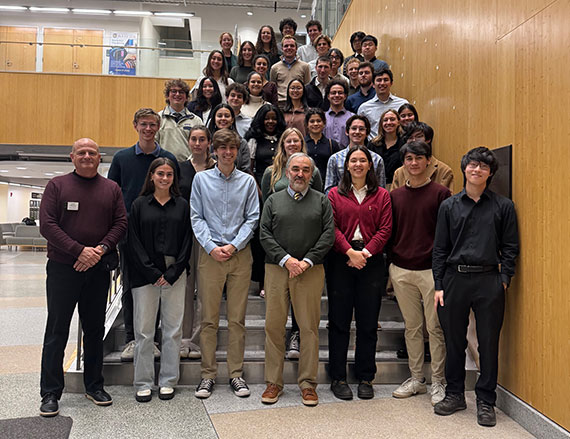
URochester’s chapter of the Tau Beta Pi Engineering Honor Society recently initiated 31 new members. Throughout the academic year, our chapter hosts a variety of activities including community service, social events, corporate information sessions, and study sessions to help other engineering students succeed. The newest members include:
Marlena Berger ’27 (optical engineering); Lauren Blanch ’27 (biomedical engineering); Eva Ciuffetelli ’27 (chemical engineering); Sophia Fabian ’27 (mechanical engineering); Zach Greenwell ’27 (biomedical engineering); Jiatong Gui ’27 (chemical engineering); Pablo Guiader ’27 (mechanical engineering); Asa Guldbransen ’26 (mechanical engineering); Katherine Hegblom ’27 (chemical engineering); Miriana Kelly ’26 (biomedical engineering); Simon Krasnow ’27 (chemical engineering); Kathryn Lambright ’26 (biomedical engineering); Allison Love ’26 (mechanical engineering); Cameron Lowe ’26 (mechanical engineering); Samantha Magowo ’27 (biomedical engineering); Siena Maislin ’27 (electrical and computer engineering); Minh Hieu Nguyen ’26 (optical engineering); Jacob Noe ’26 (mechanical engineering); Liam O’Donnell ’26 (biomedical engineering); Caleb Oshinsky ’27 (electrical and computer engineering); Noah Paradise ’27 (biomedical engineering); Noah Robinson ’27 (chemical engineering); Eitan Sacks ’27 (mechanical engineering); Sam Scheinbach ’27 (mechanical engineering); Trevor Shooshan ’27 (optical engineering); Wieting Tan ’27 (electrical and computer engineering); Aaron Tran ’27 (mechanical engineering); Khai Minh Tran Nguyen ’27 (mechanical engineering); Cagla Zaynep Tutar ’27 (biomedical engineering); Stephanie Valent-Musleh (biomedical engineering); Matthew Virtell (audio and music engineering)
Congratulations to all!
ME 204 PUZZLE TAKES SHAPE
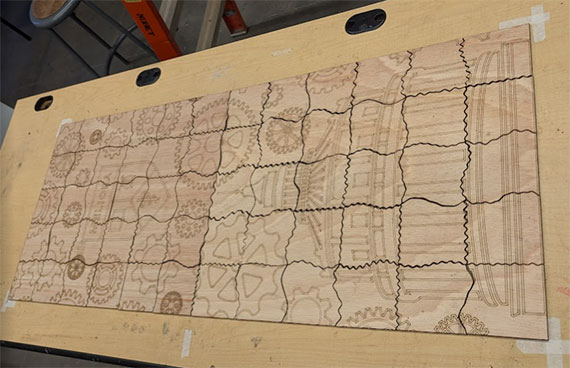
Every year, mechanical engineering students in the ME 204 senior design class fabricate a unique puzzle piece using one of the computerized numerical control (CNC) machines in the Rettner Hall shop. The puzzle is prepared by Professor Chris Muir and the students don’t know what it will reveal until they all complete and place their pieces. Visit Instagram to watch this year’s puzzle take shape!
FULL SPECTRUM SERIES: AUDIO ARTS AND TECHNOLOGY
One of the Hajim School’s newest majors is a Bachelor of Arts in audio arts and technology, which prepares students to become leaders in studio production, sound design in film/TV/games, broadcasting/podcasting, and music industries. In a Full Spectrum Series video, Assistant Professor Stephen Roessner provides an overview of the program and explains how it differs from other majors like audio and music engineering.
Watch the video on YouTube.
GRADUATE STUDENT AR/VR PROJECT DEMOS
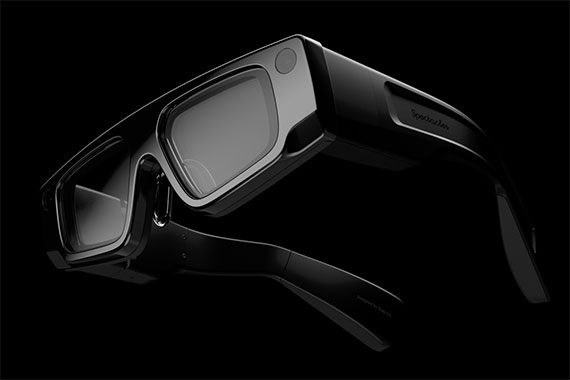
Graduate students who took the ECE 410 and CSC 412 courses in augmented and virtual reality will present an exciting showcase of innovative AR/VR projects from 2-4 p.m. on Monday, December 8 in at the Mary Ann Mavrinac Studio X. The event will provide an opportunity for you to see student class projects that push the boundaries of immersive technology, including VR projects using the Meta Quest and AR projects using the Snap Spectacles. No registration is required, and light refreshments will be provided.
REGISTER FOR THE SPRING AI FOR ALL COURSE
Want to learn about how generative AI systems work, and think about the risks and benefits as applied to areas such as art, healthcare, education, and more? Consider enrolling in CSC 160: AI for All. There are no prerequisites, and all technical content will be aimed at a general audience level. Expect assignments that require you to read about and think about AI, and even apply it through a long-term project. The Spring 2026 syllabus is in the works. For a snapshot of the Fall 2025 offering, visit the course page on the computer science website.
TEACHING INNOVATION GRANT
Instructors can apply for up to $12,500 to support the integration of experiential learning or other high-impact practices into two instances of a redesigned or new course. The application deadline for this Teaching Center grant is January 7, 2026, for Fall 2026-Spring 2027 courses. Learn more at the Teaching Center website.
TRANSPARENT ASSIGNMENT DESIGN FELLOWSHIP
Faculty are encouraged to consider joining the Teaching Center’s spring Transparent Assignment Design Fellowship cohort. The program demonstrates how to (re)design non-test assignments to get on-target work and to support the learning of all students. Fellows will learn transparent assignment design principles, transition their assignments, and workshop their assignments with peers.
The cohort meets four times for 90 minutes in person on River Campus during the spring 2026 semester and participants receive a $500 non-salary stipend to cover expenses related to their teaching and research. The application deadline is January 12, 2026. Register on the Teaching Center website.
Have a great week!
Your dean,
Wendi Heinzelman