July 13, 2026
Dear members of the Hajim School community,
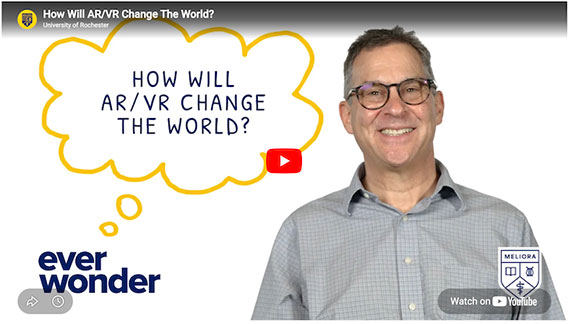
Human vision is not a continuous recording of the world. What we experience as reality is actually the brain’s best interpretation of it. In URochester’s latest Ever Wonder video, Professor Barry Silverstein explains how augmented and virtual reality combine the digital world with our perceptions of the real world. Watch the video on YouTube.
A companion story on the News Center explores how researchers including Barry and Brain and Cognitive Sciences Professors Michele Rucci and Duje Tadin are studying the process of human vision from three connected angles: how the eyes actively sample the world, how the brain filters and constructs meaning from that input, and how technology tries to reproduce the experience in AR and VR systems. Read the story.
In related news, the Center for eXtended Reality Collective is a new student organization at URochester seeking founding members from all majors. Students can sign up to join here.
HOW SOCCER PLAYERS ‘BEND IT LIKE BECKHAM’

URochester photo / J. Adam Fenster
A bending soccer kick. A slicing golf shot. A tennis ball that sinks as it crosses the net. They’re all the result of the Magnus effect, rooted in Bernoulli’s principle. Professor John Lambropoulos from the Department of Mechanical Engineering recently explained the physical phenomena so that if you’re lucky enough to witness it in the 2026 World Cup, you can appreciate the science that allows soccer players to ‘bend it like Beckham.’ Watch the video on YouTube and read about it at the News Center.
CENTER FOR MATTER AT ATOMIC PRESSURES RECEIVES ADDITIONAL YEAR OF NSF FUNDING
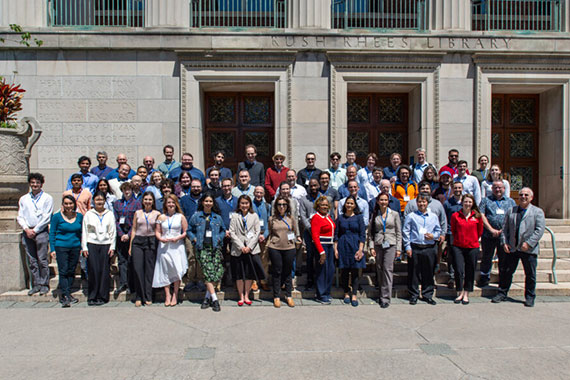
Congratulations to the Center for Matter at Atomic Pressures (CMAP) team, led by the Tracy Hyde Harris Professor Rip Collins, who received nearly $3 million from the National Science Foundation to fund CMAP for another year. This award supports 13 faculty across mechanical engineering, earth and environmental sciences, physics and astronomy, and the Laboratory for Laser Energetics, as well as two postdoctoral researchers, and six graduate students at URochester. It also supports sub-awardees at Princeton University, the University at Buffalo, Arizona State University, UC Berkeley, and University of Nevada.
NEWLY FUNDED RESEARCH
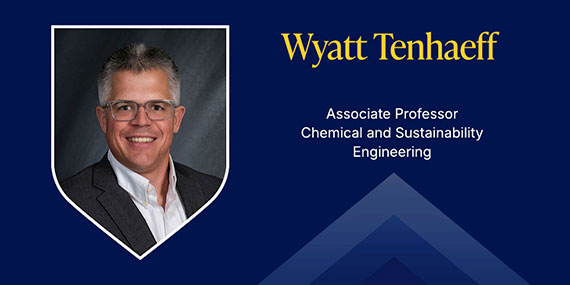
Congratulations to Associate Professor Wyatt Tenhaeff from the Department of Chemical and Sustainability Engineering, who received $299,943 from the National Science Foundation’s Division of Civil, Mechanical, and Manufacturing Innovation for a project titled “Efficient, Scalable Manufacturing of Solid-State Lithium Battery Cathodes Enabled by Radical Induced Cationic Frontal Polymerization.”
Have a great week!
Your dean,
Wendi Heinzelman