July 20, 2026
University of Rochester photo / Grant Taylor
Dear members of the Hajim School community,
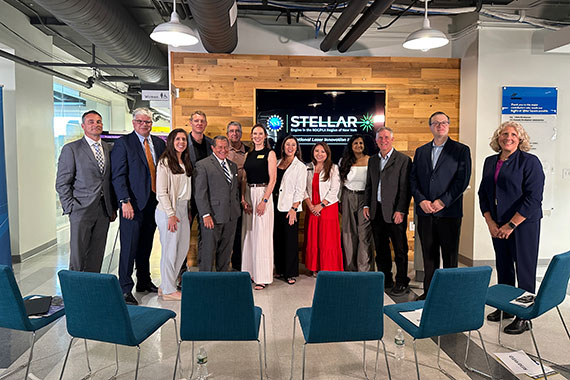
I am elated to share that the US National Science Foundation (NSF) announced it will award $15 million over the next two years to launch the NSF STELLAR Engine in the Rochester/Finger Lakes Region of New York, led by the University of Rochester. NSF could potentially provide up to $160 million over the next decade, and New York State will match with $16 million in support over the next six years. The initiative will establish an internationally competitive technology and innovation cluster in the region focused on laser technologies, education, business expansion and attraction, manufacturing, and workforce development.
An estimated $16 trillion global marketplace depends on lasers for everything from smartphones to national defense, but their production is increasingly based overseas. To bolster laser production domestically, the United States and New York State governments are investing in STELLAR (Science, Technology and Engineering for Laser and Laser Applications Research). The project’s key partners include the Institute of Optics and Laboratory for Laser Energetics (LLE) at URochester, Rochester Institute of Technology (RIT), Monroe Community College (MCC), NextCorps, Greater Rochester Enterprise (GRE), AmeriCOM, and New York State, and more than 90 organizations have offered collaboration and support for the initiative.
The NSF STELLAR Engine has been spearheaded by Tom Brown, director of URochester’s Institute of Optics and STELLAR principal investigator and interim CEO. Ideas for this began formulating nearly seven years ago and planning began in earnest in 2023, when NSF awarded the University of Rochester a $1 million NSF Regional Innovation Engines Development Award.
I want to extend a sincere thank you to everyone who played a part, large or small, in securing funding for STELLAR. Read more about this exciting new initiative at the News Center. You can also see coverage at Photonics Spectra, WXXI, the Rochester Business Journal, and News 8 WROC.
TEAM SCIENCE: USING AI FOR DENTIST-PATIENT COMMUNICATION TRAINING
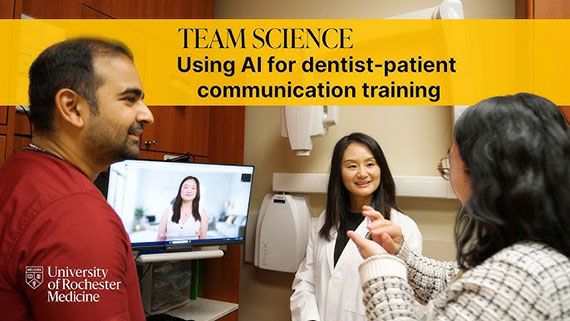
Anxiety and confusion are all too common at the dentist office, so experts from University Rochester Medicine and the Hajim School are using AI to train dentists to communicate more effectively with patients, reduce anxiety, and dispel misconceptions.
In an interesting new video, Professor Jin Xiao, associate dean for oral health education at the School of Medicine & Dentistry, and Professor Ehsan Hoque from the Department of Computer Science showcase SOPHIE, a virtual ‘patient’ that trains doctors to communicate better.
See how it works.
DANIEL KRAJOVIC ’20 NAMED ONE OF THE 2026 FUTURE CAS LEADERS
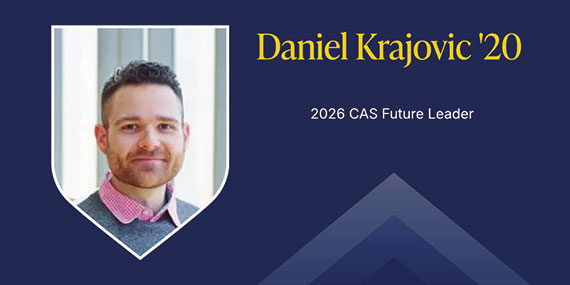
Congratulations to alumnus Daniel Krajovic ’20 (chemical engineering), who is among the 31 PhD students and postdoctoral researchers who will head to CAS headquarters as the 2026 class of CAS Future Leaders. At CAS headquarters in Columbus, Ohio, Aug. 17–22, these scientists will receive leadership training, take part in career development workshops, and learn from and network with industry experts and each other.
Learn more about Danel and the rest of the 2026 CAS Future Leaders at the C&EN website.
NEWLY FUNDED RESEARCH
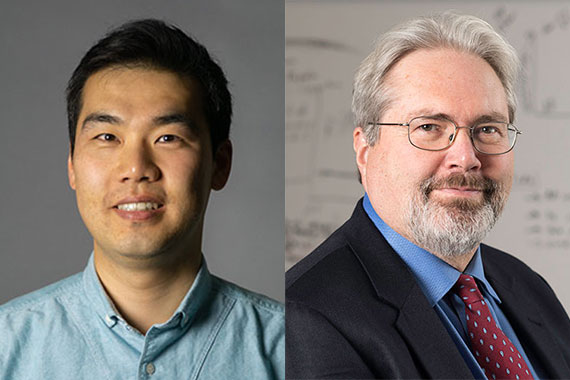
Congratulations to the following faculty who secured funding for new sponsored research projects:
- Assistant Professor of Research Choongheon Lee from the Department of Mechanical Engineering received $403,125 from the NIH National Institute of Deafness and Communication Disorders for a project titled “Direct Assessment of Human Gravity Sensors to Improve Peripheral Vestibular Assessment.”
- David Williams, the William G. Allyn Professor of Medical Optics, received a $ 2,675,241 NIH R01 renewal for a project titled “A plausible retinal mechanism for defocus sensing.”
Have a great week!
Your dean,
Wendi Heinzelman