A distinguished scholar, the former URochester faculty member lectured and taught workshops at more than 100 institutions in 33 states.
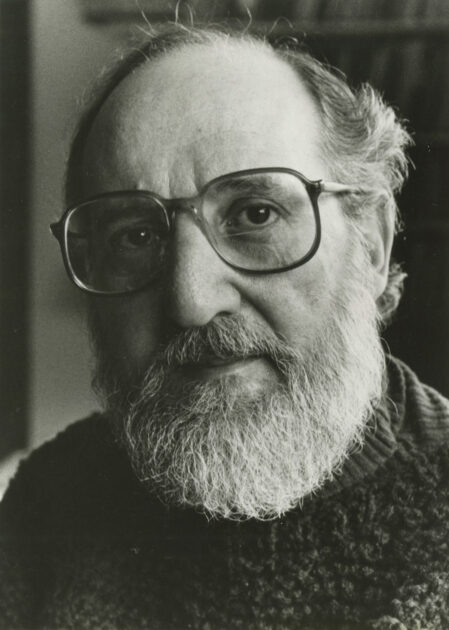
Carl Chiarenza, an artist-in-residence and a professor emeritus in the Department of Art and Art History at the University of Rochester, is being remembered as a notable American photographer and an erudite scholar.
Chiarenza, who died in May at the age of 90, was the Fanny Knapp Allen Professor of Art and Art History from 1986 until he retired in 1998. After retirement, he was named artist-in-residence and remained available for critiques and classroom visits.
Internationally known as a photographer specializing in abstract imagery, Chiarenza created photographs featured in more than 90 one-person and more than 280 group exhibitions since 1957. He authored numerous monographs and essays, as well as a seminal biography of American photographer Aaron Siskind called Aaron Siskind: Pleasures and Terrors (Little, Brown and Company, 1982).
Beyond his contributions to photography and scholarship, Chiarenza was widely admired for his generosity and warmth.
“The multitude of things that distinguish Carl as a scholar and as an artist are all secondary to the fact that he was a fine human and a generous citizen,” says Allen Topolski, a professor of art and the chair of the Department of Art and Art History. “I don’t remember many of the countless topics we covered over breakfast at the Frog Pond or Highland Diner in Rochester, but the warmth and wholly uncommon generosity of spirit is something I still embrace from every one of those times—they live with me.”
A trailblazer in photographic scholarship
Chiarenza earned an AAS in 1955 and a BFA in 1957 from Rochester Institute of Technology. He went on to earn an MS in 1959 and an AM in 1964 from Boston University.
In 1973, he became the first person to earn an art history PhD in photography from Harvard University.
“Carl ruffled feathers there by intending to write a dissertation not only on a living artist, but on a photographer—two categories that had never before been found worthy in that department,” recalls Janet Catherine Berlo, a professor emerita of art history at URochester. “It is a tribute to his talent, and the force of his will, that he was allowed to proceed.”
Chiarenza lectured and conducted workshops at more than 100 institutions in 33 states during his academic career.
Before his tenure at URochester, Chiarenza was a professor of art history at Boston University, where he served in the roles of chairman and director of graduate studies. He also taught at Smith College and Cornell University.
“He enjoyed teaching his lectures on the history of photography by starting with a cave painting,” says artist and landscape designer Heidi Katz, Chiarenza’s wife of 48 years. “He loved his smaller engaging seminars, some co-taught with colleagues from other disciplines. But finally, he loved being artist-in-residence with his own studio space on the University campus for several years after he retired.”
Finding mystery in the ordinary
Described by colleagues as a prolific and tenacious artist, Chiarenza worked predominantly in black and white, producing photography of collages made from materials such as torn paper and various foils.
His creative process often included the other art form about which he was passionate: music. “He never worked in the darkroom or studio without music being a part of it,” says Katz, adding that Chiarenza was a singer and musician who played the saxophone and clarinet.
Chiarenza’s works—from collages to single and multiple large format prints—are collected on his website, and catalogues include Journey into the Unknown, which accompanied a retrospective exhibition at the Eastman House in 2021.
An Eastman House description of the retrospective noted, “Rather than create straightforward records of the cast-off materials that appear before his camera, Chiarenza photographically transforms them into new and provocative images. […] His photographs often bear little resemblance to their actual subjects and instead suggest mysterious worlds that viewers are invited to explore.”
A legacy in art and education
Chiarenza’s academic and artistic contributions leave a legacy in the worlds of art, photography, and research. The archive of his artwork is housed at the Virginia Museum of Fine Arts in Richmond, Virginia, and his papers are at Harvard University.
Along with his artistry. Chiarenza’s legacy includes the artists, students, and scholars he mentored throughout his career.
“When I turn the key to my studio, I bring with me an audience of three,” says Topolski, adding that Chiarenza was a friend and mentor for 30 years. “Along with my father, who gives me confidence and checks the standard of my craft, and my mentor from grad school who taught me how to embed meaning into process, Carl is there to remind me that what I do is wholly important as long as it is wholly genuine. And being genuine in my studio is respecting it relative to what envelops it—kinship and family.”
Chiarenza is survived by his wife and three adult children, Jonah, Gabriella, and Suzanne.