A new book interrogates how the struggle over who counts as local shapes migration politics.
Immigration is a hot-button issue in the United States and beyond, and the unrelenting discourse includes a common belief that places belong to locals who have rights that newcomers do not have. But what does it mean to be local, and why does that matter when people move from one place to another?
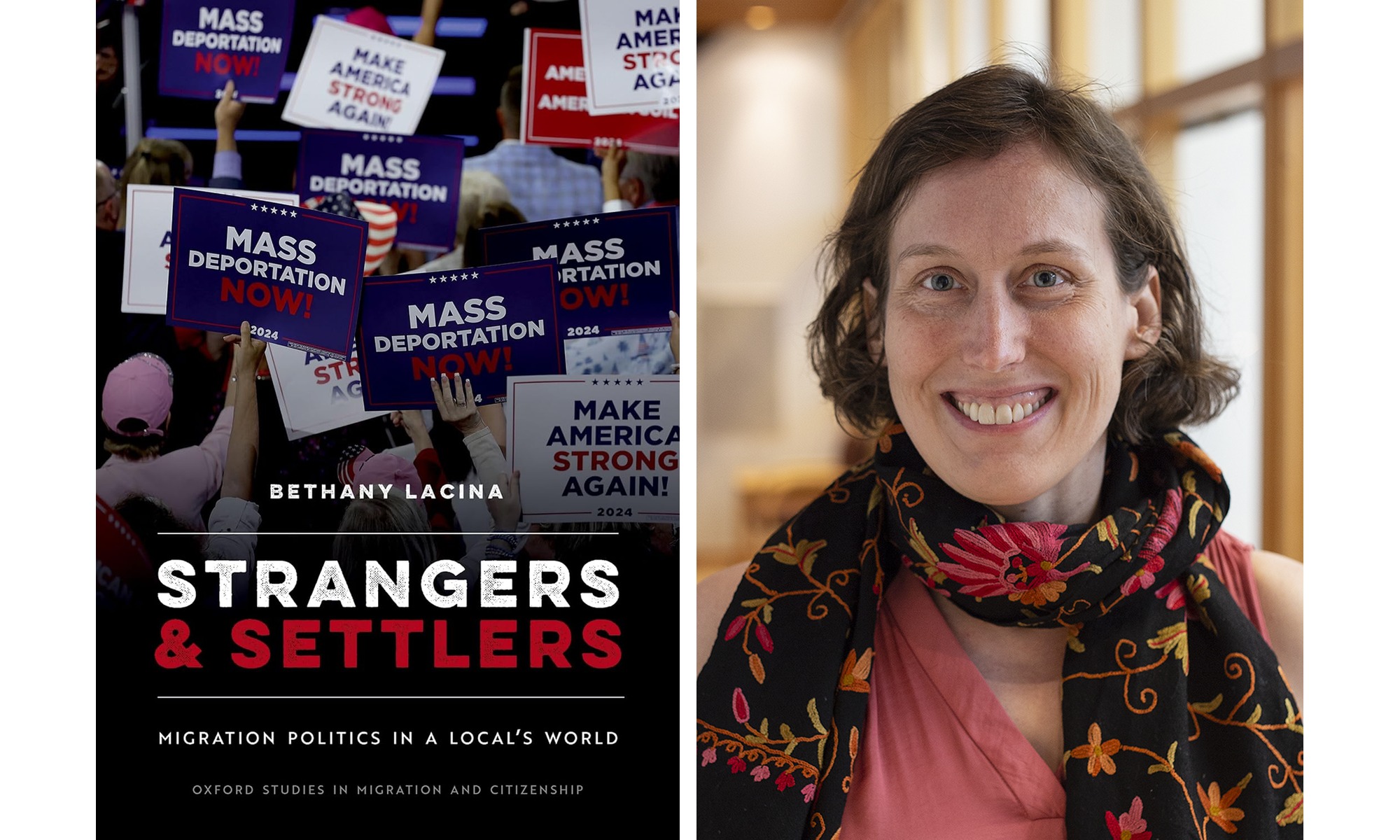
University of Rochester political scientist Bethany Lacina examines those questions in her new book Strangers and Settlers: Migration Politics in a Local World (Oxford University Press, 2026). Research for the global comparative study of nativism drew on 40 years of public opinion surveys from 146 countries and census records from 70 countries from the 1950s to today.
Big questions, complicated dynamics
In an unexpected turn, the impetus for that research came before the publication of her 2018 book Nativism and Economic Integration Across the Developing World: Collision and Accommodation (Cambridge University Press, 2018), about the controversy over domestic migration in non-industrialized countries.
“Immigration discourse has been non-stop in the US since before I started that book,” says Lacina, an associate professor of political science who studies migration, conflict, and ethnic politics. “I became frustrated with some of the narrowness of that debate. I wanted to see if some of the patterns I’d found outside the US and Europe also helped explain what was happening in industrialized settings.”
In Strangers and Settlers, Lacina investigates a widespread notion that people have special rights in the place where they are “one of the locals.”
“This is a belief that is important to immigration politics in Western countries right now,” Lacina says. “But it shows up all over the world, in different eras and around different issues. In the United States, for example, an intuition that a place’s existing residents have special rights appears in different ways in debates about gentrification, indigenous rights, and patronizing regional businesses.”
“Members of ethnic and racial minorities and immigrants have, on average, more liberal views on immigration than members of majority groups and non-immigrants,” Lacina adds. “However, that difference is usually only a modest shift, so that the average member of the group probably still has fairly restrictive policy preferences.”
Challenging a go-to answer in the immigration debate
According to Lacina, internalized racism is the classic reason given for why some minorities and immigrants are hawkish on immigration.
The researcher casts doubt on that explanation by measuring racial liberalism—specifically, support for affirmative action for historically underrepresented ethno-racial groups in higher education.
“Among white people born in the US, being racially liberal with respect to affirmative action tends to go along with having permissive views on immigration,” Lacina says. “For example, believing that Americans should not be favored by employers over non-US nationals. The correlation between support for affirmative action and liberal immigration policy is what we’d expect based on the positions of left-wing political parties in Western countries.”
However, Lacina’s research also finds that the correlation does not hold among non-white, US-born Americans or among immigrants in the US (people born outside the US). “Within those groups, people who favor affirmative action in higher education are a little more likely to say that employers should hire Americans over immigrants.”
“What these patterns tell us is that both affirmative action and immigration are policy issues that touch on the question of what we owe to individuals by virtue of their personal and family history in a place.” She adds, “My ongoing research is about finding better ways to describe the differences in what people believe about those obligations.”