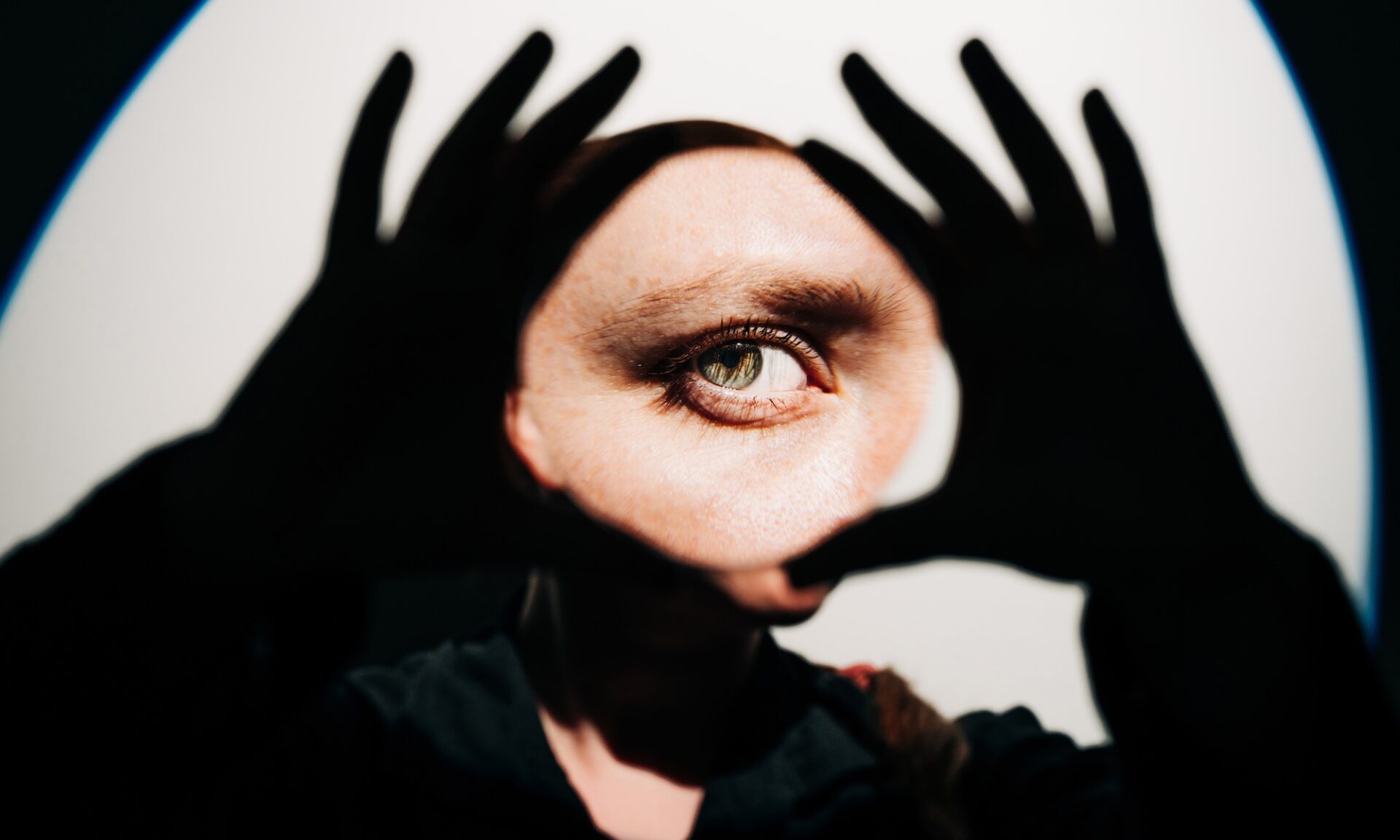
MORE THAN MEETS THE EYE: What are optical and visual illusions, and how are they created? Artists and scientists at URochester are exploring the process from all angles. (Getty Images photo)
At URochester, artists and art historians explore how scale, shading, and texture can transform what we perceive.
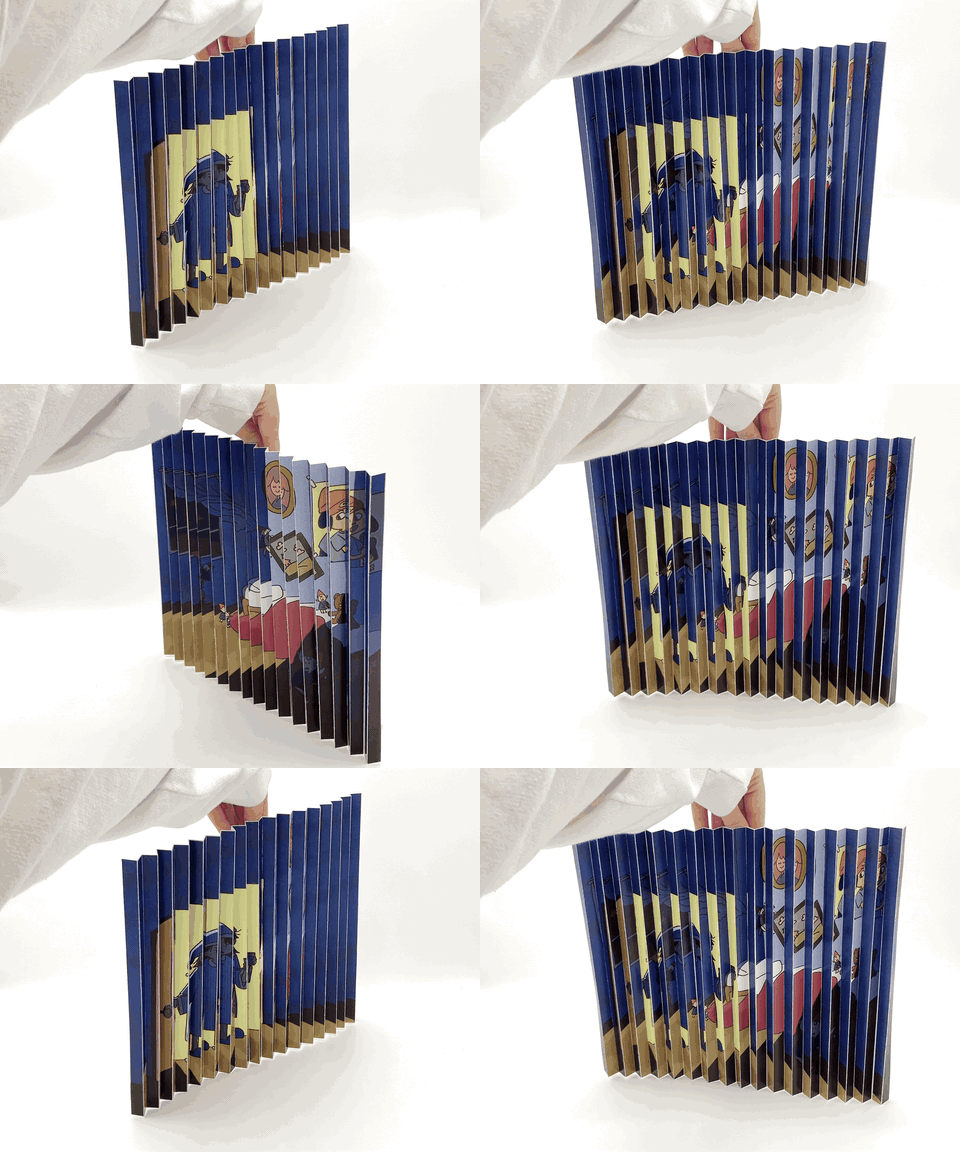
Rotate the lenticular artwork by Mila Kiran Jacobs ’26, and one scene dissolves into another. Viewed from one side, a figure stands against a yellow doorway. From the other, we see the room’s interior. Between those positions, strips of both images share the surface. The artwork’s accordion-like folds present different faces to the viewer as the piece turns, toggling between concealing and revealing.
But even when we fix our gaze upon a piece of art, we see details that aren’t there: painted shadows, doorways to nowhere, and shapes conjuring phantom contours. In creating optical illusions, artists leverage these tactics to control what reaches our eyes and how our brain interprets it.
At the University of Rochester, artists, art historians, and vision scientists explore that process from different angles—investigating how illusions work, how to create them, and what they reveal about perception.
What are optical and visual illusions?
THE ARTWORK HAS TWO FACES: In this piece of lenticular art by Mila Kiran Jacobs ’26, two scenes are divided into narrow strips and arranged on alternating sides of accordion-like folds. As viewers change their position, they see different sets of strips, making one image seem to disappear as another emerges. The effect depends on the viewer’s angle rather than movement within the artwork. (Photos courtesy of Mizin Shin)
The term optical illusion is often used broadly, but Duje Tadin, a professor of brain and cognitive sciences at URochester, makes a useful distinction. Optical illusions arise from the physical behavior of light, while visual illusions result from our interpretation of visual information. A lens can redirect light and alter an image. An arrangement of marks can make us perceive a shape that has not been drawn.
Artists can draw upon both. Some works change the light or the parts of an image available to the viewer. Others use perspective, shading, or context to suggest something beyond the marks on the surface. Tadin sees such effects as evidence of the interpretive work involved in vision.
“Illusions are not mistakes of the brain,” he insists. “They’re really a window into how the brain processes visual information.”
How do artists create optical illusions?
In the printmaking studio of Mizin Shin, students like Jacobs learn through building illusions by hand. Shin, an associate professor of art and art history at URochester whose work spans traditional and emerging print technologies, guides students in creating lenticular prints that seem to flip or move as the viewer does.
But even sketching an apple, Shin explains, involves creating an impression of depth and volume on a two-dimensional surface through value scales and shading. Linear perspective similarly allows artists to suggest three-dimensional space on a flat surface.
How do I draw an optical illusion?
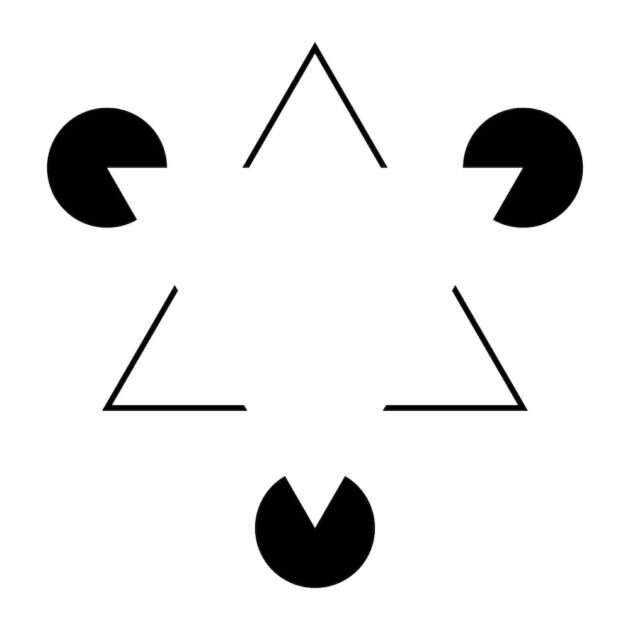
(Wikimedia Commons)
You can draw a simplified Kanizsa triangle with a pencil and a black marker on white paper.
Lightly sketch three equal circles with their centers at the corners of an imaginary equilateral triangle. Leave space between them.
Mark a 60-degree wedge in each circle, pointing inward. Align the wedge edges with the sides of the imaginary triangle.
Fill the circles with black, leaving the wedges white. Erase the pencil guides and avoid drawing lines between the shapes.
A white triangle may seem to sit over the black shapes. Try a second drawing with one opening facing outward. Comparing them shows how much depends on the relationship among the shapes. Then apply that active looking to any artwork that you create or enjoy. Change your position, move a layer, or search for the marks that evoke an edge. The illusion becomes something you can investigate as well as enjoy.
How have artists used illusions throughout history?
Artists have been experimenting with ways to represent three-dimensional space on flat surfaces for centuries. In 15th-century Renaissance Europe, the development of linear perspective gave painters a systematic way to suggest depth and distance from a fixed viewpoint.
“In its way, all of Renaissance painting is an optical illusion,” says Shin. “It has trained our human eyes to interpret volume from brushstrokes on a canvas.”
PERSPECTIVES BY PLANE: This 16th-century depiction of Tenochtitlan, the capital of the Aztec Empire, uses intersecting turquoise waterways to organize the city into four quarters. Surrounding figures and symbols communicate information about its founding and history. (From the Codex Mendoza. Bodleian Libraries, University of Oxford, 2026, MS. Arch. Selden. A. 1, fol. 2r.)
But European artists weren’t alone in exploring how images could represent space, explains Alanna Radlo-Dzur, a URochester assistant professor of art history. In 16th-century central Mexico, artists were also developing sophisticated visual systems that organized geography, history, and relationships without relying on a single vanishing point. As an example, she references a map of Tenochtitlan painted around 1541. Its waterways divide the city into four quarters, while figures and symbols convey geography and the city’s founding history. Rather than presenting a scene from one fixed viewpoint, the image brings together multiple kinds of information.
The two traditions demonstrate different approaches to a common artistic challenge: how to represent a complex world on a flat surface.
Other artists have used visual conventions to make flat surfaces look convincingly three-dimensional. Trompe l’oeil—French for “deceive the eye”—takes that ambition to an extreme.
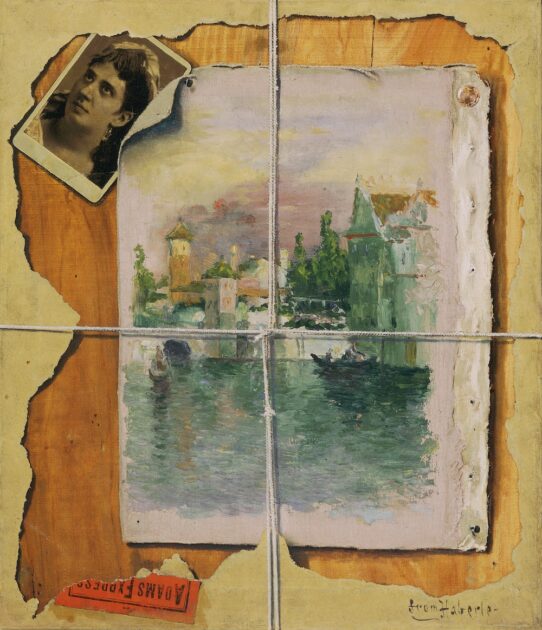
At URochester’s Memorial Art Gallery (MAG), John Haberle’s Torn-in-Transit with Woman’s Photograph (1888–89) offers a compelling example of evoking objects that aren’t there through strategic perspective, shading, and texture. A Venetian landscape appears to arrive wrapped in torn brown paper, complete with twine and an attached photograph. The damaged packaging is part of the painted illusion, with details that encourage deception. Because torn paper and twine are what viewers might expect to find around a painting, the painted wrapping seems to become its own object.
TROMPE OF THE AGES: Through precise shading, texture, and perspective, John Haberle’s oil painting Torn-in-Transit with Woman’s Photograph creates a trompe l’oeil that makes a flat surface appear to contain three-dimensional objects: torn brown paper, string, and a tucked-away photograph. (Memorial Art Gallery of the University of Rochester: Marion Stratton Gould Fund)
In the 20th century, Op Art, short for “optical art,” employed repeated geometric forms, strong contrasts, and carefully arranged colors to make flat images seem to vibrate, swell, or shift. Op Art makes perception itself the focus, using relationships among shapes and colors to generate the visual instability that suggests movement.
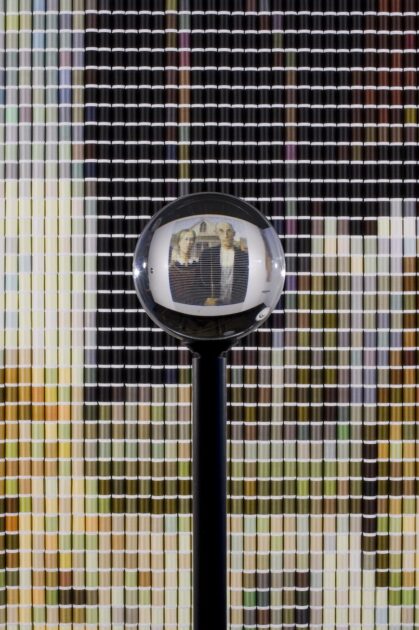
More recent contemporary art challenges the viewer to notice the process of perception. For After Grant Wood (American Gothic) 3, a 2010 work at the MAG, Devorah Sperber assembled 4,320 spools of thread into an upside-down, pixelated version of Grant Wood’s painting. Viewed up close, the spools register as fields of color. Through an acrylic sphere, which reverses the image, the farmer and his daughter become recognizable. The same arrangement can appear as a collection of ordinary objects or as a familiar painted scene, depending on how it is viewed.
To demonstrate the brain’s role in visual perception, Shin keeps a book by Japanese designer Takahiro Kurashima on display in her studio. In Moirémotion, readers slide a transparent patterned film over printed pages. Overlapping lines create patterns that appear to shift, spin, and flash. The effect is known as a moiré pattern: slightly offset layers of lines produce a larger pattern that changes as one layer moves relative to the other.
“That subtle misalignment of patterns produces the illusion of movement in our mind,” Shin says.
Why do some artists challenge what we see?
Evelyne Leblanc-Roberge, a professor of art at URochester whose expertise includes lens-based media, explores what happens when such an illusion doesn’t quite settle. Her work draws on waiting rooms, windows, ordinary walls, and doors, using camouflage and shifting points of view to make familiar spaces worth another look.
THE UPSIDE DOWN: Viewed directly, the 4,320 individual spools of colored thread in Devorah Sperber’s After Grant Wood (American Gothic) 3 resemble an abstract arrangement of colors. When viewed through an acrylic sphere, the image is reversed, allowing the recognizable figures to emerge. The work demonstrates how the way we view an image can transform what we perceive. (Photo courtesy of Devorah Sperber)
“These are places we often stop seeing,” she says. “I am less interested in showing that I can make an image pass as ‘real’ than in what happens in the seconds when it doesn’t quite settle.”
The viewer’s position matters here, just as it does in Jacobs’ folded artwork. A convincing image from one vantage point can become uncertain from another. Leblanc-Roberge uses that ambiguity to underscore the act of looking.
“Notice how much of your seeing depends on where you stand, what you notice, and who you’re with,” she says. “Looking becomes an activity of the whole body, and not a passive reception.”
One of Tadin’s favorite effects, the illusory contour, engages viewers in that active perception. A familiar example is the Kanizsa triangle, in which circles with wedges strategically removed conjure a phantom triangle.
Whether they’re folding paper, painting convincing shadows, or arranging patterns that seem to move, artists invite us to question what we see—and discover how much our own perspective contributes to the experience.
‘They’re not mistakes of the brain’
Can you always trust what you see? URochester professor of brain and cognitive sciences Duje Tadin explores the science behind optical illusions and visual illusions, revealing how our brains interpret visual information and why what we perceive isn’t always what’s actually there. From surprising tricks of perspective to illusions that challenge our perception of reality, discover what these visual phenomena can teach us about how the brain works.