Skip to content
From the Magazine

Ask the archivist: What’s one question that’s stumped you?

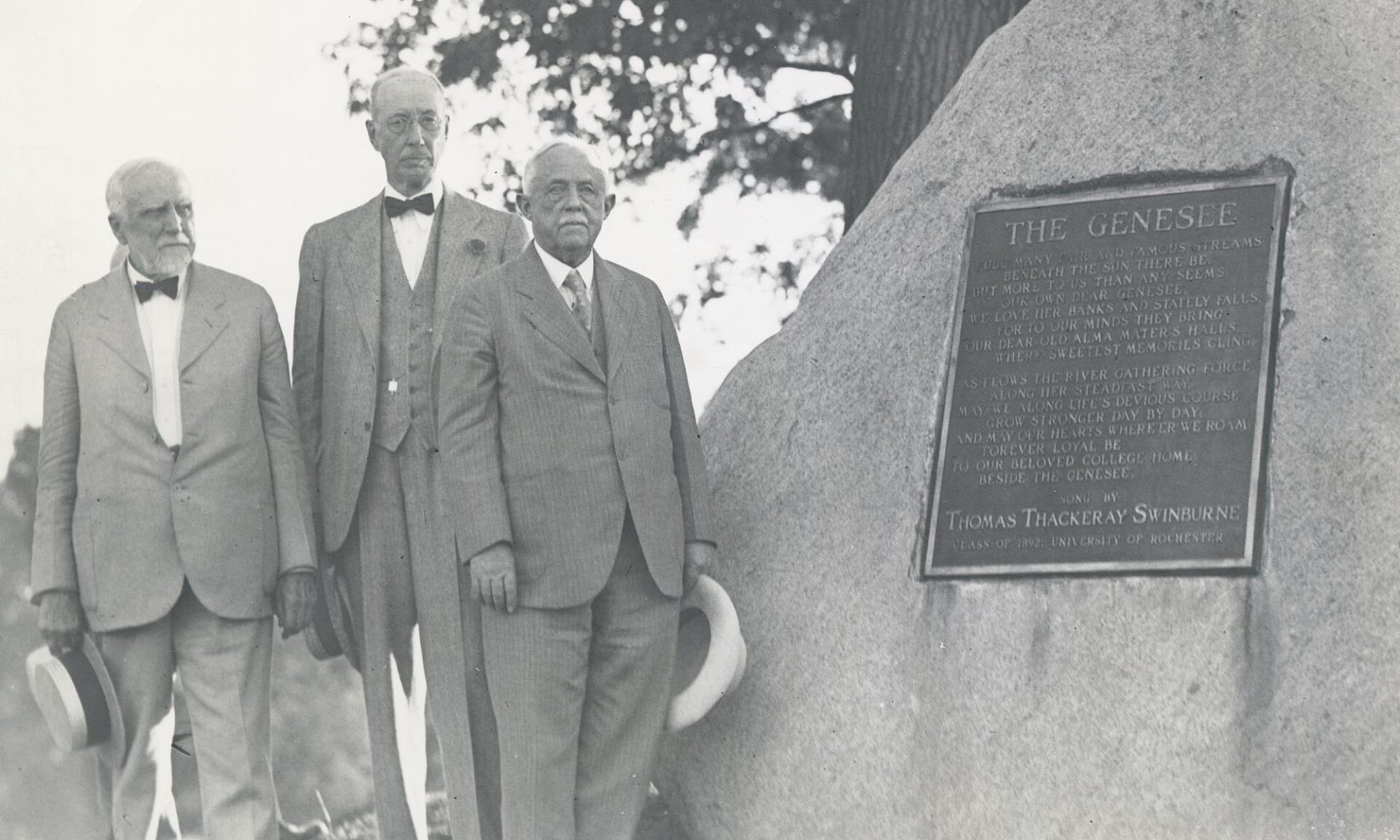
SET IN STONE: Herman LeRoy Fairchild, Edward Foreman, and Rush Rhees stand beside the Swinburne Rock memorializing “The Genesee” lyricist Thomas Thackeray Swinburne (Class of 1892). (University Libraries / Department of Rare Books, Special Collections, and Preservation)

A question for Melissa Mead, the John M. and Barbara Keil University Archivist and Rochester Collections Librarian.

In your 13 years as University archivist, what’s one question that’s stumped you but that you remain determined to answer?
—Tama Miyake Lung, editor, Rochester Review
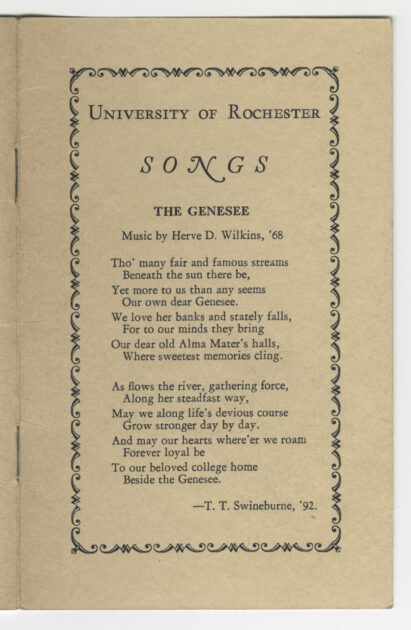

Vintage University of Rochester songbook page featuring “The Genesee,” with lyrics by T. T. Swinburne and music by Herve D. Wilkins.
WELL VERSED: A page from a 1920s songbook with two of three verses from “The Genesee.” (University Libraries/Department of Rare Books, Special Collections, and Preservation)

My prize for “still looking for the answer” goes to the school song, “The Genesee.” Why do we only sing two verses, when it was written with three? For me, determining when we dropped the middle verse has been the first step to the why. There are a lot of clues and some distracting anecdotes but no definitive answer yet to this admittedly low-stakes question.

A 1916 article in the student newspaper, the Campus, proclaims: “‘The Genesee’ as an Alma Mater is ideal, for it links our college to the river about which our city centers . . . its first notes are the signal for ‘on your feet’ and ‘hats off.’”

We all know the words—written in 1891 by Thomas Thackeray Swinburne (Class of 1892)—with music arranged by Herve Wilkins (Class of 1866).

“The Genesee” was embraced by students and within a decade became our alma mater. It’s the first entry in a songbook used at the Commencement Week festivities of 1893.

But Swinburne kept tinkering with it: A new version appeared in the Campus on December 14, 1898. The biggest changes were in verse three: Gone were the gathering force, the devious course, and forever loyal be, replaced by a mill-wheel, a grove, and vernal hours.

Was Swinburne more focused on improving the poem (in his view) than on lyrics? The revisions confused singers: Letters in the Campus urged upperclassmen to learn the new words so they would be in sync with the first-years. Luckily, the lyric reverted after a few years.

What evidence is there for when the switch to two verses occurred? A songbook pasted in the scrapbook of Raymond Ball (Class of 1914) may be the first printed indication, although freshman handbooks continued printing three verses.

Online and in tune

Melissa Mead’s favorite video rendition of “The Genesee” is from the virtual degree conferral hosted for the Class of 2020.

In 1926, the annual Rochester-Hobart football match was filmed for the first time, and the marching band presented “The Genesee.” The silent movie was screened in the Eastman Theatre, and as the intertitle cued “All up for Rochester’s Alma Mater,” the orchestra played the two-verse version, according to the College for Women’s newspaper, the Cloister Window.

Later that fall, inconsolable after the death of his sister, Swinburne died by suicide in the river he honored with his lyrics and poems. Planning for a memorial boulder at the end of the Eastman Quadrangle to honor Swinburne began in 1930 with the instruction that it bear “a bronze tablet which shall incorporate two verses of the poem, ‘The Genesee.’”

That leaves “why”: Stylistically, the second verse is the least focused on student-university nostalgia. Its lines frequently tripped up singers because the words were too similar to the other verses. Other possible answers present themselves, including the need for brevity and even peer pressure: Yale and Columbia also have three-verse alma maters, of which only the first and third are traditionally sung.

And so research, like the river, continues.


This story appears in the fall 2025 issue of Rochester Review, the magazine of the University of Rochester.