International teacher exchange is often understood as a one-way transfer of knowledge, with visiting educators traveling to the United States to learn from American schools and universities. Yet the Fulbright Distinguished Awards in Teaching for International Educators (Fulbright DAI) program at the University of Rochester’s Warner School of Education & Human Development demonstrates that the most meaningful exchanges are fundamentally reciprocal. Visiting Fulbright teachers enrich local classrooms with their expertise, languages, and lived experiences, while Rochester’s schools and educators, in turn, reshape the teachers’ professional identities and practices in ways that continue long after they return home.
Each year, the Fulbright DAI cohort brings extraordinary linguistic and cultural diversity into three participating Rochester-area school districts. Collectively, participants represent educational systems across the Global South and beyond, contributing expertise in languages including French, Portuguese, Spanish, Mandarin, Hindi, Arabic, Indonesian, Hebrew, and English, among many others. Their presence is especially meaningful in Rochester classrooms that serve multilingual learners and students from immigrant and refugee backgrounds, where issues of language, migration, and identity are part of students’ everyday lives.
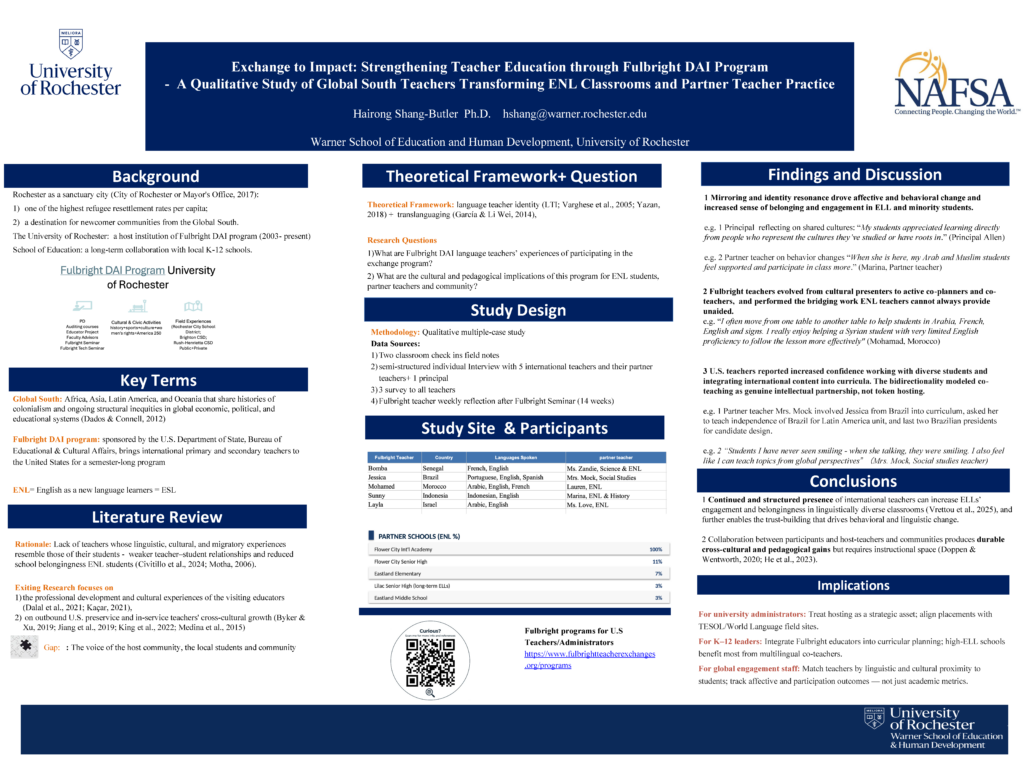
A pilot study conducted by Hairong Shang-Butler, associate professor (clinical) and associate department chair with the teaching & curriculum department of the Warner School of Education & Human Development, with the program’s third Fulbright DAI cohort examined how these international teaching placements affected both visiting teachers and their U.S. partners. The findings revealed that the exchange produced lasting benefits that extended well beyond the semester-long placement.
Identity, Representation, and Belonging
For many English language learners, seeing a teacher who had also crossed borders, learned English as an additional language, and successfully built a professional career carried powerful symbolic meaning. One student quietly told a Fulbright teacher, “You remind me of my dad.” Such moments of recognition created opportunities for identity mirroring that are often absent in schools, fostering a stronger sense of belonging among students who do not always see themselves reflected in positions of authority.
As one Fulbright teacher reflected, “They saw that someone like them could stand at the front of the room.” These experiences suggest that representation extends beyond cultural awareness—it can influence students’ confidence, aspirations, and sense of possibility.
Additionally, mirroring and identity resonance drove affective and behavioral change and increased sense of belonging and engagement in ELL and minority students.
From Visitor to Collaborative Teacher
Unlike brief international visits, the Fulbright DAI placement spans an entire academic semester, allowing relationships and professional trust to develop over time. Participants begin by observing classrooms but gradually transition into genuine instructional partnerships with their U.S. colleagues.
Rather than simply assisting in classrooms, Fulbright teachers co-designed lessons, co-taught instruction, and collaborated on strategies for supporting multilingual learners. One Rochester partner teacher reflected, “By the end, we were planning lessons together, not just sharing a room.”
The study suggests that this sustained presence—not merely international visitation—is what enables authentic professional collaboration to emerge.
Lasting Professional Growth on Both Sides
Perhaps the study’s most significant finding was that the exchange did not end when participants returned home.
Many Fulbright teachers continued collaborating with their Rochester partner teachers years later. They join classrooms virtually to speak with students, facilitate international letter-writing and classroom exchanges, collaborate on professional development initiatives, and, in some cases, visit one another in person. The partnerships evolve into enduring professional networks rather than concluding with the official program.
The experience has also inspired several Rochester-area teachers to pursue international teaching opportunities themselves, extending the cycle of exchange beyond the Fulbright program.
U.S. partner teachers likewise described lasting changes to their own instructional practice. Many adopted new translanguaging strategies, broadened their approaches to supporting multilingual learners, and gained greater confidence incorporating global perspectives into their teaching.
As one high school teacher explained, “It changed how I teach. I think about my students differently now, and I feel more confident teaching global history.”
The exchange therefore reshaped local pedagogy in ways that continued well after the Fulbright teachers had returned to their home countries.
Global Impact Beyond Rochester
The transformation is equally profound for the visiting educators themselves. Returning Fulbright teachers carry Rochester’s classrooms back to schools around the world, bringing with them new instructional strategies, expanded understanding of artificial intelligence and emerging educational technologies, enduring professional relationships, and a renewed sense of teacher identity.
Rather than simply adopting American educational practices, participants adapt what they have learned to their own cultural and educational contexts. In doing so, the influence of Rochester classrooms extends far beyond New York, reaching students and schools across multiple continents.
At the same time, Rochester benefits from the expertise that international teachers bring from their own educational systems. Their perspectives challenge assumptions, introduce new pedagogical approaches, and deepen the cultural competence of local educators. The exchange thus becomes a genuine partnership in which knowledge flows in both directions.
The Fulbright DAI program ultimately reframes what international teacher exchange can be. Rather than a one-way transfer of knowledge, it represents a mutually transformative relationship in which educators, students, and schools are all changed through sustained collaboration. The impact does not stop at the border or at the end of the semester—it continues in classrooms across Rochester and in communities around the world, illustrating the enduring power of reciprocal global engagement.