University photographer J. Adam Fenster gives a behind-the-scenes tour of his favorite photos he made this year. Plus, the research that resonated.
How do you best tell the story of a research university, from campus lab to Genesee River and everything in between? For senior University photographer J. Adam Fenster, it’s about access—and looking out for what might be just beyond the lens.
2025 at the University of Rochester was ripe with progress, passion, and possibility. And as the year draws to a close, we talk with Fenster about his favorite photos from the last 12 months, and what might be on the horizon for the future. Here’s to what’s next—Ever Wonder. Ever Better.
Tour de force
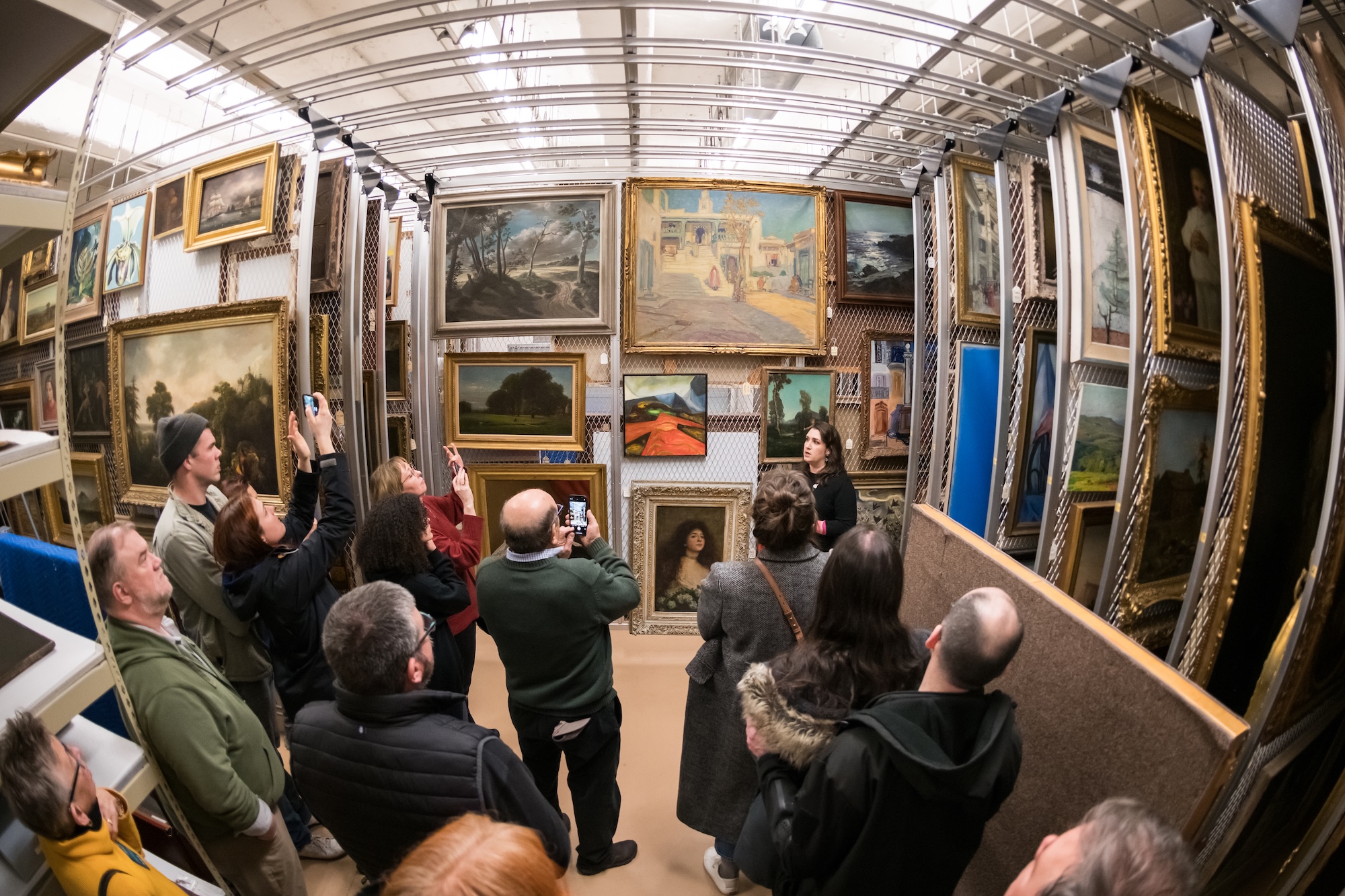
Lauren Tagliaferro, a curatorial assistant at the Memorial Art Gallery, speaks to visitors in the painting storage room during a tour of the museum’s art storage areas. The museum’s DeTour series gives visitors a chance to go behind the scenes and uncover a new perspective.
“I think I read about the tour in @Rochester,” says Fenster. “Having been here for a while now, I’m always looking for a new angle on an old thing. At the museum, for every piece of art you see, there are probably 10 you don’t. And here we finally get to see where and how all the other stuff is stored. Equipment-wise, using the fish-eye lens helps to capture all the visual layers—people, art, storage area—contained in the scene.”
Clean machine
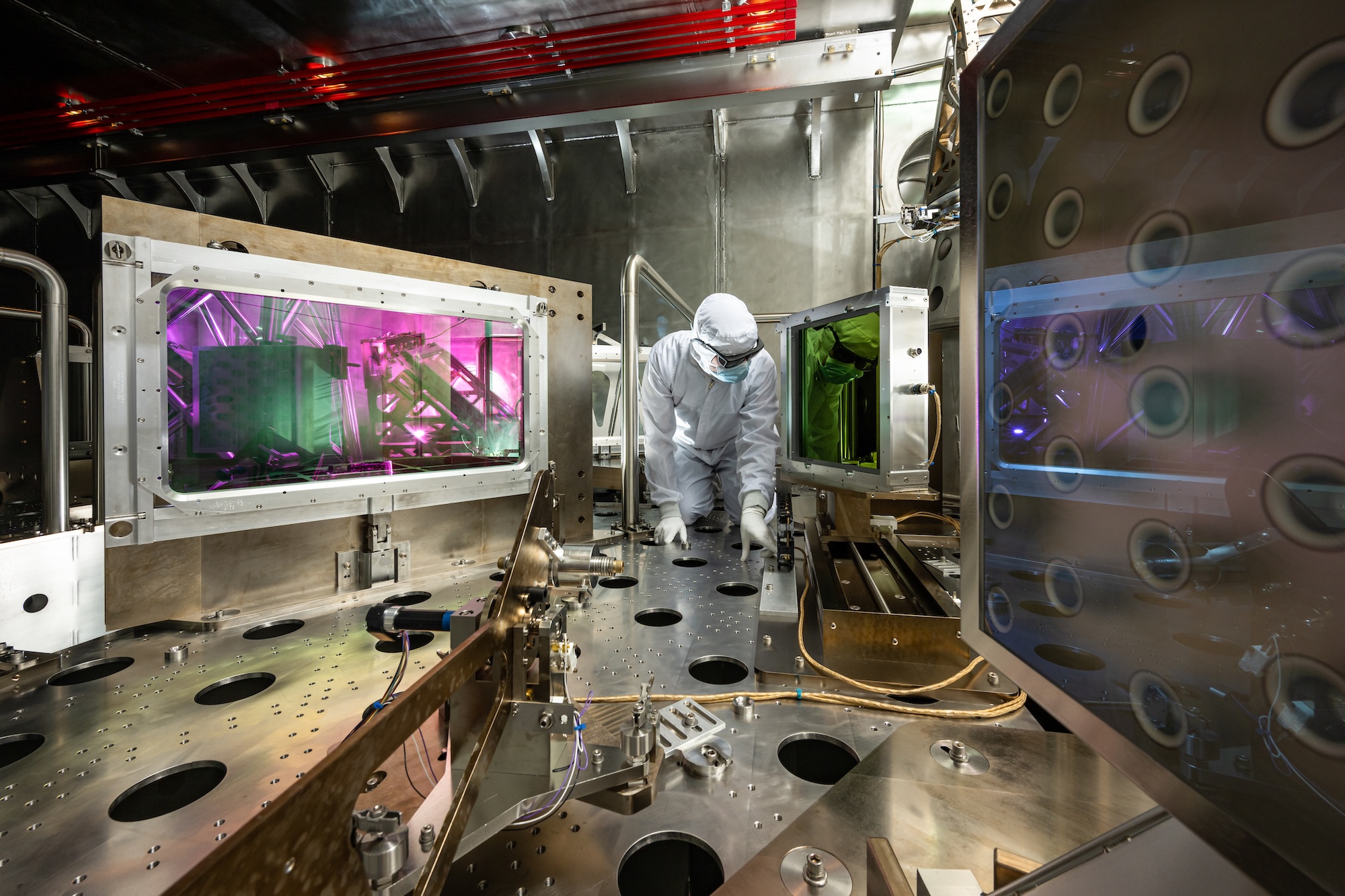
David Canning, facility manager for the Omega EP Laser, inside the grating compressor chamber (GCC) of the Omega EP Laser at the Laboratory for Laser Energetics.
There’s a safety talk and protocols to keep a dustless space dustless—including wiping down gear and wearing specific clothing—but, shares Fenster, “Any time you go inside the laser bays, it’s a big deal, especially the GCC. Dave was very accommodating in letting me in there—our visit was the only time the entire year that the chamber was open for maintenance.”
In a stainless steel chamber, it’s hard to control the light. “It’s one giant reflector”, he says, but bringing in a powerful light can lead to some surprising results. “I like the iridescent colors of the grating glass contrasted with the metallic sheen everywhere. And then you have Dave reflected in the panel on the right.”
Mentorship in action
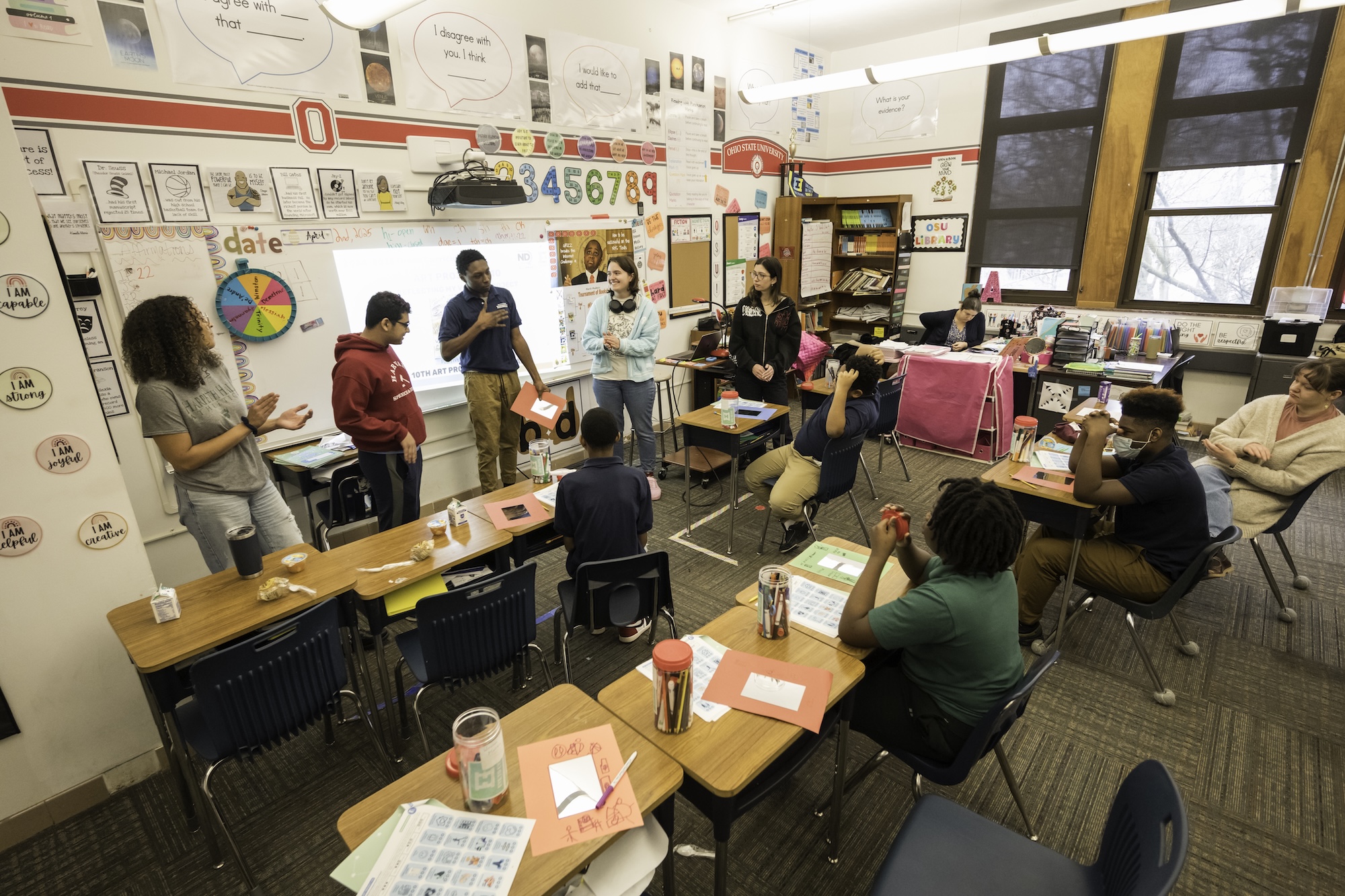
Zoë Miles ’25 (T5), Sree Chatterjee ’26, Jenna Savino ’26, and Maddie Bellamy ’27 are pictured with Rochester Prep student Marquez Smith (center). These URochester students volunteer with Eye to Eye, a national nonprofit organization that pairs neurodivergent middle school students with learning and attention differences with college and high school students who share a similar label to help mentor the next generation.
“It’s good to show these outreach efforts. I feel like I don’t get a lot of opportunities for this kind of work, so when they do come up, it’s good to get in there. And it probably wasn’t too long ago that our students were the age of the students behind the desks.”
A material world
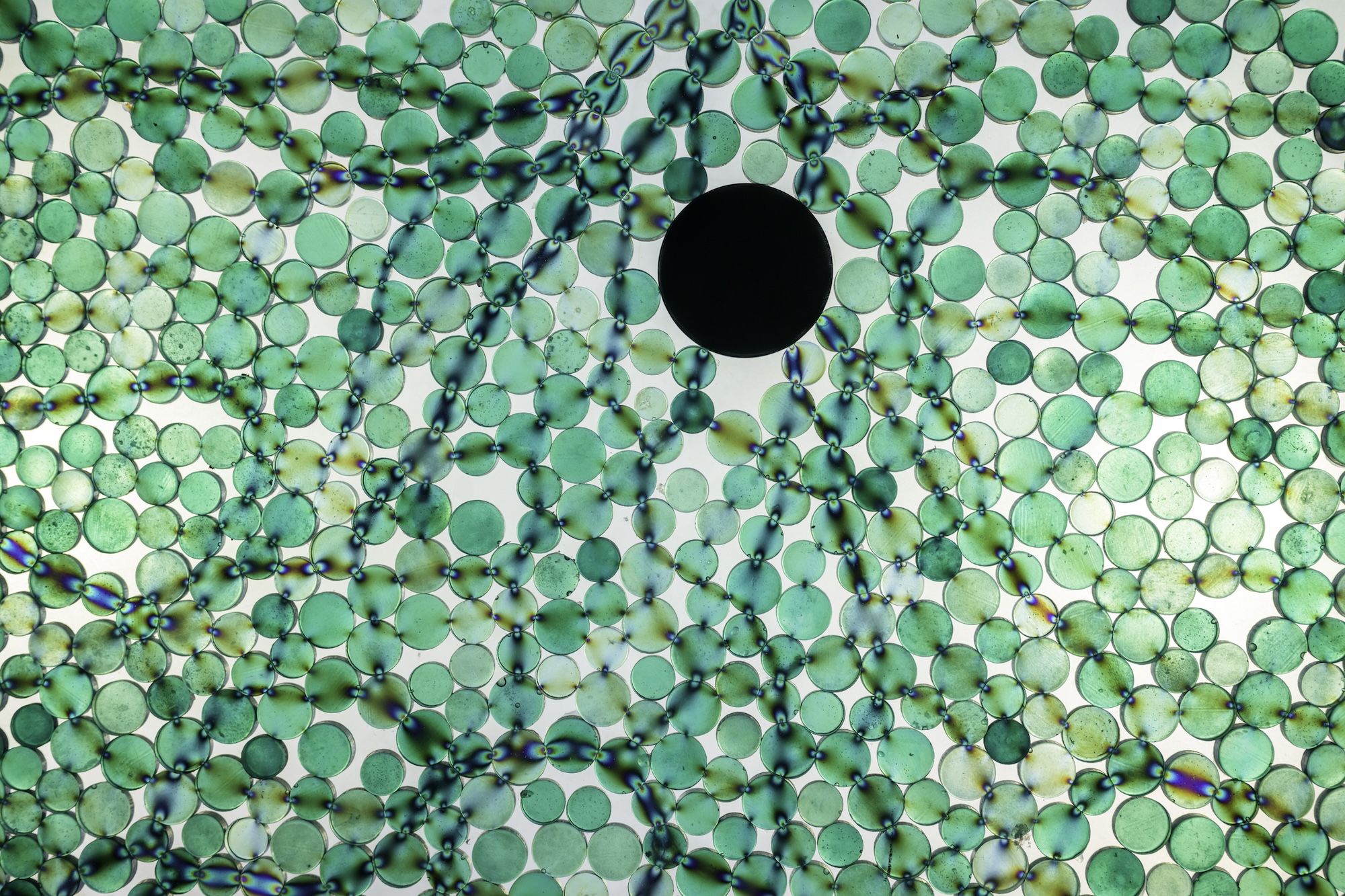
Viewed with polarized light, photoelastic materials display distinct patterns of birefringence and force chain propagation after a collision. This experiment was conducted by Sarah Williams, a postdoctoral associate in the Department of Earth and Environmental Sciences and the DRIP (Dirt, Rivers, Ice, Particles) Lab, an interdisciplinary group of scientists in the department.
“For someone who doesn’t quite understand all the science behind it, I don’t want to say it doesn’t matter what this is, but I’m attracted to the colors and the patterns in this image,” laughs Fenster. “I see an abstract story that I haven’t seen anywhere before. And so that makes me want to look closer. And then you learn about birefringence and other earth science terms. It’s a cool photo that introduces you to the science.”
Spark of interest
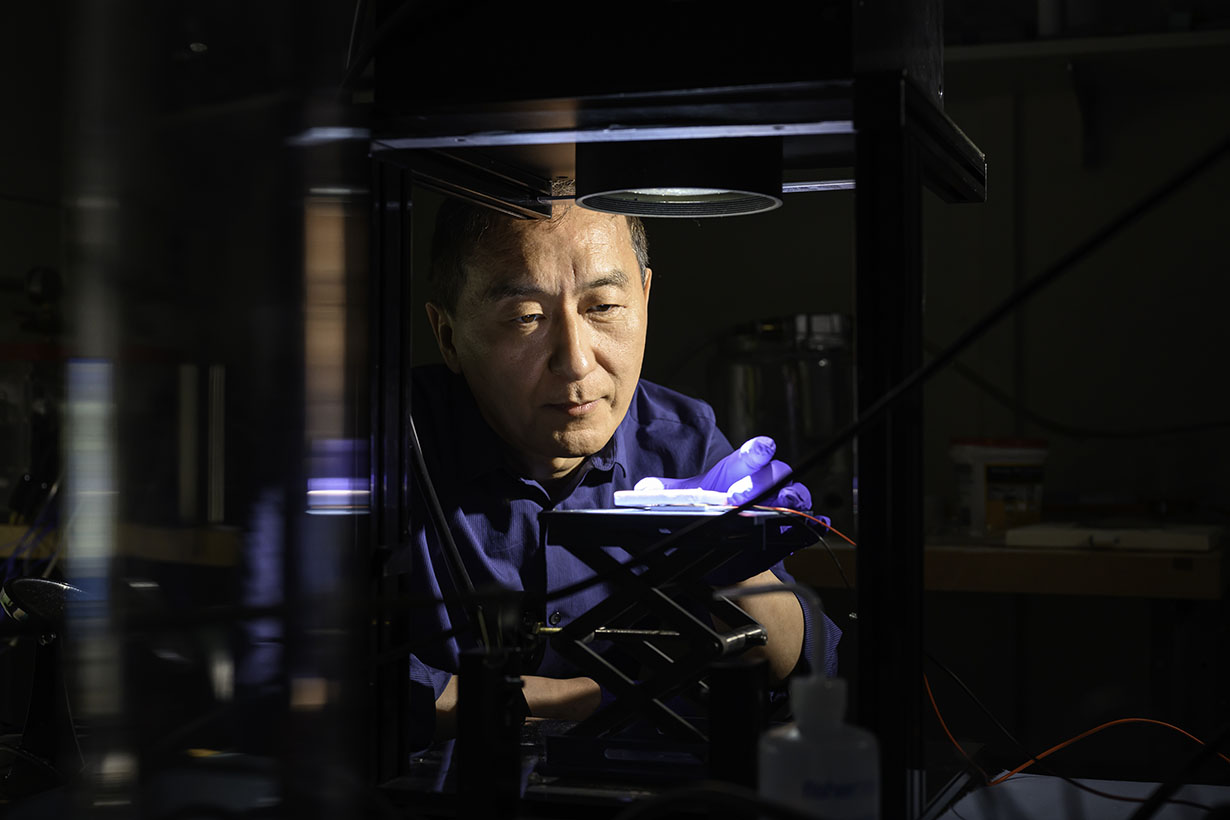
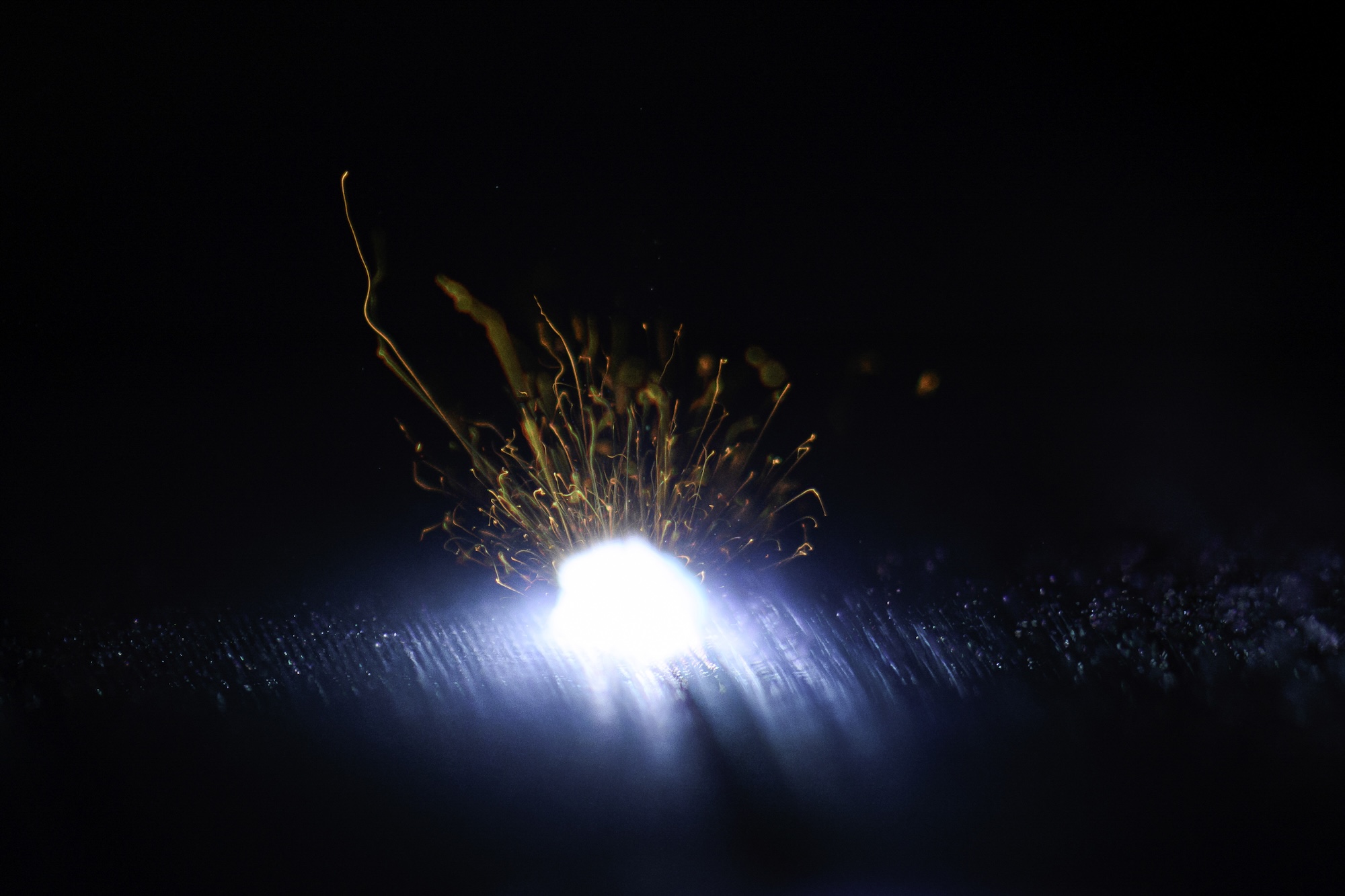
A composite of multiple images, here a laser etches nanostructures into a highly absorbent black metal surface in the lab of Chunlei Guo, a professor of optics and of physics, and a senior scientist at the Laboratory for Laser Energetics. This technique, developed by Guo, enhances solar absorption but minimizes infrared emissions to create highly efficient solar thermoelectric generators.
Notes Fenster, “I’ve been documenting Chunlei’s research almost as long as I’ve been at the University. But I had never photographed the process that he uses to create this material. And I’ve always wanted to do that. This surface is moving and creating these sparks that are flying everywhere. It would be cool enough to have one exposure, but I thought, ‘Why don’t I combine several of them and get even more stuff flying?’ It’s kind of like photographing fireworks, but on a much smaller scale.”
Flex messages
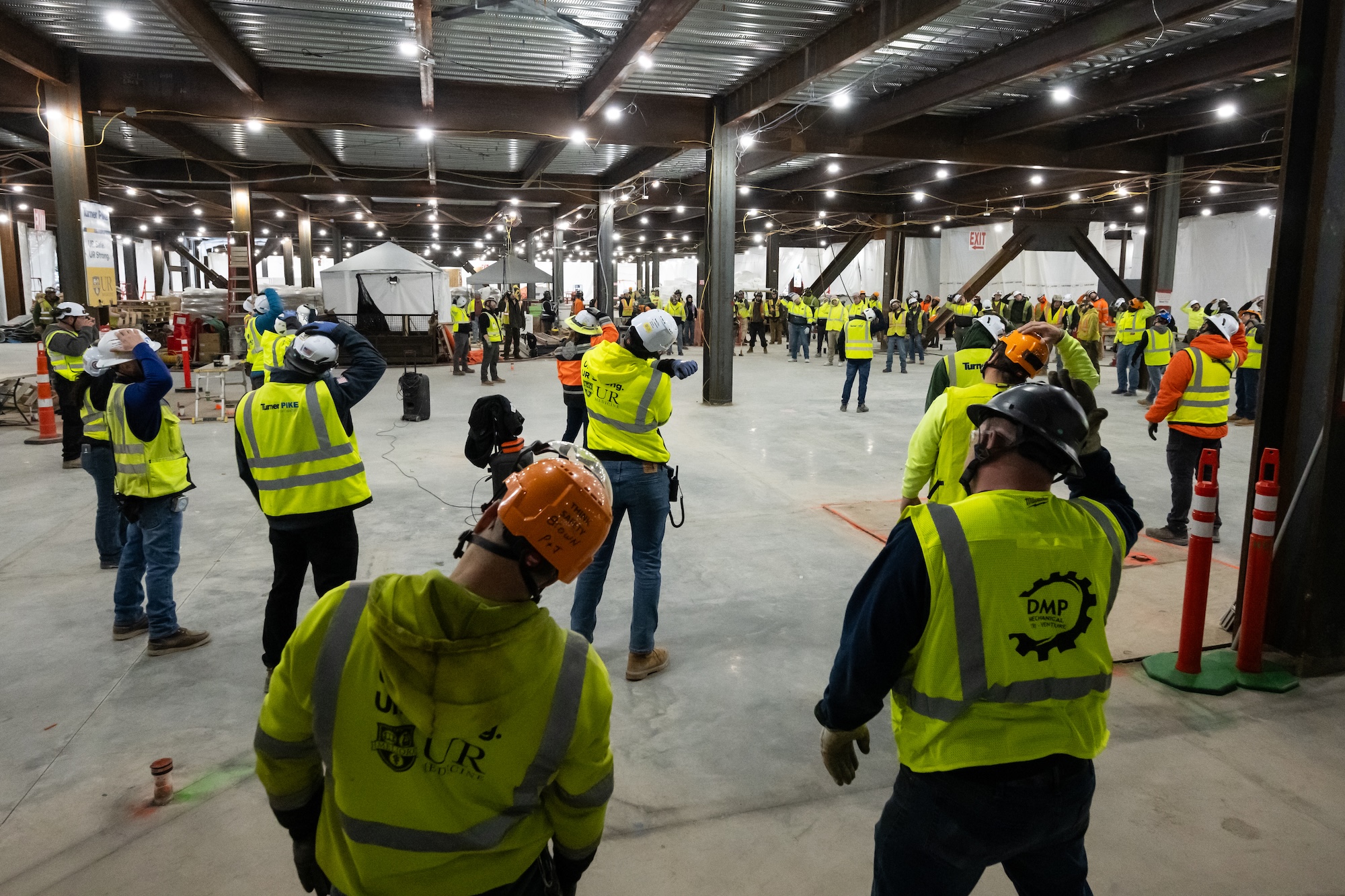
Workers gather for a morning stretch and flex session at the Strong Emergency Department expansion project construction site. Through this project, the Emergency Department will nearly quadruple in size and include space for psychiatric emergency care.
In the course of documenting this milestone construction, Fenster heard about the stretch and flex session that precedes work every morning and thought it might make for an interesting, offbeat image. “Just not something you typically see at a construction site. They bring out a little PA system, they blast upbeat rock tunes, and they go through their stretches. This photo also helps show just how many people are involved in a project of this size.”
Among several rocks and a hard place
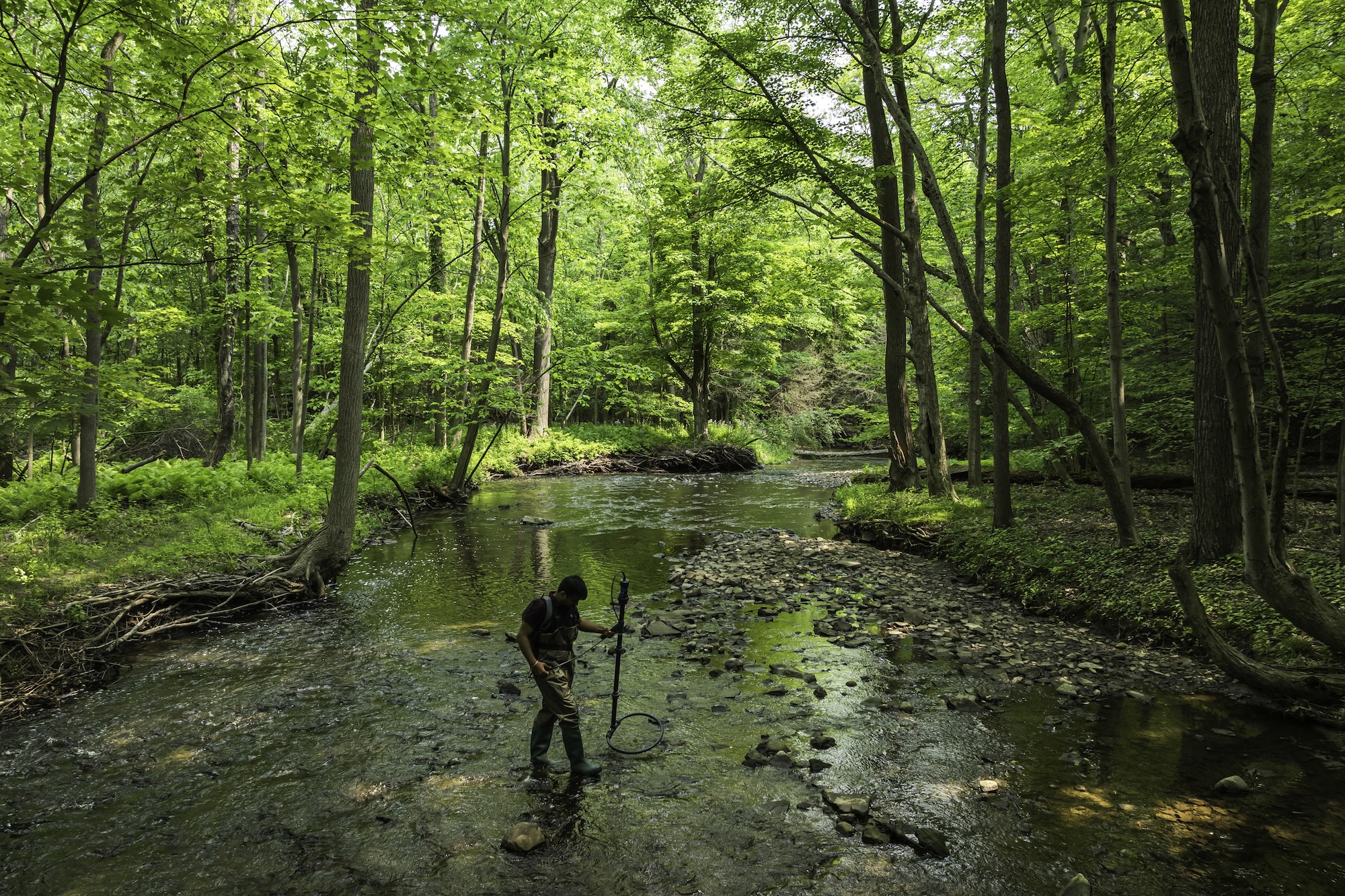
Anshul Yadav, a postdoctoral associate in the lab of Rachel Glade, an assistant professor of earth and environmental sciences and of mechanical engineering, uses a self-made device to track the movement of RFID-tagged rocks in a stream in nearby Webster, New York.
“Here was an opportunity to show field research taking place at URochester,” says Fenster. “And,” he added, “an opportunity to explain why that research is important. That ‘why’ is essential in answering the bigger question: Why do universities exist?”
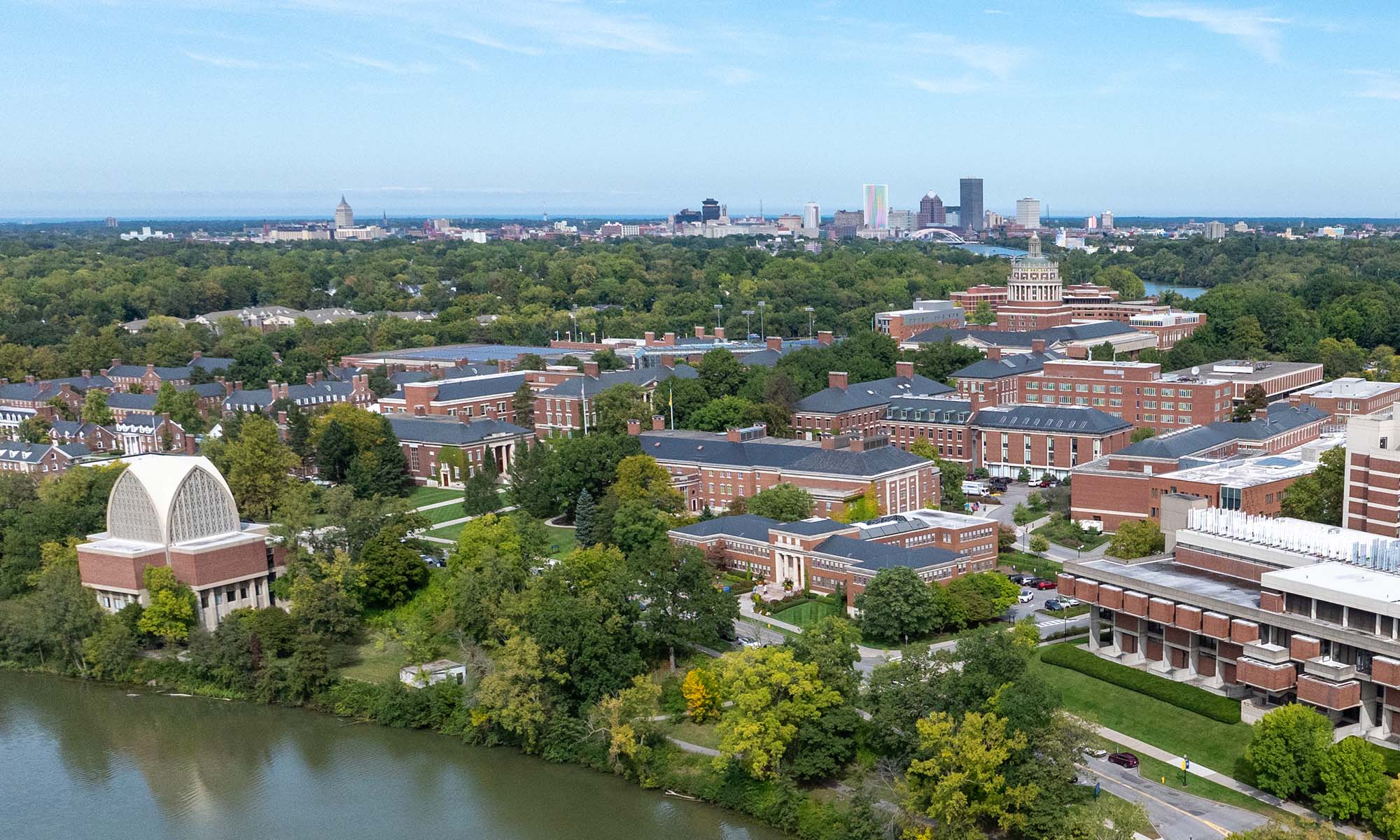
When asked how he captured this shot, Fenster gave a surprising answer: it’s a drone photo. “It’s a lot trickier flying in a space like this, over a stream bed deep in the woods, than up over the Genesee River, which I’ve also done. This is basically flying in a tunnel, with lots of overhanging branches and stuff sticking out. But it’s worth it for the unique angle it provides.”
Let’s focus
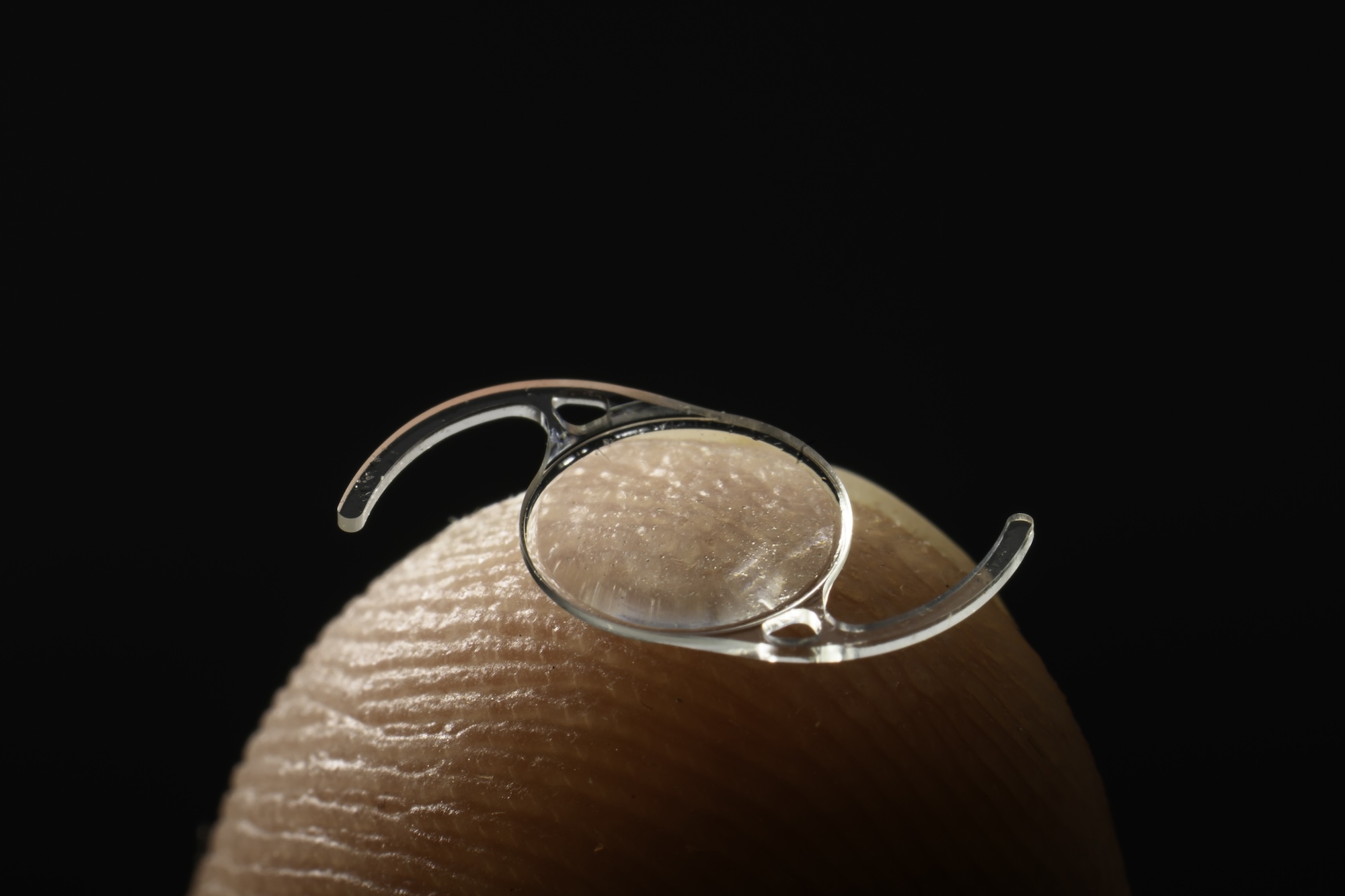
An intraocular lens is photographed on a fingertip to show its scale. Earlier this year, Susana Marcos, the Nicholas George Endowed Professor in Optics and the David R. Williams Director of the Center for Visual Science, served as the lead guest editor of a special issue of the journals of Biomedical Optics Express and Optics Express exploring the state of the technology.
Before you ask: Yes, that is Fenster’s finger supporting the lens. And while he did also photograph an intraocular lens insertion surgery, “I thought it would be helpful for the story to make photos of the lens itself, showing its odd galaxy-esque shape and including a finger for scale. And while it was challenging to photograph, it makes you appreciate just how much more challenging it must be for the surgeons to insert these precisely.”
It was the fest of times
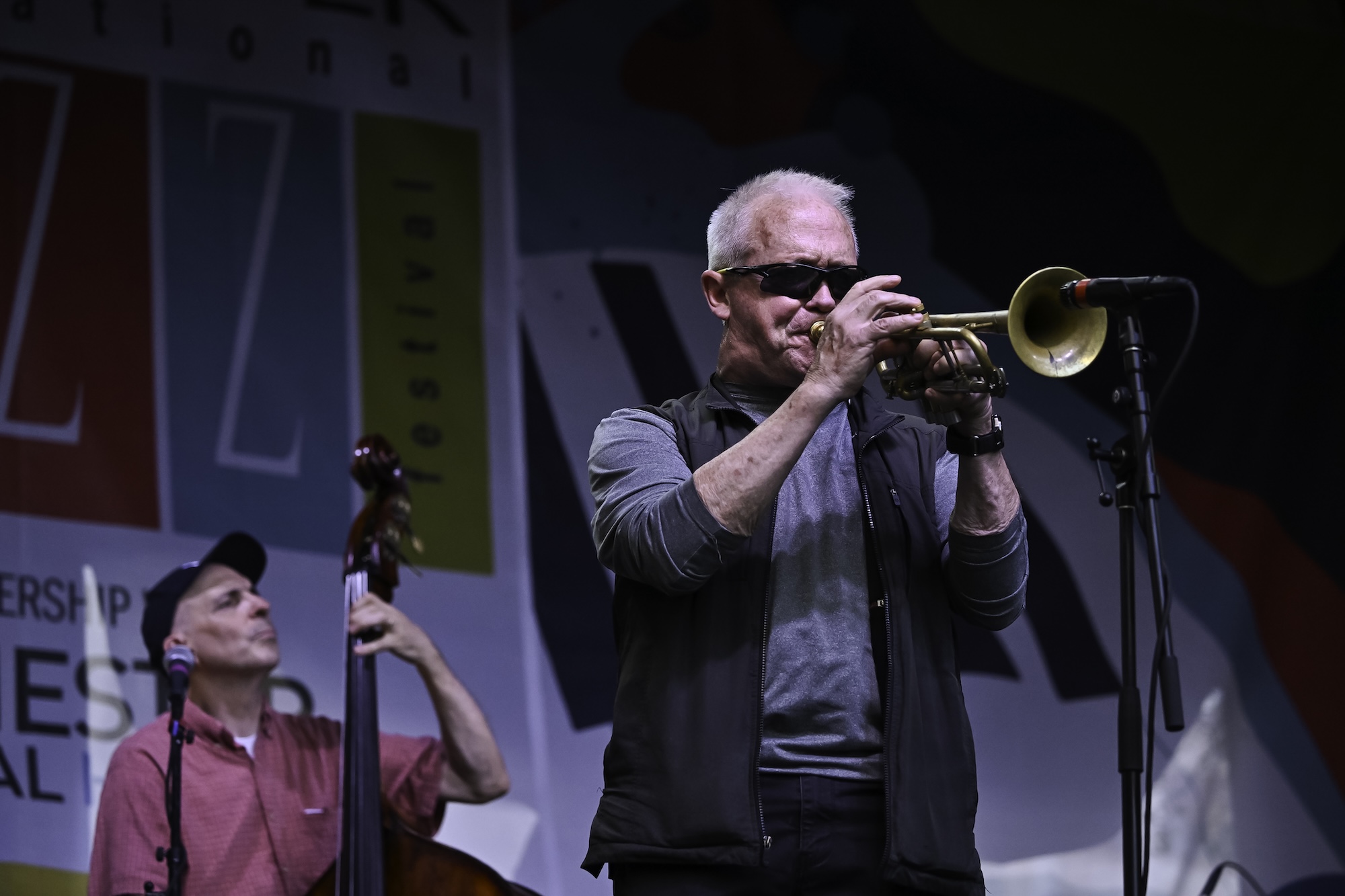
Jeff Campbell (bass) and Clay Jenkins (trumpet), both professors of jazz studies and contemporary media at the Eastman School of Music, perform with Eastman’s Jazz Honors Unit 2 during the Rochester International Jazz Festival. Eastman’s faculty, alumni, and students performed throughout the week at various locations.
“This is a good example of a locator photo,” notes Fenster. “You don’t need to read the caption to know where this is. It’s peak musical action.”
Bloom where you’re transplanted
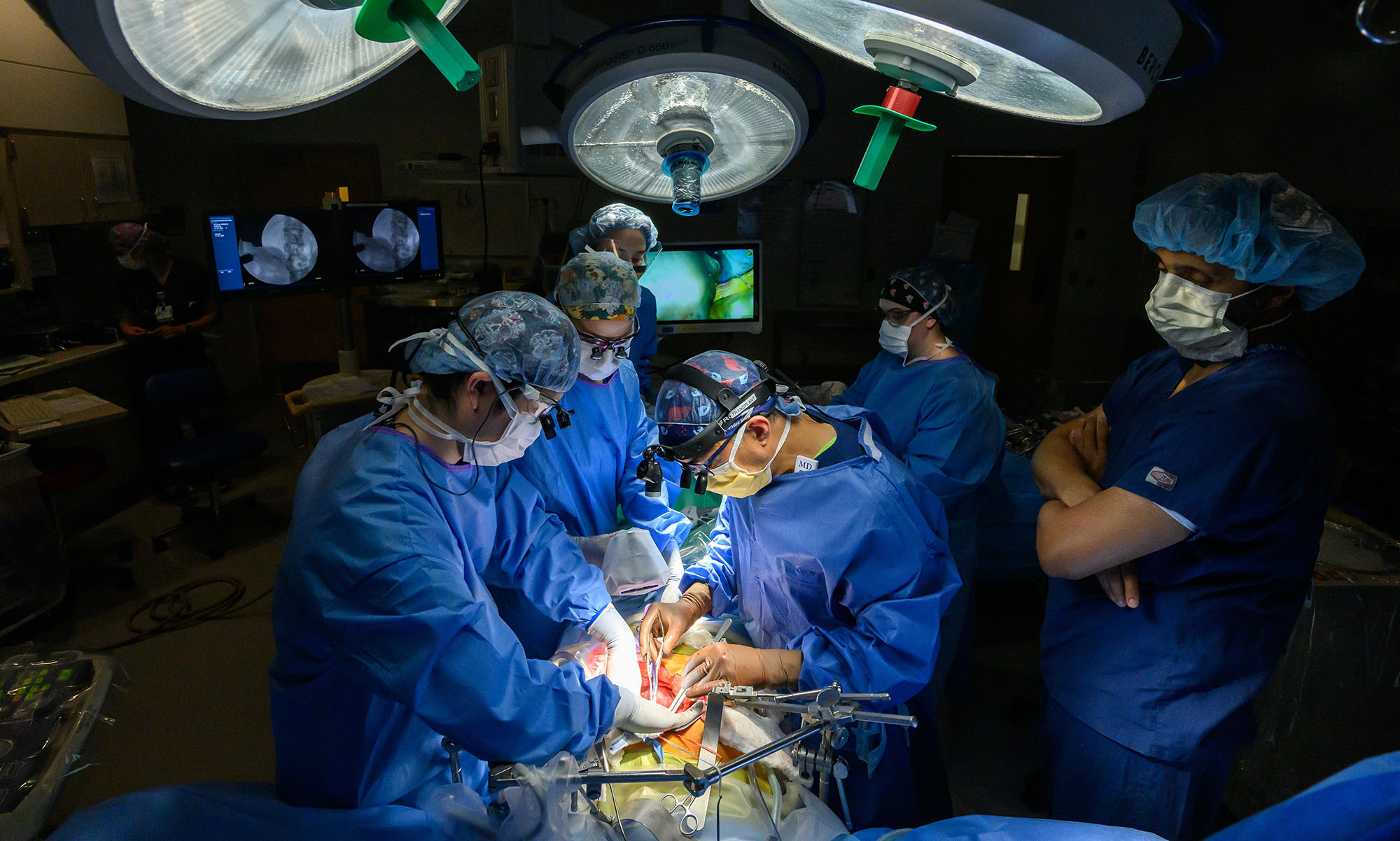
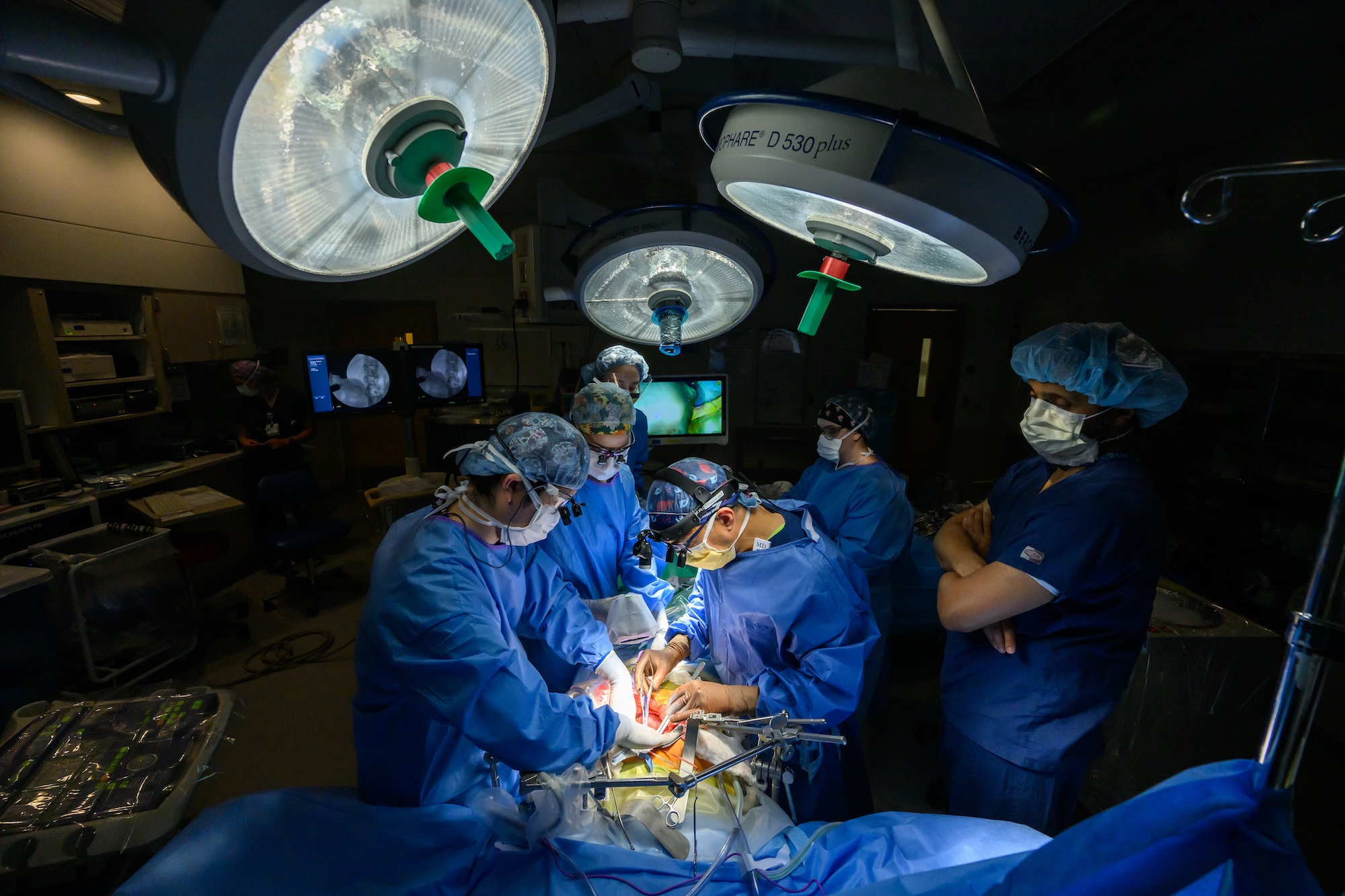
Roberto Hernandez-Alejandro, center, chief of the Transplant Institute at the Medical Center, and fellow surgeon Koji Tomiyama, left, perform a living donor liver transplant surgery in July 2025. URochester’s pioneering living donor liver transplant program was profiled in the most recent issue of Rochester Review.
“This photo took a lot of planning and was made possible by the great access I was provided by Medical Center staff, the donor and recipients who gave their permission, and the time I was permitted to work inside the OR. With a narrower window, I would not have been able to capture this brief moment when all the room lights were turned off, which creates a nice contrasting scene that highlights the team and the action at the center.”
Do we want to know one more thing, asks Fenster. “You hear about doctors playing music in their ORs. Dr. Hernandez-Alejandro is a big fan of 80s pop music. So while this very serious operation is taking place, he’s blasting A-ha and Duran Duran. There was something kind of surreal about that.”
(Gene)see you out on the water
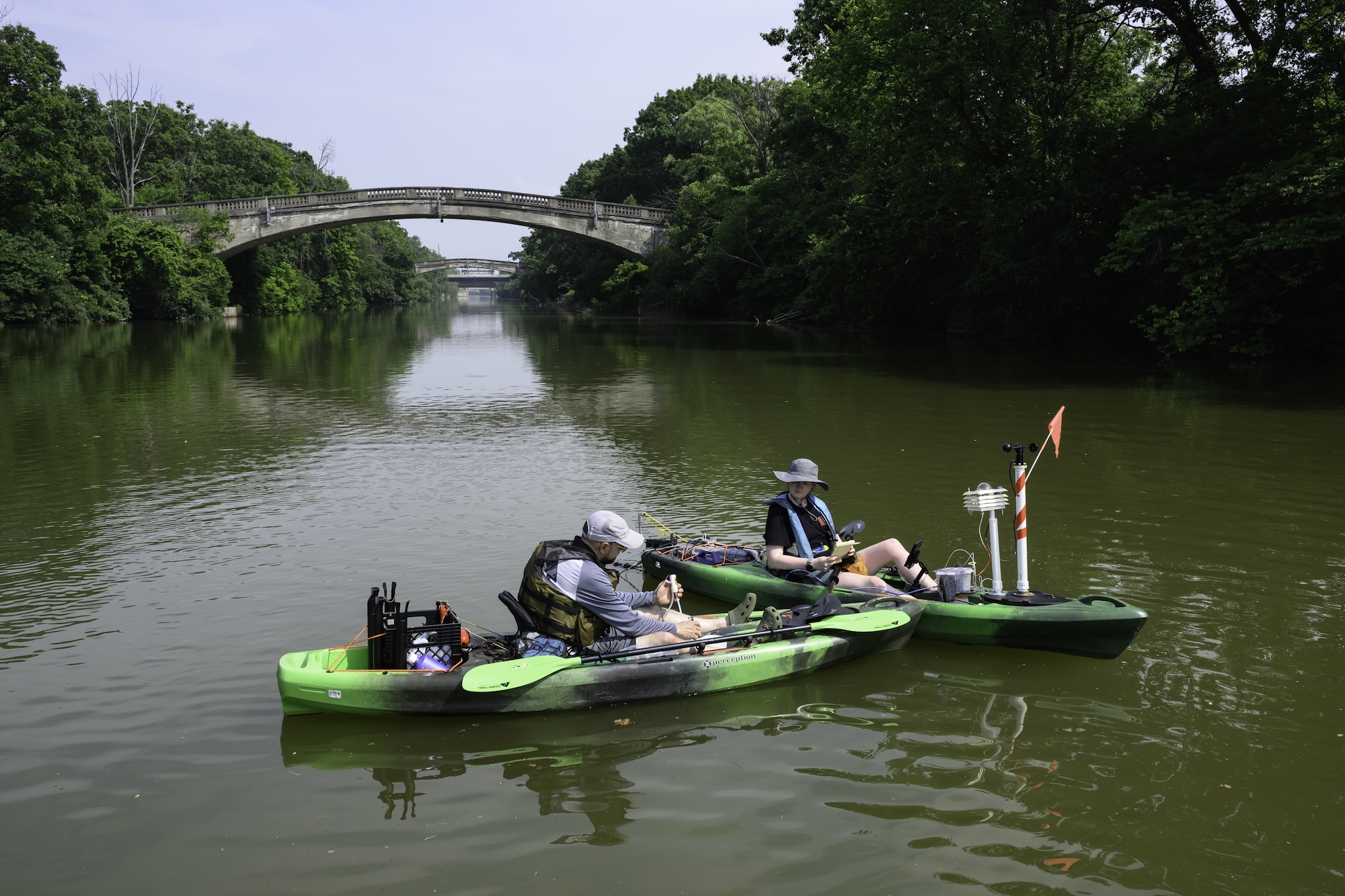
Earth and environmental sciences professor John Kessler and PhD candidate Katherine “Katie” Gregory ride specially equipped kayaks down the Genesee River to gather continuous measurements of methane, carbon dioxide, and oxygen. These “floating laboratories” are collecting real-time data.
“I love the concept of using tricked-out kayaks to study greenhouse gases—they are basically miniaturized versions of the much larger boats he takes into the Great Lakes and the Atlantic to make similar measurements. They let me join them for the day in my canoe, which I was standing in for this photo—never a good idea. But I needed to get that angle.”
Preventative measures
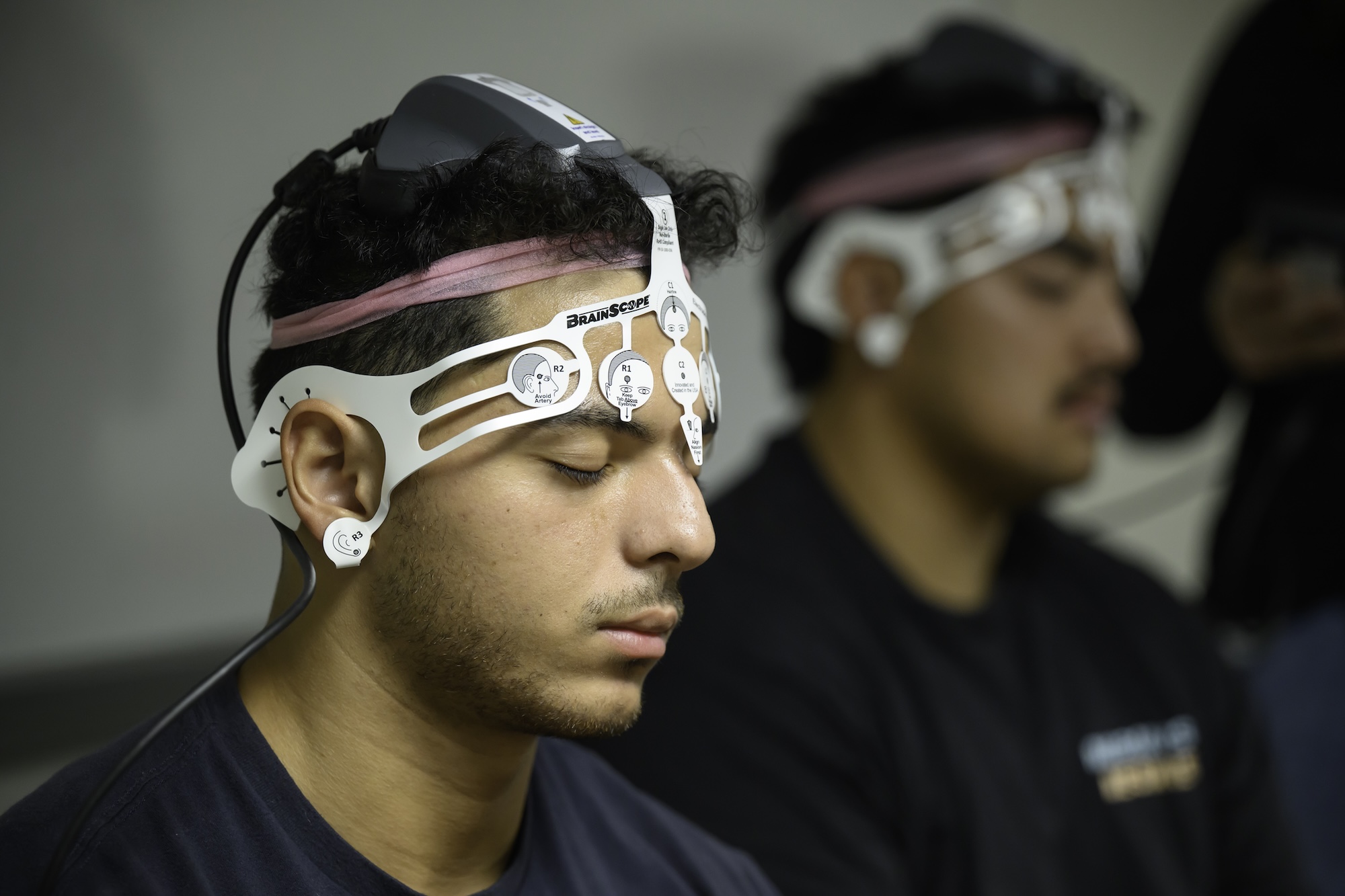
URochester football players Daniel Santos ’26 and Lucas Villanueva ’26 undergo an EEG (electroencephalogram) in the Goergen Athletic Center. They’re part of a study looking at repetitive head hits led by Jeff Bazarian, a professor of emergency medicine and of neurology.
“Anytime you’ve got electrodes attached to people’s heads, you’ve got to get photos. And I’ve been wanting to photograph Bazarian’s work for years. While not every concussion is sports-related, the research they get from this will help anyone with a concussion. Again, it comes back to: Why do research universities matter? Why do they need funding? This is why.”
Pier to pier research
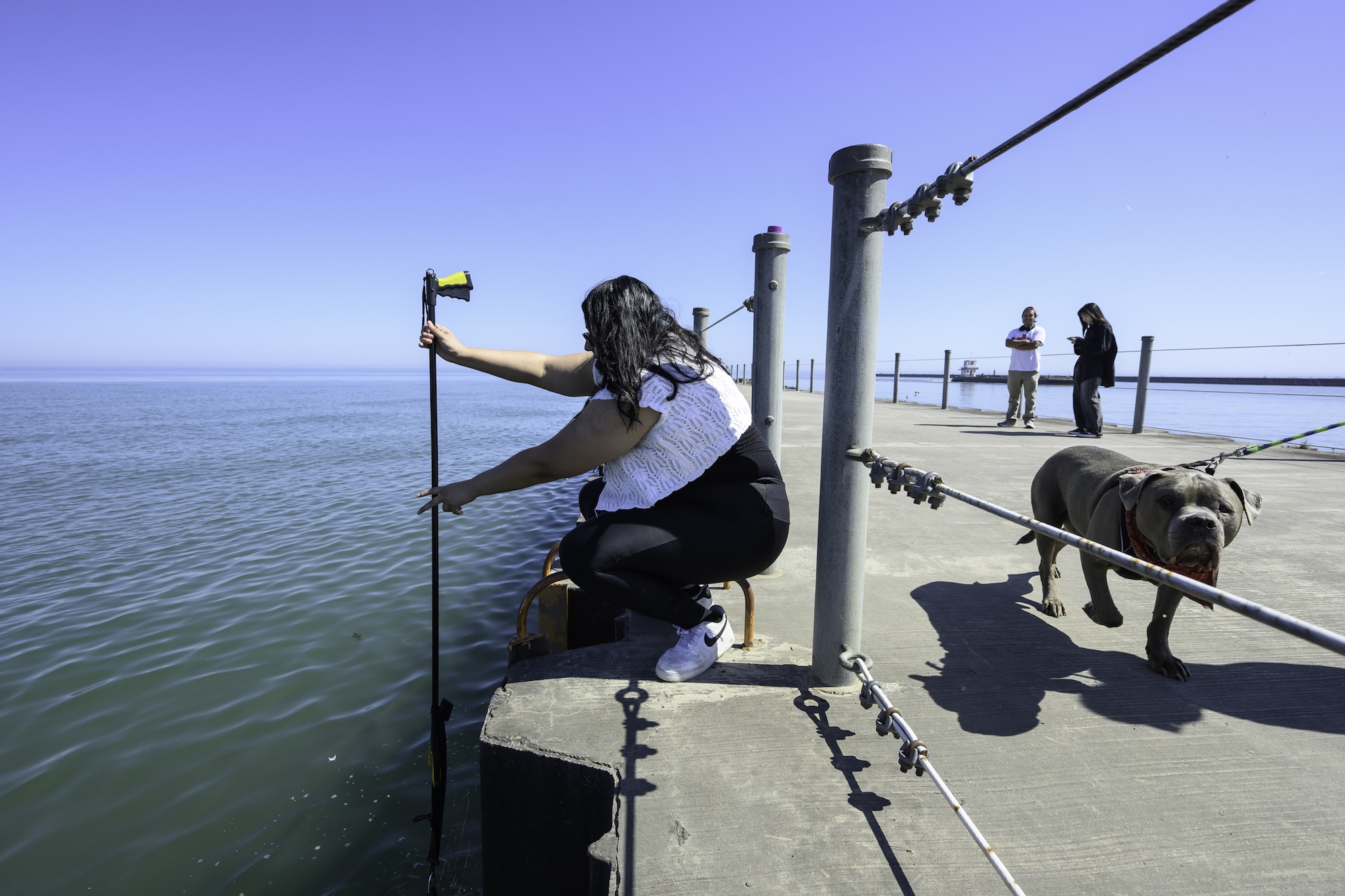
Toxicology PhD candidate Alma Avila Oropeza retrieves a sample jar from Lake Ontario from Charlotte Pier. The research is part of the efforts of the Lake Ontario MicroPlastics Center (LOMP), jointly hosted by URochester and the Rochester Institute of Technology. The center is a hub for research, translation, and community engagement around how different types of plastics enter and move through the Great Lakes ecosystems and how microplastics may affect human health under different environmental conditions.
“This one took a lot of planning, but it was a great opportunity to learn just how they get their data. The sampling itself is one thing, and then they have to go back to the lab and analyze it. It’s important to show just how much work goes into the process.”
And the dog? “It adds a bit of comic relief, and helps situate the viewer: You can tell where this is taking place.”
Scoping it all out
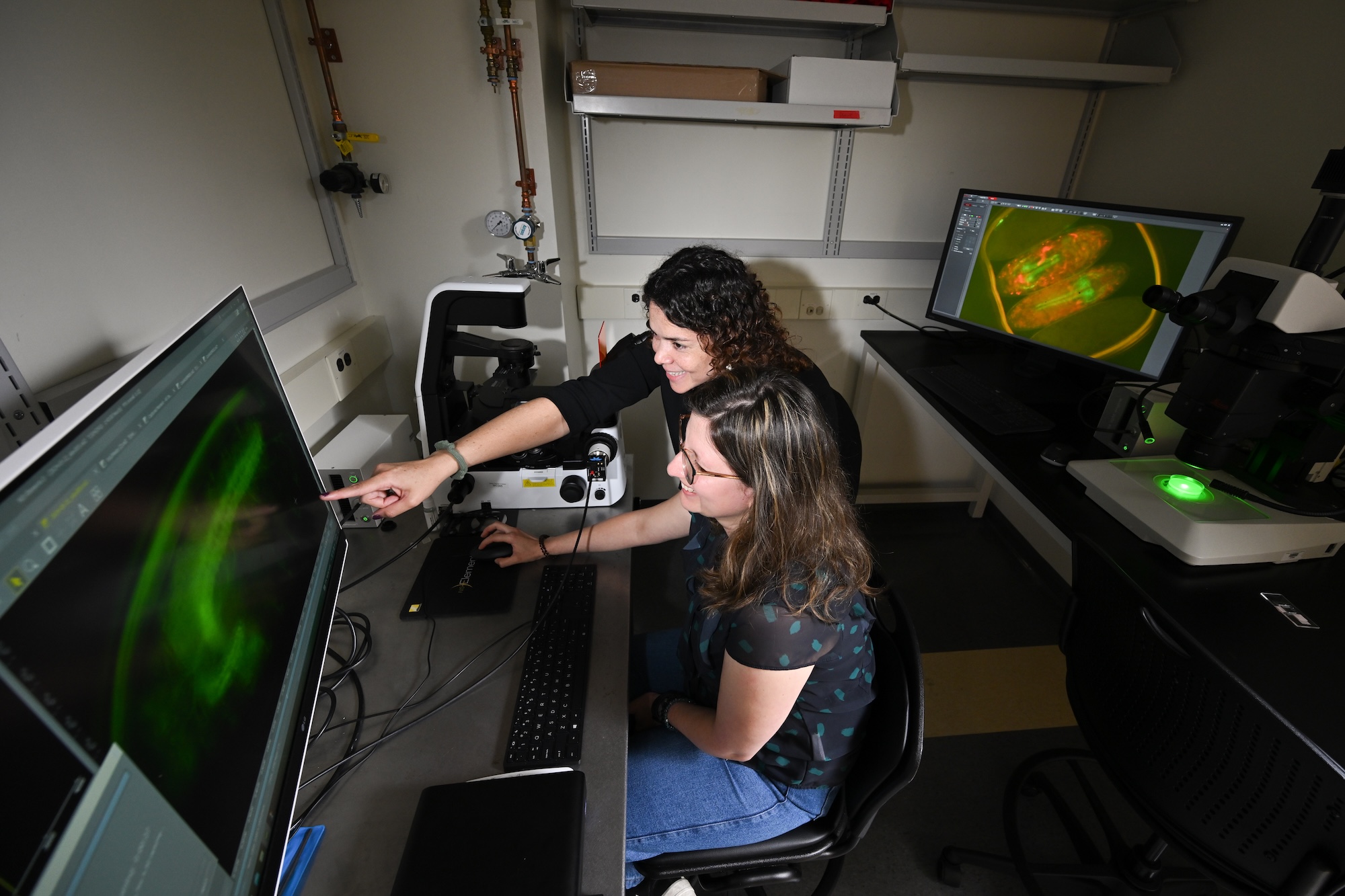
Assistant Professor of Biomedical Engineering Marisol Herrera-Perez and PhD student Maria Camila Ferrucho are using a fluorescent microscope to activate an optogenetic tool to observe how manipulating proteins affects the condensation of the ventral nerve cord of flies. Herrera-Perez received a National Institutes of Health MIRA grant to investigate the mechanical signals that guide how a single cell becomes a complex organism.
“This is sort of a standard lab photo, but the key is proper lighting,” shares Fenster. “This is not how the lighting looked when I went in there. And as a photographer, you want to highlight the essence of what’s going on, what they’re doing. And that’s the microscopes and what the microscopes are pulling up on the computer screens.”
Catching the good light en garde
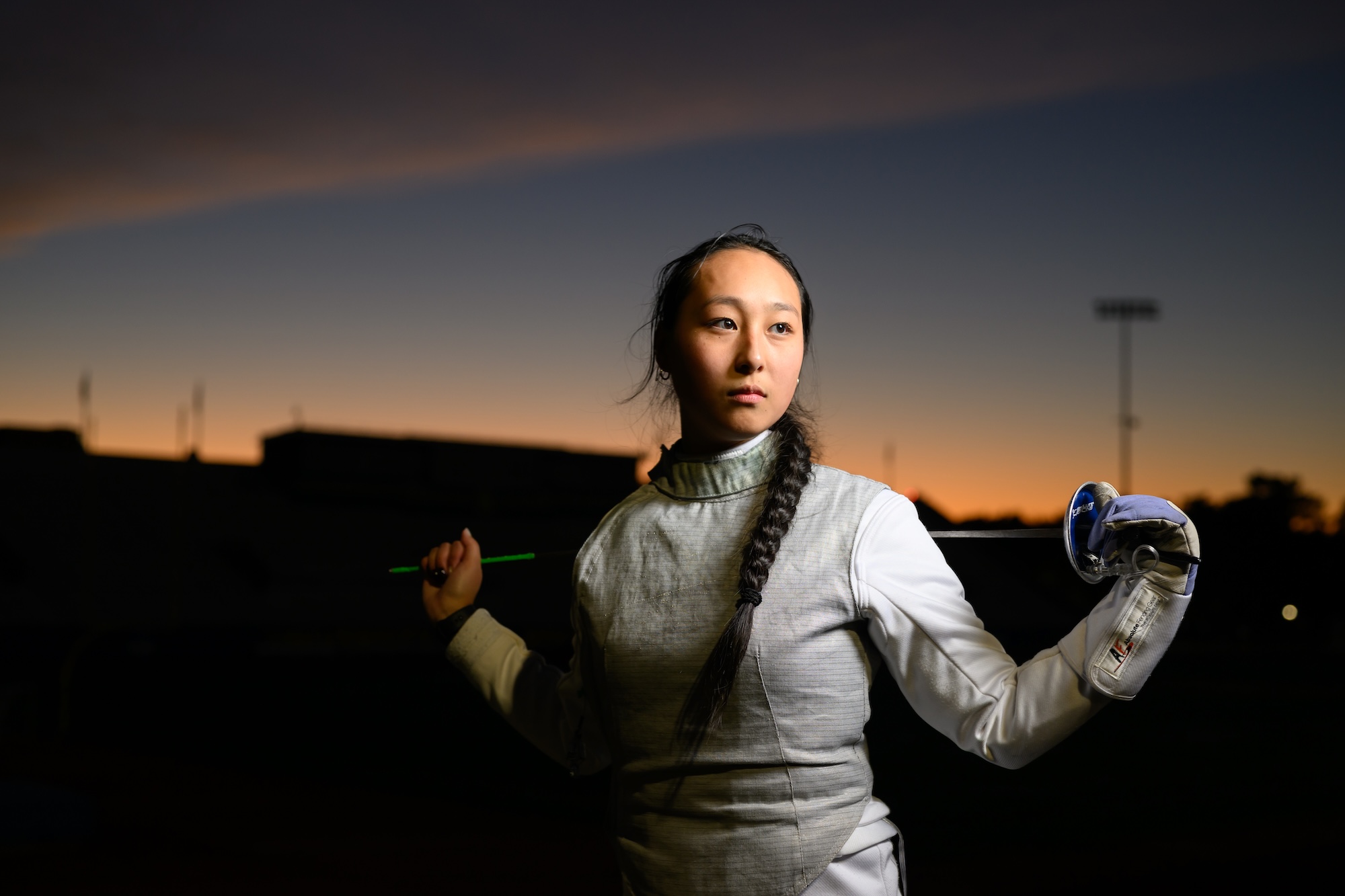
Jacqueline Hsiao ’27, UR fencing club president and 2024 Fencing Junior Olympics competitor, is photographed outside during a practice.
“It was all about timing,” Fenster says. “I got nervous watching the nice golden hour light melt away while making action photos inside the gym, knowing I wanted to leave enough time for an outdoor portrait with what promised to be a beautiful sunset. By the time I dragged all my gear out there, the sun had already set. Fortunately, there was enough glow left in the sky for a dramatic portrait using a single light off to the side.”
A closer look
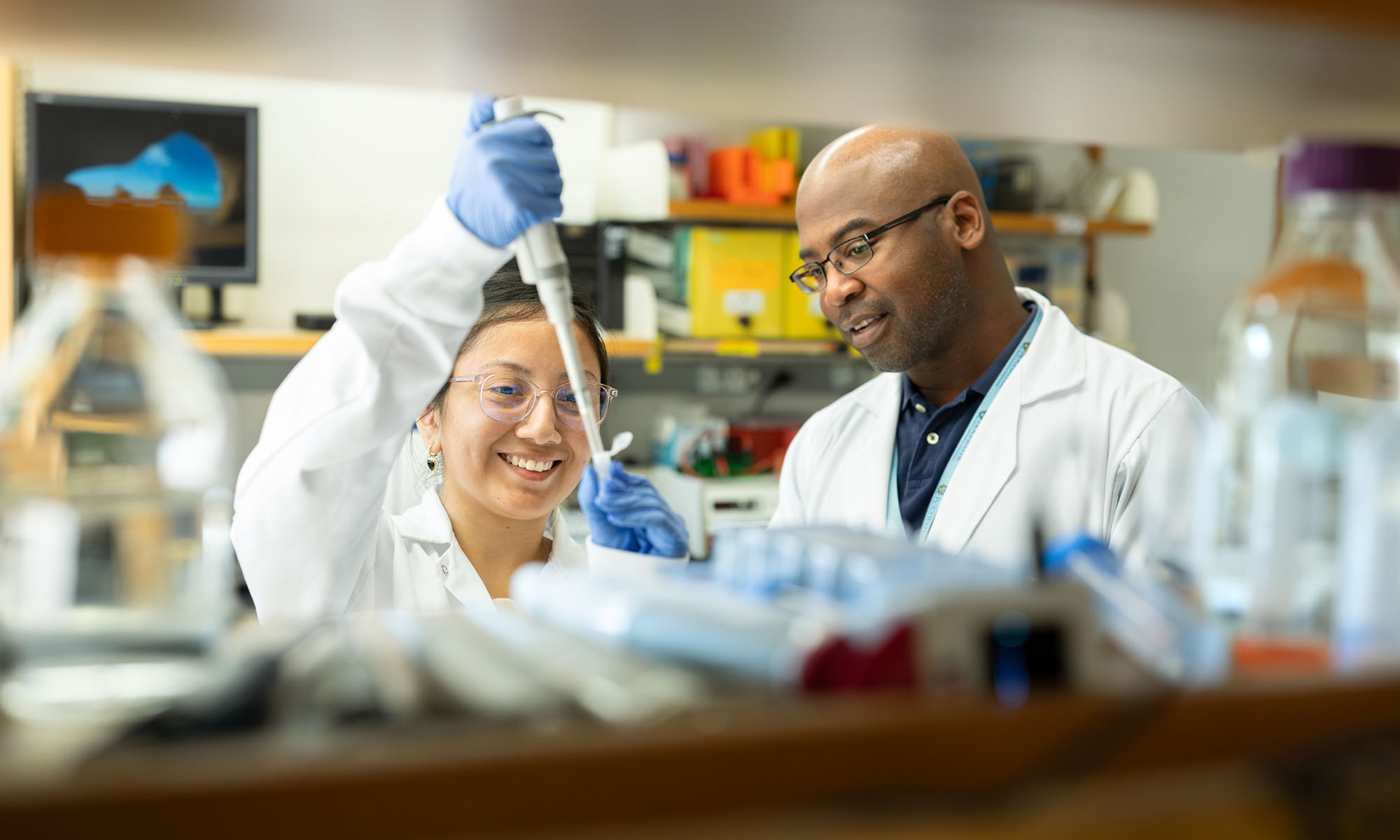
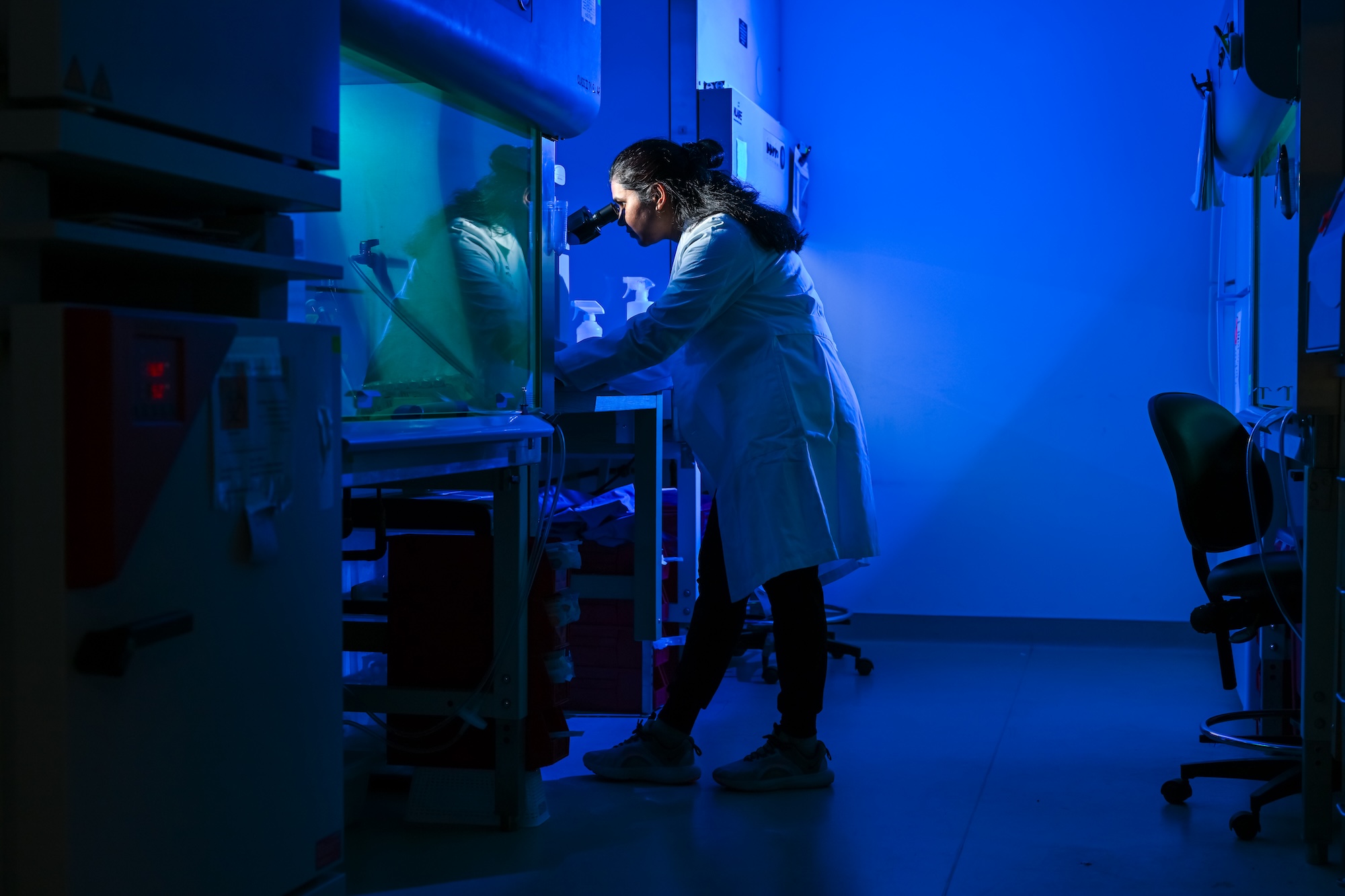
Staff scientist Preeti Maurya spins down and vacuums cells in the tissue culture room in the lab of Craig Morrell, Dean’s professor of medicine and codirector of the Aab Cardiovascular Research Institute at the Medical Center.
Here comes the blue science gel. “If this photo looks staged, that’s because it is! Do you think the lab is always blue? No,” jokes Fenster. “Do you think there’s a tiny spotlight on Maurya’s face all the time when she’s at that microscope? No. Everything is lit and staged by me. What’s not staged is the research that a photo like this helps to illustrate. It’s worth putting in the time when possible to make a space look extra special if it leads people to take a closer look.”
Homeward bound
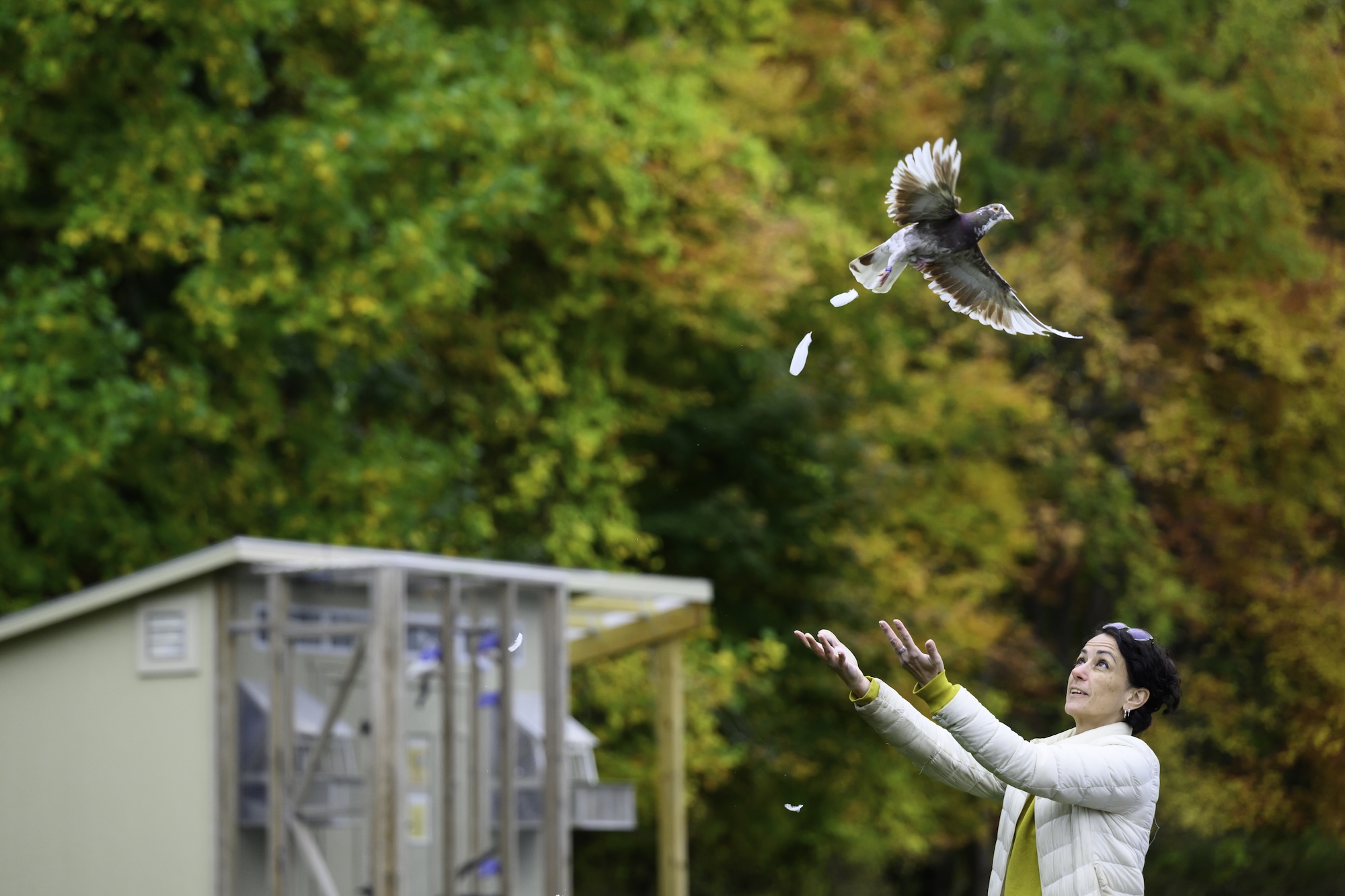
Dora Biro, the Beverly Petterson Bishop and Charles W. Bishop Professor of Brain and Cognitive Sciences, works with homing pigeons at their coop near the Larry and Cindy Bloch Alumni and Advancement Center. Biro and fellow Brain and Cognitive Sciences Associate Professor Takao Sasaki’s Collective Cognition Lab explores how the perceptual and cognitive capacities of different species—as adapted to their varying ecological needs—shape the challenges and opportunities that come with living in groups, including conflict resolution, behavioral coordination, knowledge accumulation, and collective decision-making.
Like Bazarian, Biro is someone that Fenster has wanted to photograph for a while. It took a bit of direction and more than a few takes, but the result was worth it. “This is one of hundreds of photos that I made that day, both inside and outside of the coop. We probably made five or so attempts at this. The overcast sky was actually advantageous because I had nice uniform light everywhere.
“I also like that you can see the coop in the background, which is on the Advancement campus,” reflects Fenster. “It’s offbeat, it’s eclectic, and it again demonstrates the range of research we do here. And thanks to Biro for recognizing the value of capturing an image like this.”
Stellar performance
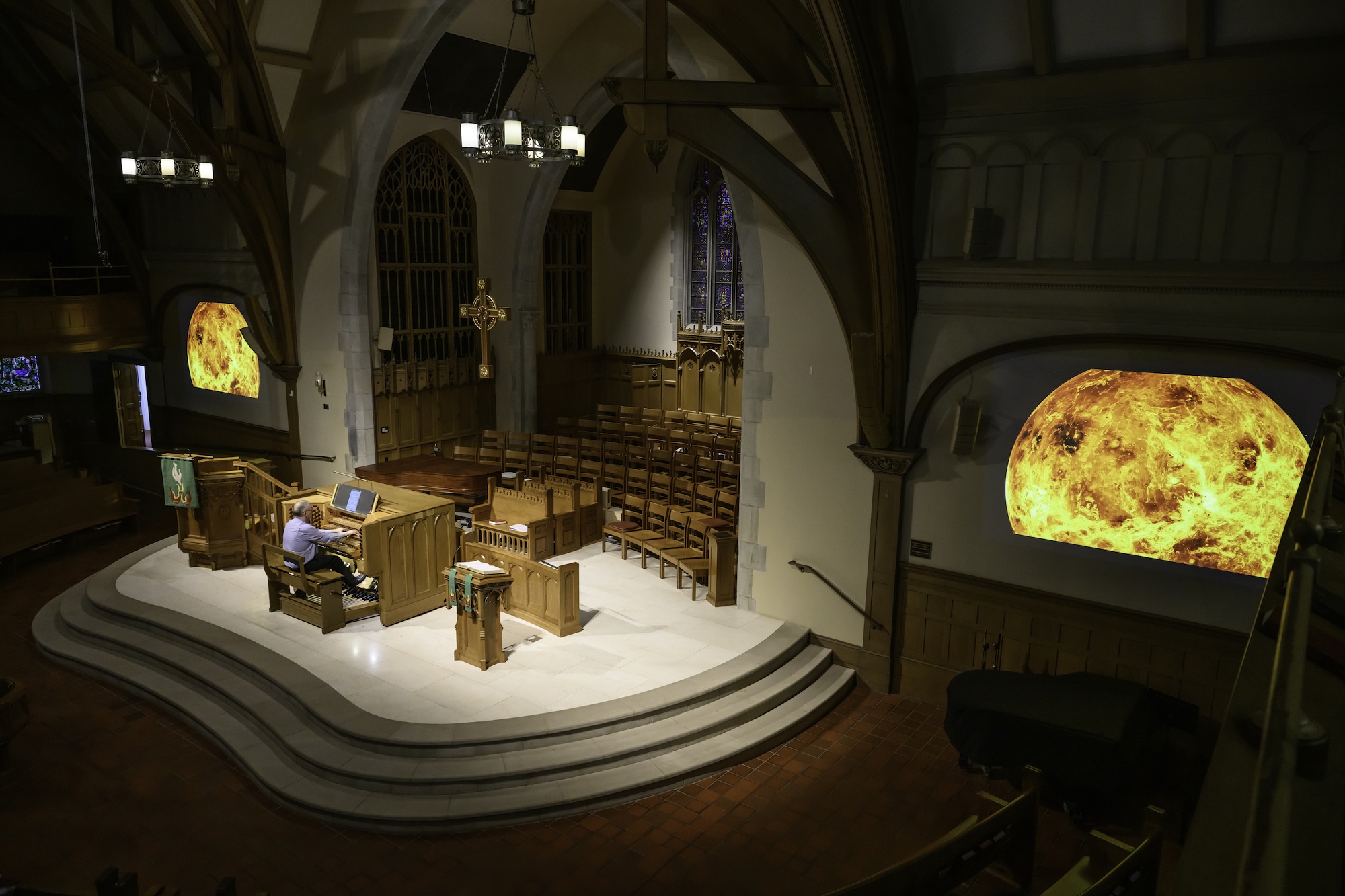
Roger Sayer, the original organist for the film Interstellar, plays his arrangement of the music from the original soundtrack by composer Hans Zimmer at Third Presbyterian Church during Eastman School of Music’s inaugural Soundtrax Film Music Festival. The festival, which took place in the fall, was the first of its kind in North America.
How can you really illustrate sound? “We’ve got the guy who performed on the original score for Interstellar? And he’s going to come here, and play it live on a gigantic organ, in this cool old church? That’s it. That’s the photo.” Again, access was everything. “I’m up in the balcony, trying not to make any noise, trying to be discreet because all around you, people are trying to enjoy the show.”
On the cutting edge
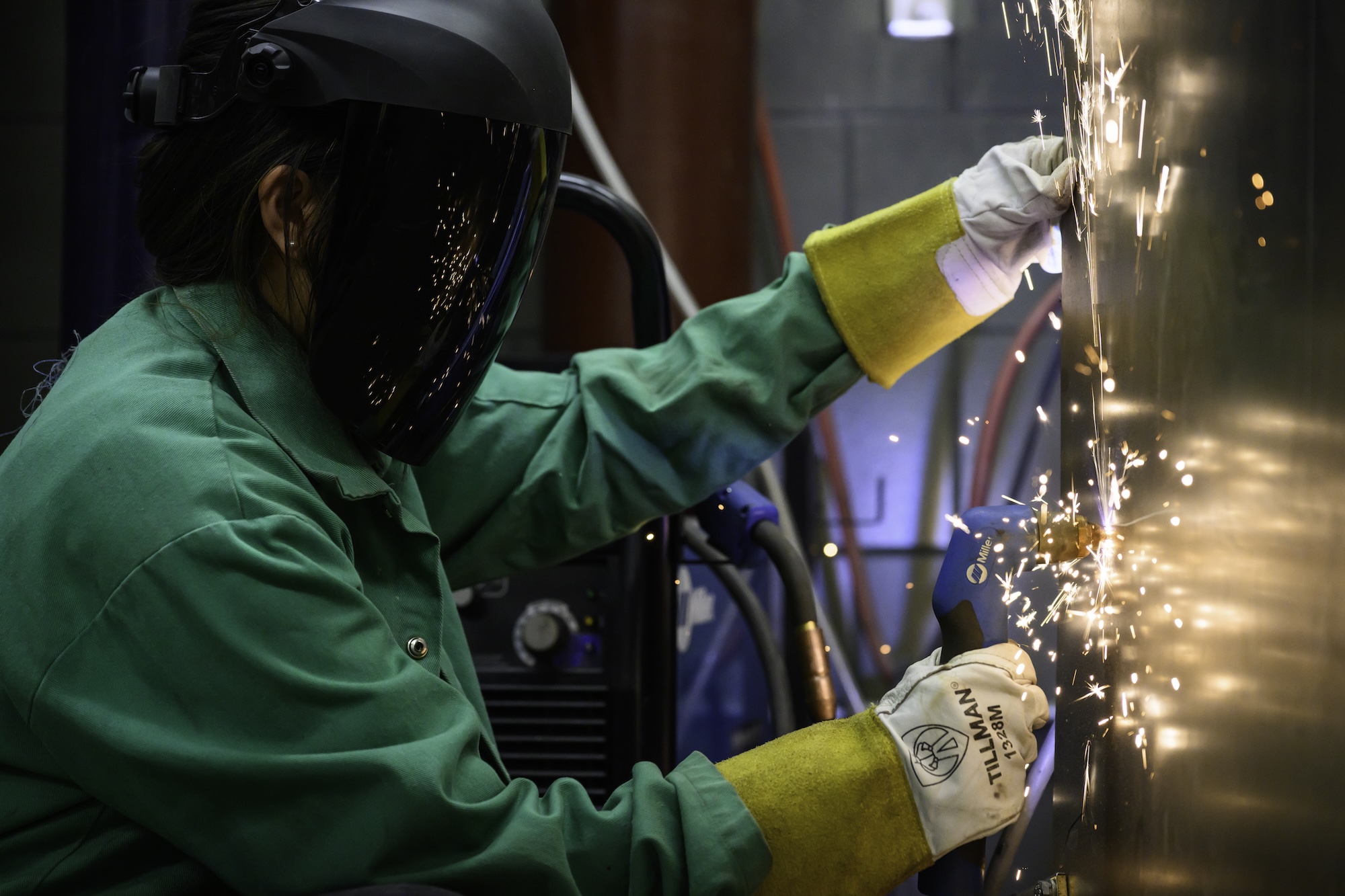
Biology and psychology major Amanda Lee ’27 uses a plasma cutter to fabricate an archive-themed sculpture project for “What We Chronicle” in a hybrid drawing sculpture class led by Allen Topolski, chair of the Department of Art and Art History.
“Much like in the photo from Chunlei Guo’s lab, we have sparks flying. Only this time, they’re much larger. And you have the cool reflections in the visor, with a lot of colors.
“I only got hit a couple of times with those hot shards,” he adds. “They did have me wear safety glasses.”
Weight for it, weight for it
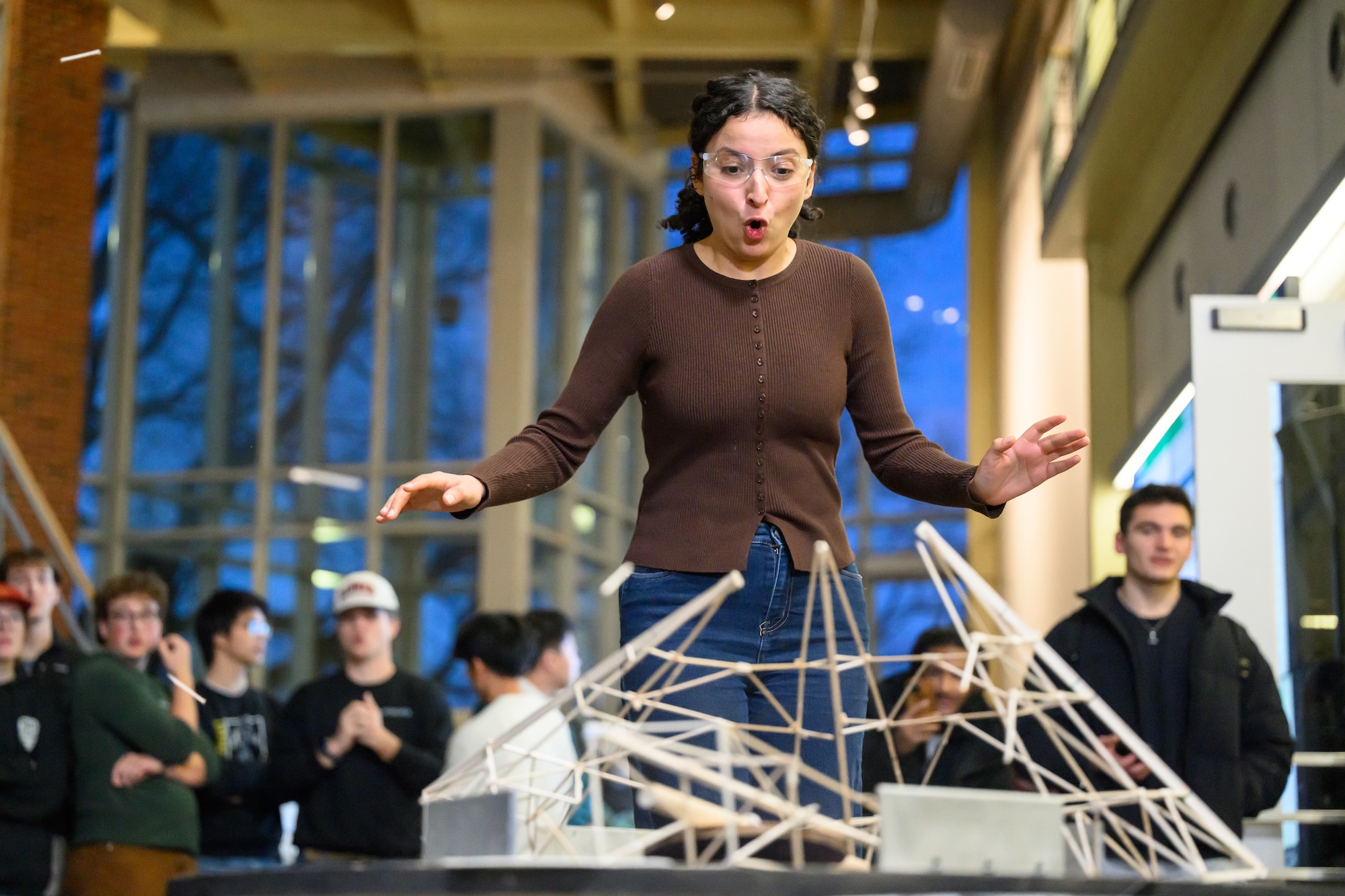
As part of the curriculum in Professor of Mechanical Engineering Chris Muir’s ME 204 class, students test the efficiency of balsa wood structures. The structure with the highest strength-to-weight ratio receives an A for the class. Here, senior Amel Rouabhia reacts as her team’s structure comes apart. Beloved by students for years, Muir’s class might make you want to head back to school.
“This photo—this experience—is all about faces and reactions. I’ve been photographing this event with Muir for years. And while there is real science behind it, he makes it visual, approachable, and exciting for all his students. This always seems to be the best angle, too, compressing the structure, the team, and the onlookers all into one tight frame. They know what’s going to happen to the structure, but they don’t know when, so they’re still surprised. They’re never really ready for it, and that’s what gives you these great reactions.”
“AJ [Pow, senior video producer] had the genius idea to light it this year by strapping video lights to the railings overhead, which helped immensely with having more light on the subjects, and the blue evening sky filtering in from outside helps it feel more dramatic.”