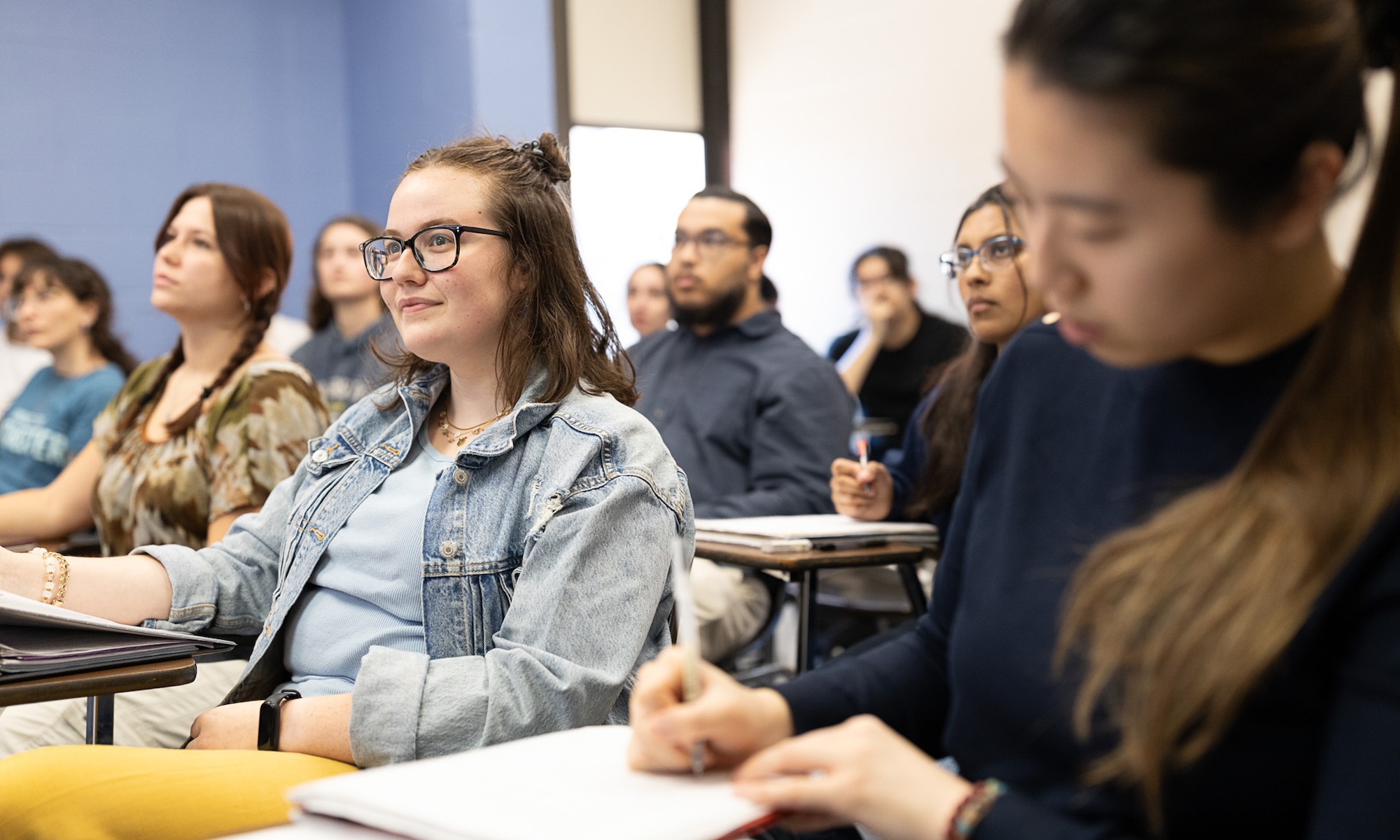
URochester students foster lifelong skills as they source stories, verify facts, and report under pressure.
How do you persuade a stranger to talk to you? How do you separate fact from opinion? And how can journalists balance accuracy, fairness, and the public’s right to know?
These are among the questions students tackle in ENGL 131: Reporting and Writing the News at the University of Rochester, where the best way to learn journalism is to practice it.
Offered by the Department of English and counting toward the journalism minor, the course combines newsroom-style assignments, writing workshops, and lessons drawn from instructor David Andreatta’s decades as a professional journalist. Students learn the fundamentals of gathering, verifying, and presenting information while exploring everything from breaking news and sports writing to media ethics and the evolving role of artificial intelligence in journalism.
“In a textbook, sources always return calls and speak in quotable soundbites, deadlines feel theoretical, and getting something wrong has muted consequences,” says Andreatta. “Real reporting shatters those controlled conditions, and I think that’s where learning begins.”
Get the lede out
Early in the semester, students learn that the most important sentence in a news story is often the first—and that the last can leave an impression, too.
To master writing effective ledes, they sort through a tangle of information, identify the most newsworthy details, and compete to craft the strongest opening. Then comes a familiar assignment with an unfamiliar twist: retelling “Little Red Riding Hood” as a news story.
The tale changes with the structure. In an inverted pyramid, the rescue comes first, followed by details in descending order of importance. An hourglass opens with the news before retracing the drama chronologically. A list organizes the story around key points, while the Wall Street Journal formula begins with a scene or character and widens to the bigger picture. The same events can produce dramatically different stories depending on how the reporter chooses to tell them.
Other exercises include covering a mock press conference and taking news quizzes modeled on National Public Radio’s quiz show, Wait Wait…Don’t Tell Me!
Behind the playful assignments is a serious purpose: learning to distinguish reliable information from misinformation, pinpointing what matters most, and conveying it accurately and concisely.
Andreatta brings lived experience to the classroom. A former columnist and investigative reporter at Rochester’s Democrat and Chronicle, he has worked at the New York Post, Canada’s Globe and Mail, CITY magazine, and WXXI News; he also regularly contributes to The New York Times. Andreatta has taught ENGL 131 since 2021 and serves as a lead media relations specialist in University Marketing and Communications.
“Shoe-leather reporting teaches students how to approach a stranger, how to pivot when emails and phone calls go unanswered as the deadline approaches, how to separate fact from opinion or fiction, and the discipline to strip away their own biases,” Andreatta explains.
“Reporting isn’t just an academic exercise; it’s an agility course for life.”
They scoop, they score
In October, students covered PBS NewsHour co-anchor Amna Nawaz’s Meliora Weekend keynote, interviewing audience members afterward. They also attended a Rochester Yellowjackets match of their choice.
Kevin Carpenter-Holmes ’29 reported on a field hockey game for homework that became a piece in the Campus Times, the University’s student newspaper. “It was rewarding to see my voice get published for other people to read,” he says.
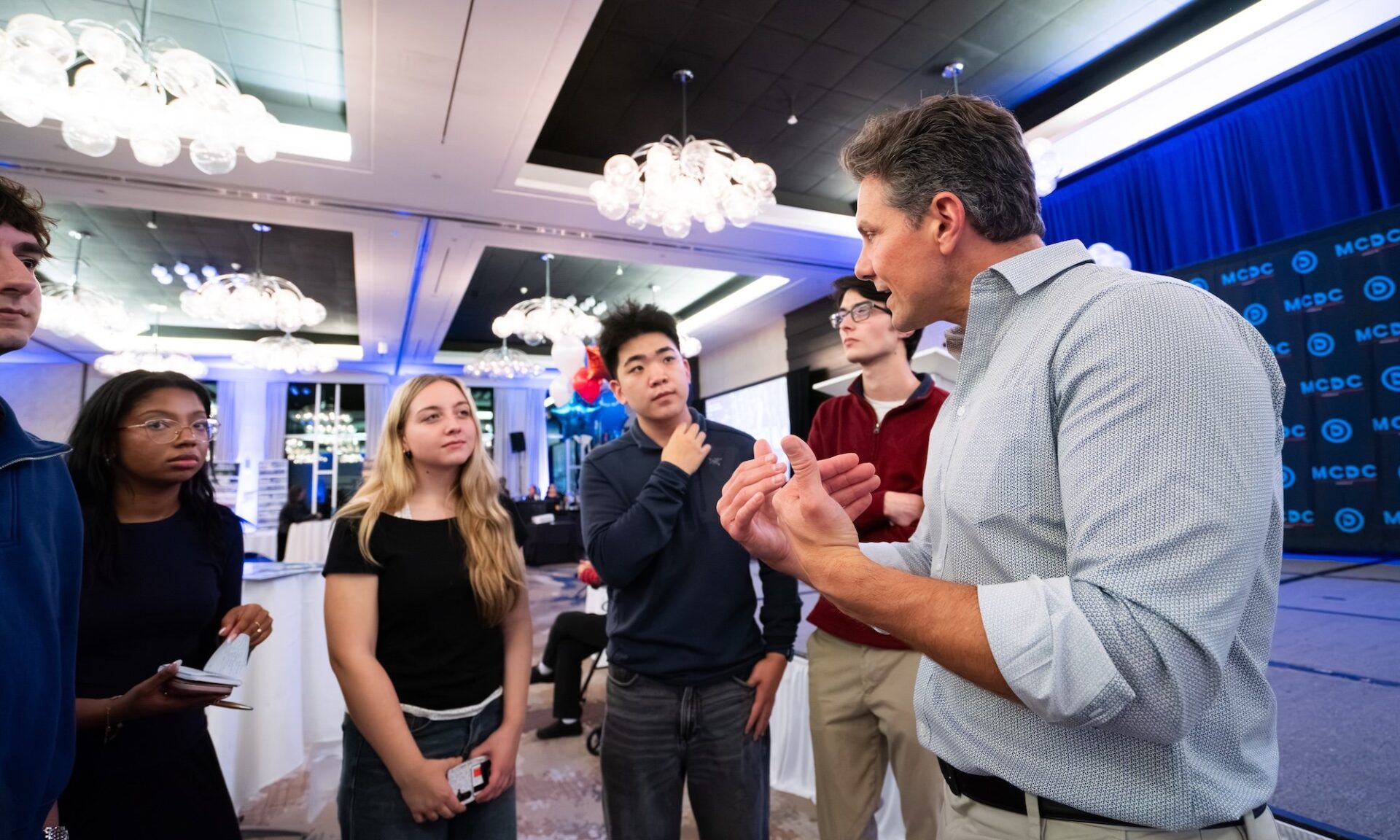
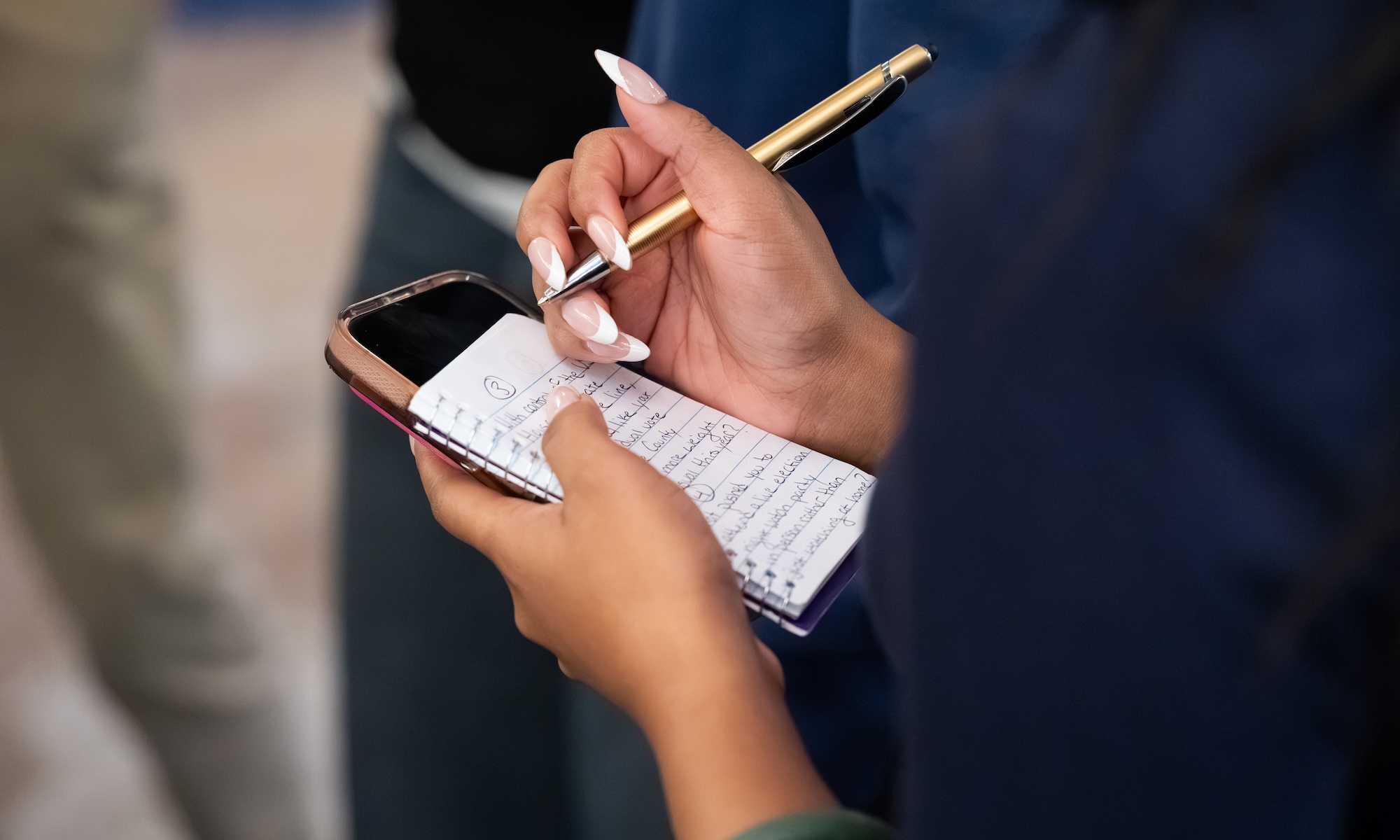
On election night, the class attended the Monroe County Democratic Committee’s watch party, where they recorded vote totals, captured the atmosphere, and interviewed attendees and elected officials. Their assignment: to turn in a 1,000-word story by the end of the week.
“Media works quickly, and part of being a journalist is writing under deadline pressure that you never face in any other class,” Andreatta told his students.
Besides reporting facts, he encouraged them to incorporate details, especially quotes.
“Readers love to hear voices,” he said. “They give color and spice to stories.”
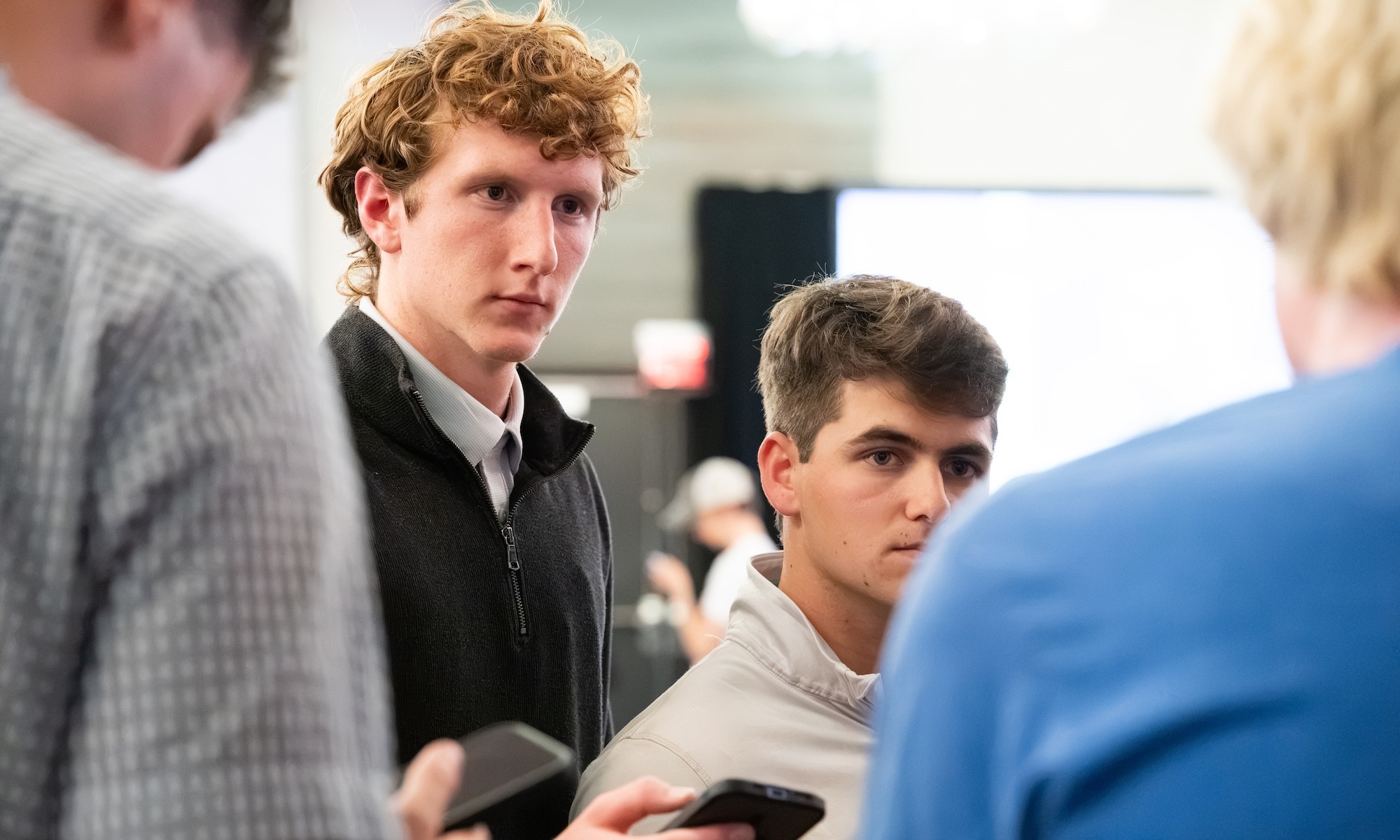
For Carpenter-Holmes, asking questions face-to-face underscored the power of connection.
“We are exposed to so much online commentary that asking people to express their opinions in person feels so impactful,” he says. “And because of how polarized our politics are right now, understanding how news is reported and consumed has become really important.”
Read (and write) the fine print
The course’s final reporting assignment asks students to dive into the legacy of a notable Rochesterian.
To research and write advance obituaries, students draw on biographical details, anecdotes, and quotations. In previous years, WXXI has purchased obituaries written by students.
“From the standpoint of a developing student, our instructor has made me realize that if you appreciate the curriculum in which you are learning, you will excel in the classroom,” says Samuel Loeb ’29. Although Loeb, a finance major, does not plan to pursue journalism, he says he has honed “a ton of skills” he can leverage in the future.
Andreatta knows his students have diverse interests. “Whether my students go into law, medicine, business, or any other field, the reporter’s toolkit—being an active listener, working a room, verifying and distilling information, and keeping cool under pressure—has skills they’ll need in their professional lives.”
“Reporting isn’t just an academic exercise,” he says. “It’s an agility course for life.”