When URochester music students trade reeds, strings, and sticks for software, a world of creative possibility emerges.
A dish brush scrubbing a frying pan. Air blown into a Nintendo 64 cartridge. A cushion thumped against a couch. All sounds Swedish musician and former YouTuber Seth Everman sampled to recreate—with the help of a keyboard—Billie Eilish’s “Bad Guy.”
University of Rochester students in MCT 101: Introduction to Music Technology, open to undergraduates at the Eastman School of Music and the River Campus, take up a similar challenge. Early in the semester, Dennis DeSantis ’05E (DMA), an associate professor of music and technology, tasks them with creating a minute-long composition using field recordings obtained on a “soundwalk.” It’s one of the first of many assignments designed to instill the fundamentals of sound recording and manipulation.
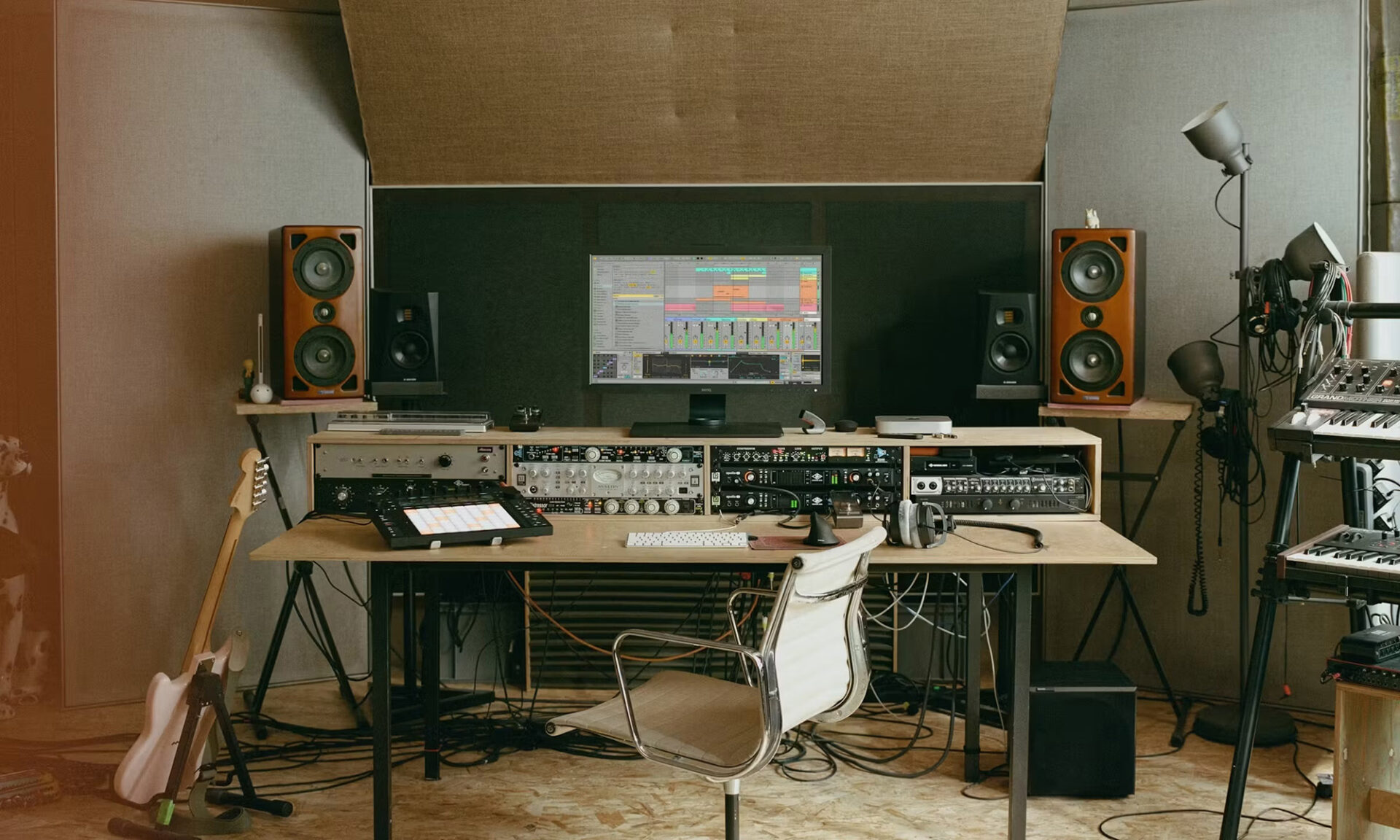
MCT 101 is built for aspiring music producers, engineers craving creative expression, and trained musicians looking to bolster their skills. Across four units—Capturing Sound, MIDI, Creating and Shaping Sound, and Beyond Sound—the course provides basic, hands-on exploration of contemporary music technology, including digital audio workstations, synthesis, sampling, recording, and signal flow.
Another early assignment asks students to create a “bad recording,” something downright antithetical to Eastman standards. DeSantis uses it as part of an exercise in learning how to diagnose accidental degradation and appreciate deliberate noise and distortion used as musical texture.
“My hope is that students take away a better understanding of how to make music using technology and manipulate sound in creative ways,” he says. “At a higher level, I want them to leave feeling empowered to experiment with music technology and, more generally, music.”
Students have access to a small keyboard controller and do most of their work using Ableton Live, a digital audio workstation that DeSantis helped develop in his previous role as head of music learning at music software company Ableton. Because the field and tools are constantly evolving, students are encouraged to be open and willing to experiment.
Some of that experimentation could serve as an on-ramp to the kind of research happening at SoundSpace, a URochester transdisciplinary research center focused on exploring the interplay among music, sound, and technological innovation.
“The relationship between technology and artistry can vary widely from person to person,” DeSantis says. Some musicians use technology to extend an instrumental or vocal practice. For others, technology becomes the instrument. Between those poles lie many more ways to make music.