What AI can—and can’t—teach doctors about connection.
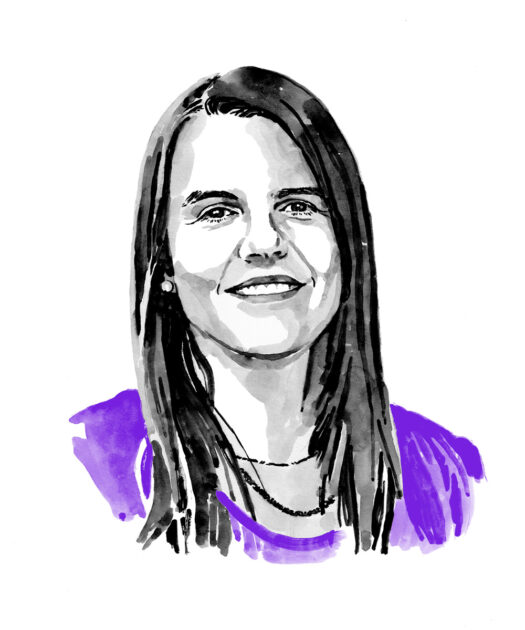
Erika Ramsdale ’21 (MS) is an associate professor of medicine in the Division of Hematology and Oncology at the University of Rochester Medicine Wilmot Cancer Institute. This content is excerpted from an article of the same title, written by Ramsdale and published in the Journal of Clinical Oncology (vol. 44, no. 28, October 2026).
One day, I met a patient who was never born and who could not die. Her name was Maya. She had metastatic stomach cancer. Her face was a featureless landscape, with none of the quirks of individual embodiment (the mole by your right earlobe, the cloud across your pupil). Maya was a virtual human. She was created to train physicians to have serious illness conversations. I had volunteered to interact with her.
I opened the visit like I normally do in my oncology clinic. “How are you feeling today?”
“Great!” she chirped. “How are you doing? What is new with you?”
I smiled. “I am doing OK. I’m glad to hear you are feeling well. Let’s talk about how your last chemotherapy went.”
She frowned a little, or I think she did. Her voice was gregarious and crisp, with infomercial inflection. “But I really want to know what is going on with you! Let’s talk about your life.”
I glanced at the student who was walking me through the software demonstration. He mumbled something about “retraining the model” and “unexpected behavior.”
I swiveled my focus back to the two-dimensional, uncannily still face and upper torso sitting in the exact middle of a nondescript rectangle. I could not tell if she was wringing her hands or sitting on the edge of her seat. Were her fingernails painted or chewed and ragged? Perhaps she wore a plain wedding band on her left hand or a set of brass knuckles. I had no way to read what she might need from this interaction and from me. No way, that is, except for ignoring unexpected answers and repeating myself, recombining words until I received clear information back.
Systematically tweaking a request to get the desired output is known as prompt engineering when working with AI language models, and it is an essential skill in working with these machines. When working with patients, ignoring their answers (no matter how unexpected) and repeating questions at them is bad bedside manner. Eliciting information from people requires delicate work, not an engineering approach. …
“To learn how to care for people, we should start and end where we always have: with the person in front of us.”
Another fundamental belief has emerged from my work with patients: Our voice and our care are embodied. It is not just the words that matter or the mechanics of them, but the bodies inhabiting the space, the semiotic extravaganza of them. The beads of sweat on the bridge of a nose. The pause, the looking up and to the left, the hitch in the throat. It is bodies that act, and act on us, creating and reinforcing human connection. I walk into the clinic room, I squeeze your hand, I smell the scent of the detergent you use, and I remember that your grandson’s high school graduation is coming up soon. “What do you hope for?” I asked when you were diagnosed with stomach cancer. You did not hesitate. “I want to see my grandson graduate high school. I’ll do whatever it takes.” …
After I closed Maya’s rectangle, the software created a report grading me on various aspects of the interaction. It also graded me on my empathy, giving me very low marks. It suggested how to improve, by saying things such as, “That sounds very difficult” or “I am sorry you are experiencing this.” Within this framework, empathy itself is flattened to call-and-response, a set of platitudes, an algorithm. It is true that these small scripts can help patients feel heard and understood. AI models are often rated higher in empathy than human clinicians. They can consistently deploy rote phrases and mirroring that sound empathic, and they have no bodies or internal states to interfere with this. They do not experience hunger, irritation, the time pressure of a full waiting room, or any of the thousands of frictions that complicate real communication. … Machines do not teach humans to be more human, and when given the choice, patients prioritize human connection over empathic phrasing. The art may start with a script, but it does not end there. …
To learn how to care for people, we should start and end where we always have: with the person in front of us. At your next appointment, I ask you about your grandson’s graduation. Your face breaks open, smiling, and you say, “It was a perfect day. I felt well, and I could enjoy it. I wasn’t even too tired.” You add, wryly, “You can just chuck me in the ravine now!” I wonder what Maya would want me to say to this. It must be hard for you, thinking about being flung into a ravine. Instead, I laugh. We both do. I respond, “Well, I took an oath not to throw people in ravines. So here we are. What’s next?” And you tell me.
This story appears in the fall 2026 issue of Rochester Review, the magazine of the University of Rochester.