Science & Technology
Genetically modified food: Would you eat it if you understood the science behind it?
 Sandra Knispel
|
Communications Specialist
A team of psychologists and biologists, including from the University of Rochester, set out to discover if consumers’ attitudes toward genetically modified food would change if the public understood the underlying science better. (Getty Images)
What to know about genetically modified foods (GMOs)
- Understanding genetically modified foods can reduce skepticism. Researchers found that people who knew more about the science behind GMOs tended to have more positive attitudes toward them.
- Knowledge of GMOs matters more than general science knowledge. Across studies in the United States, United Kingdom, and Netherlands, understanding genetic modification was a stronger predictor of attitudes toward GM foods than general scientific literacy.
- Learning about GMO science can increase willingness to eat genetically modified foods. In an experiment, participants taught the basic science behind genetic modification developed more positive attitudes and greater willingness to eat GM products.
- Science education can change perceptions of GMO risks. Participants who learned how genetically modified foods are produced perceived them as less risky than those who did not receive the same instruction.
Genetically modified foods, also known as GM foods or GMOs, have long sparked debate among consumers. Although major scientific organizations have concluded that currently available genetically engineered foods are not inherently riskier to eat than comparable conventional foods, public skepticism persists.
But could understanding the science behind genetic modification change people’s minds?
A team of psychologists and biologists from the University of Rochester, the University of Amsterdam, and Cardiff University set out to answer that question.
Their findings, published in the Journal of Environmental Psychology, suggest that learning how genetic modification works can make people more receptive to GM foods—and more willing to eat them.
“Political orientation and demographics inform attitudes and we can’t change those,” says John McPhetres, the study’s lead author, who earned a PhD in psychology from the University of Rochester. “But we can teach people about the science behind GMOs, and that seems to be effective in allowing people to make more informed decisions about the products that they use or avoid.”
“But we can teach people about the science behind GMOs, and that seems to be effective in allowing people to make more informed decisions about the products that they use or avoid.”
Previous research has shown that more than half of Americans know very little or nothing at all about genetically modified food.
In a series of studies, the team discovered that people’s existing knowledge about GM food is the greatest determining factor of their attitudes towards the food—overriding all other tested factors. In fact, existing GM knowledge was more than 19 times higher as a determinant—compared to the influence of demographic factors such as a person’s education, socioeconomic status, race, age, and gender.
The team replicated the US findings in the United Kingdom and the Netherlands, where opposition to modified food has tended to be higher than in the United States, and where GM food is highly regulated in response to consumer concerns.
In one study, using a representative US sample, participants responded on a scale of 1 (don’t care if foods have been genetically modified), 2 (willing to eat, but prefer unmodified foods), to 3 (will not eat genetically modified foods). Next, the team asked 11 general science knowledge questions—such as whether the universe began with a huge explosion, antibiotics kill viruses as well as bacteria, electrons are smaller than atoms, and how long it takes for the earth to orbit the sun. In study 2, participants took an additional quiz about their knowledge about the science, methods, and benefits of GM foods and procedures.
The team found that specific knowledge about GM foods and procedures is independent from a person’s general science knowledge—making the first (GM knowledge) a nearly twice as strong predictor of GM attitudes.
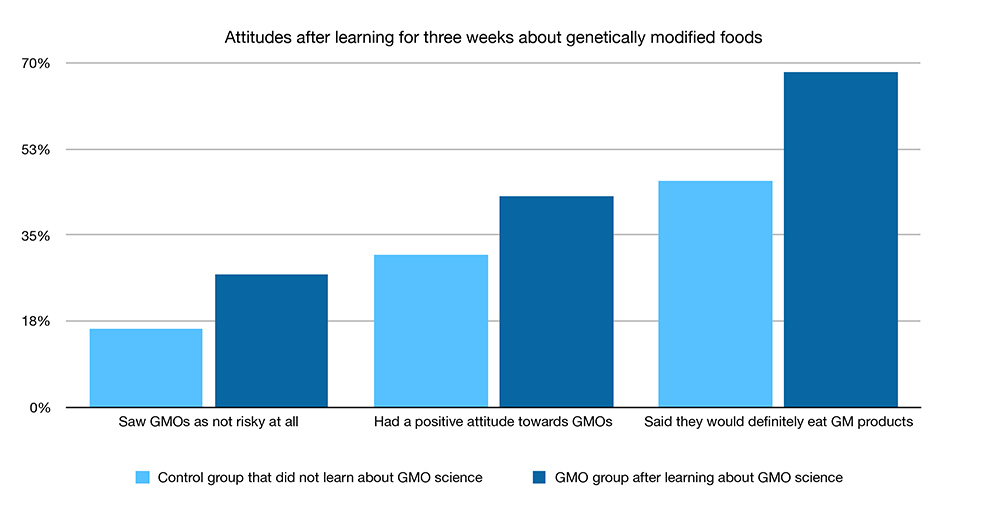
Can learning about GMOs change people’s minds?
To find out whether learning about genetically modified foods could actually change people’s attitudes, the researchers conducted a five-week experiment involving 231 undergraduate students in the United States.
Participants received instruction about the basic science behind genetic modification. University of Rochester biologist Jennifer Brisson helped develop and vet the learning materials.
The results showed that participants who learned about GM technology developed more positive attitudes toward genetically modified foods, expressed greater willingness to eat them, and perceived them as less risky.
The experiment offered evidence that science education can help reduce skepticism toward GM foods—not simply that people who already understand the technology tend to view it more favorably.
Their findings, argues the team, lend direct support for the deficit model of science attitudes, which—in broad terms—holds that the public’s skepticism towards science and technology is largely due to a lack of understanding, or absence of pertinent information.
The team’s online modules avoid confrontational approaches “which threaten preexisting beliefs and convictions,” suggesting a relatively simple guide for how to overcome skepticism about GM foods: focus on the actual underlying science not the message.
For McPhetres, the studies tie neatly into his larger research focus on people’s basic science knowledge and general interest in science—and how to improve both.
Knowledge and appreciation of science—“that’s the kind of information that people need to make informed decisions about products they use, and the food they eat,” say McPhetres who’s now heading to Canada for a joint post-doctoral appointment between the University of Regina in Saskatchewan, and the Massachusetts Institute of Technology.