
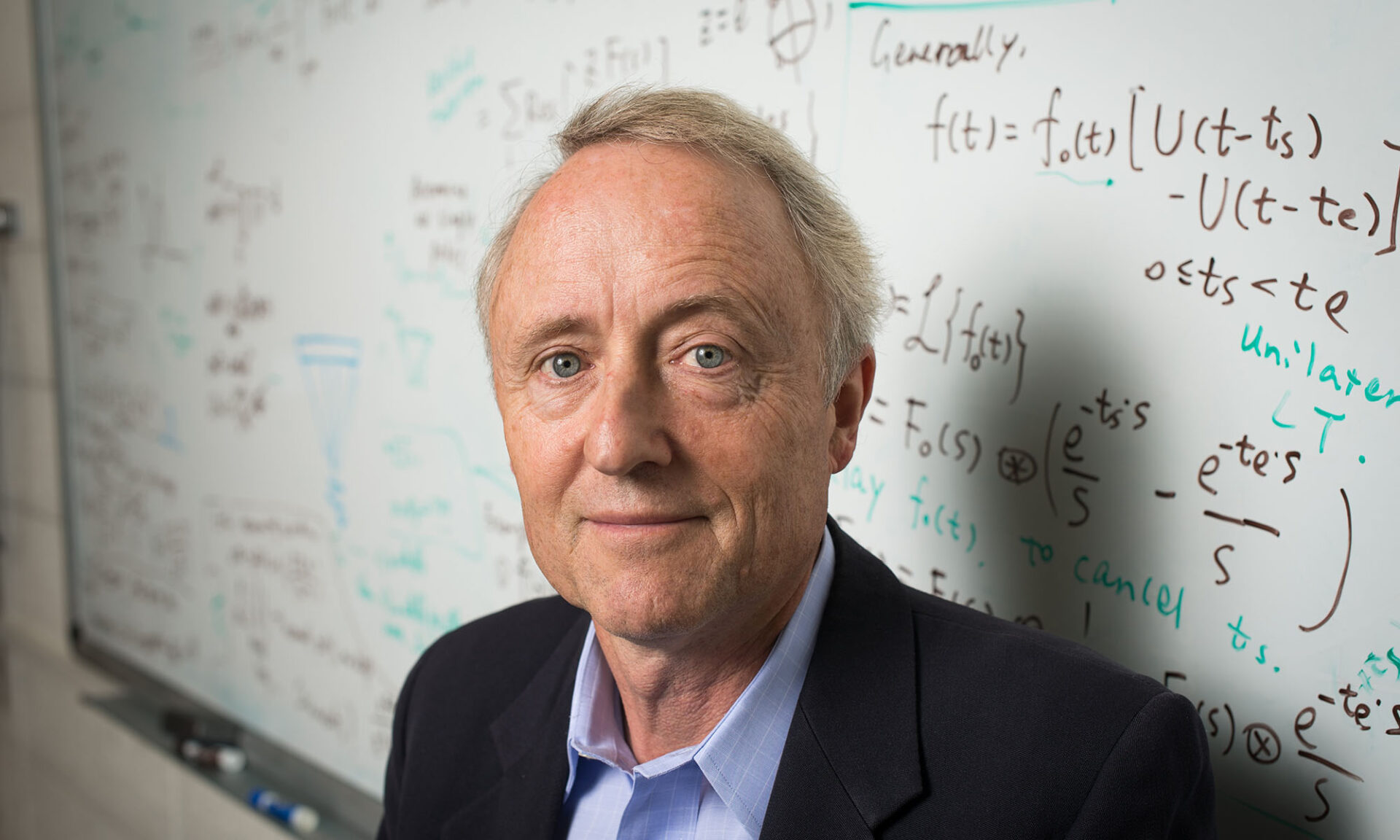
The William F. May Professor of Engineering and Dean Emeritus of Engineering and Applied Sciences leaves a legacy of innovation and inspiration.
Kevin Parker, the William F. May Professor of Engineering and Applied Sciences at the University of Rochester, died in late December at the age of 71. He is being remembered as a pioneer in the field of ultrasound imaging and a revered faculty member in the Department of Electrical and Computer Engineering.
Parker’s research about elastography and techniques for diagnosing cancer, liver disease, and other pathologies shaped the field of ultrasound imaging and inspired countless researchers.
Colleagues and former students describe Parker as a scholar who “led with vision, integrity, and a deep commitment to excellence,” says Marvin Doyley, the Wilson Professor of Electronic Imaging and chair of the department. “Equally meaningful was his generosity as a mentor. Many of us benefited from his guidance; I still remember seeking his advice at key moments in my career.”
At URochester, Parker served in numerous critical leadership positions, including as director of the Rochester Center for Biomedical Ultrasound from 1990 to 2006, chair of the Department of Electrical and Computer Engineering from 1992 to 1998, associate vice provost for research and graduate affairs from 1996 to 1998, and dean of what was then called the School of Engineering and Applied Sciences from 1998 to 2008.
“Kevin devoted his career to innovation that has changed the world,” says Wendi Heinzelman, dean of the Hajim School of Engineering & Applied Sciences. “As our school’s longest-serving dean, he was instrumental in establishing the Department of Biomedical Engineering and the development of the Robert B. Goergen Hall. He was a remarkable person, and his legacy lives on through his students and through his immeasurable contributions to printing, diagnostics, and imaging.”
Blue noise mask and other paradigm-shifting innovations
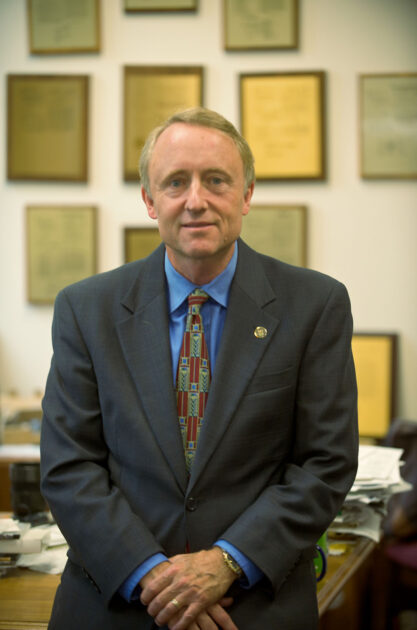
Parker experienced tremendous success translating his research into real-world applications and fruitful business ventures. He held 33 US patents and 14 international patents that have been licensed to 25 companies. In 2016, Parker became the first person from the University of Rochester to be named a fellow of the National Academy of Inventors.
Blue noise mask, which Parker invented with then-graduate student Theophano Mitsa ’91 (PhD), was a deceptively elegant technological process that transformed how electronic devices in the early 1990s rendered images. They were able to shift otherwise distracting errors in the printing process to higher wavelengths where—because of a quirk of the human eye—they would be less visible. The technology would be licensed by more than a dozen companies, including Hewlett Packard, and become one of the most lucrative inventions in the University’s history.
“I could not have a more brilliant advisor,” says Mitsa. She recalls Parker approaching her with an idea when she was experimenting with blue noise but struggling to find anything worthy of a PhD. thesis. “On the board, he started creating graphs that described the blue noise mask. What a brilliant idea. The big guys—Xerox, Kodak, and HP— were trying for years to find a technique to create a mask that yielded blue noise but could not do it. Back then, there were two ways to halftone: a fast but grainy one with a mask, and a slow but blue-noise-yielding technique (error diffusion). The blue noise mask was the first one to combine speed and quality.”
A series of patents Parker obtained with Robert Lerner, a former associate professor of radiology, and Ron Huang, a graduate student, helped launch the field of sonoelastography, which offers novel ways to measure tissue stiffness. In 2000, a succession of ultrasound, MRI, CT scan, and biomarker patents with Sara Totterman, a former professor of radiology, and graduate student Jose Tamez-Pena led to the founding of VirtualScopics Inc. The company specialized in making medical imaging analysis tools to help clinical researchers speed up the drug development process.
Parker’s former student Edward Ashton ’96 (PhD) was brought in to serve as the chief scientific officer of VirtualScopics, which quickly became an industry success. When the company went public in 2005, it had grown to about 40 employees and was earning about $3 million annually. VirtualScopics was acquired multiple times before becoming part of ICON PLC, which currently employs 44,000 people.
“No one person—honestly, no ten people—have had more to do with making me who I am, both personally and professionally, than Kevin Parker,” says Ashton, now ICON’s senior director for oncology imaging and a prolific novelist. “He was an adviser, a confidante, and above all, a friend. The world is a poorer place without him.”
‘A brilliant scientist, inventor, teacher’
Parker was a fellow of the Institute of Electrical & Electronics Engineers (IEEE), the American Institute of Ultrasound in Medicine (AIUM), the Acoustical Society of America (ASA), and the American Institute for Medical and Biological Engineering (AIMBE). He earned numerous awards and accolades over his career, including URochester’s George Eastman Medal, the AIUM Joseph Holmes Pioneer Award for Contributions to Medical Ultrasound, the Eastman Kodak Outstanding Innovation Award, and the Ultrasound in Medicine and Biology World Federation Prize.
Many of Parker’s former students have gone on to become leaders in ultrasound imaging and other fields. In 2019, an endowed professorship named after Parker was established at URochester with royalties from the blue noise mask patents; his former student Diane Dalecki was installed as the inaugural Kevin J. Parker Distinguished Professor in Biomedical Engineering.
“I have always been so deeply honored and humbled to hold this named professorship, and now, even more so in Kevin’s absence,” says Dalecki. “I have had the profound privilege of knowing Professor Parker for decades, first as a student and then as a colleague. Professor Parker was a brilliant scientist, inventor, teacher, and importantly, a wonderfully kind and generous person. He was an important mentor, colleague, and friend. This is great loss for our scientific community and the University of Rochester.”
Parker remained an active researcher until his death. He was listed as a coauthor on numerous studies published in 2025 and recently secured patents related to the H-scan technique developed in his lab and on reverberant shear wave fields.
“Kevin was the reason I decided to pursue my PhD at the University of Rochester,” says Benjamin Castañeda ’09 (PhD), now a professor of biomedical engineering at URochester. “From our first meeting, I saw him as a role model: a world-class researcher who had invented a new imaging modality, served as dean of the School of Engineering and Applied Sciences, and successfully translated his work into industry. Little did I know that this was only the tip of the iceberg. Kevin was not only a brilliant scientist and an inspiring mentor, but also a generous, wise, and deeply humble human being. His legacy will endure through the many lives and careers he shaped, and he will be deeply missed.”
Adds Stephen McAleavey, an associate professor of biomedical engineering and chair of the department, who took ECE 452: Medical Imaging with Parker during his senior year as an undergraduate at URochester: “The experience and his encouragement convinced me to stay at Rochester for my PhD. He was an incredibly kind and patient mentor. And though he was incredibly busy, he was always so generous with his time.”
Parker is survived by his wife, Jean, and their four children. More details about his life and memorial services are available in his obituary.