
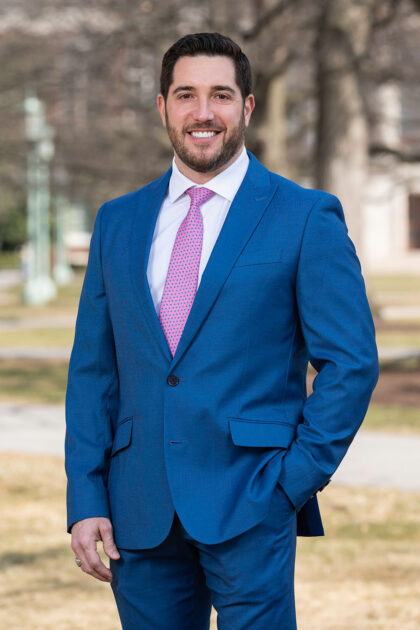
Rob Alexander, the University’s vice provost for enrollment, and two colleagues discuss enrollment headwinds and strategies.
Since 2008, colleges and universities have been on a slow march toward a serious existential threat. It began with the Great Recession, which so thoroughly wracked the economy that many Americans decided to delay having children or not have them at all. Those in higher ed observed that fewer babies in 2008–2012 meant fewer 18-year-olds in 2026–2030, a foreboding that, in the last five or six years, became known as the “enrollment cliff.”
For the better part of the next two decades, the University of Rochester will be competing for a much smaller pool of students. The Western Interstate Commission for Higher Education (WICHE) provides an annual “student pool” forecast in its report “Knocking at the College Door.” In its 11th edition (December 2024), the WICHE report says the total number of US high school graduates is expected to peak this year and will decline steadily through 2041.
The cliff is no longer theoretical; it’s a current threat, but URochester is not in free fall. In a Leadership Conversations webinar, Rob Alexander, the vice provost for enrollment, led a conversation with Joe Testani, the deputy to President Sarah Mangelsdorf, that explored how the University is responding to the decline of this key US demographic. But that’s not the only enrollment challenge URochester faces. Heidi Marcin, the director of enrollment marketing, and Megan Ryan, the assistant vice provost for enrollment, joined Alexander in the conversation to help cover the gamut of enrollment threats and the strategies the University is employing to counter them.
Here are five takeaways.
Up against serious enrollment headwinds, URochester is overperforming.
A convergence of enrollment challenges is squeezing universities across the country. The enrollment cliff will unquestionably contribute to a steep drop in the number of college-bound students (over time) at URochester, but so will skepticism about the value of a degree, increased sensitivity to cost, and changes in college-going behavior.
Unpredictable federal policy changes compound the demographic decline. For example, visa and immigration uncertainty has led the US to be a less desirable destination for international students, who help stabilize University revenue. Policies that jeopardize federal research funding is another external challenge as they make it harder for American research-intensive universities like URochester to compete globally for graduate students.
Alexander shared that despite all that, URochester is seeing application growth.
“Domestic applications are up about 33 percent versus two years ago. International is up as well.”
In this climate, that’s high-five-worthy data. The headwinds URochester faces seriously hinder enrollment performance, threatening financial stability (potential tuition revenue loss) and student experience (inability to cultivate a well-rounded student body). And that directly affects how successful the University can be in achieving its goals of providing exceptional undergraduate education and generating sustainable growth.
Humility has to give way to bold storytelling.
One of the four pillars of URochester’s brand is “grounded brilliance”—in other words, striking a balance between humility and boastfulness. Ryan noted that finding that “sweet spot” will help the University successfully compete for students as they and their families start to think about college or winnow their preferred institutions. Among the many downstream effects of there being fewer potential students is a zero-sum enrollment landscape—while students are applying to more colleges, they only enroll at one.
Translation: The University has to assert what makes it great.
Ryan emphasized the importance of the strengthened partnership with University Marketing and Communications. Students need to see themselves at URochester, and that requires richer, more personal stories that highlight the value of the URochester experience. And it needs to happen early in the process, which is a multi-year effort. While the University is actively making decisions for the fall of 2026, it’s already deep into recruitment for fall 2027.
“From the moment they’re connecting with us, we’re talking about the experiences that they’re going to have… and those stories are coming from our marketing and communications partners.”
The enrollment team is also looking to partners across academic departments to create more meaningful connections. URochester’s faculty is highly accessible for a research-intensive institution, making them one of the University’s most potent and necessary recruitment tools.
New student journeys require a new mindset.
It’s a new day in enrollment marketing. In addition to factoring in what students expect from a university, institutions now need to consider how they’re moving through the search process. Marcin broke this down by highlighting three major shifts.
- Students are the captains now. There used to be a predictable, linear funnel, where students requested information, and the institution would deliver it in a certain way and at a certain cadence. Now it’s a student-directed journey that has them moving in and out of channels and doing their own research.
“A lot of times, the first contact we have with a student is an application. We call that a stealth applicant, and it’s a growing segment every year.”
- Parents aren’t side characters. Engaging families is no longer optional as they have become full partners in the decision-making process. And students want them to be. So, communication with and outreach to parents is no longer a courtesy; it’s a strategic imperative.
- Digital marketing had a glow up. There was a time when a static website and some plain-text emails were cutting-edge. That time is long gone. Students live in a multi-platform, multi-device world, and they expect institutions to meet them there. Execution needs to be seamless.
URochester is evolving in response by investing in newer tactics like digital advertising and paid search. It’s also engaging in platform-specific, social media storytelling, where student voices are elevated by making them the content creators and allowing them to tell authentic, relatable stories.
Graduate and international enrollment require rethinking.
Going back to the demographic decline, graduate and international student enrollment are now essential stabilizing forces. Alexander made the point that offsetting the effects of the enrollment cliff means that URochester needs to widen its enrollment strategy—especially at the graduate program level.
Alexander pointed out that, compared to its peers, URochester has a higher proportion of undergraduates to master’s students, suggesting there’s room to grow across schools. Although individual graduate programs have been recruiting effectively, they’ve done it without the infrastructure and support that a University-wide approach can provide. There’s also great potential for new partnership agreements with domestic liberal arts schools that don’t offer master’s degree programs.
Turning to the international landscape, Alexander noted that URochester has a strong legacy of enrolling students from across the world.
“China had been the source of the bulk of our international students… but with that single source slowing very precipitously, we’re putting a lot of effort into diversification.”
There’s been notable growth in students from India, South Korea, and Vietnam—in addition to areas beyond Asia—and partnerships are deepening across Africa, the Americas, and the Middle East.
So how can marketing support these efforts? Not without some complexity.
When it comes to graduate students, Marcin noted that they make decisions in a reverse order from their undergraduate peers. Undergraduate students tend to know where they want to go, but not what they want to study, while graduate students are likelier to know what they want to study, but not where they want to do it. That makes paid search and targeted digital outreach essential tactics.
“If graduate students are putting ‘best [program]’ into Google, we want to make sure our programs are coming up.”
Marcin emphasized that ROI, outcomes, and research strength—areas where the University has significant advantages—drive graduate decision-making.
Globally, Marcin pointed to URochester’s longstanding international identity as an asset. Even as traditional recruitment methods shift and specific markets become more challenging, the University has something many schools lack: a global community ready to help.
Retention is as necessary as attraction.
Nationally, about a third of all college students transfer at least once during their collegiate careers. Keeping URochester students at URochester is the most cost-effective way to achieve its enrollment-based goals. Ryan explained that the University is strengthening its internal pipelines.
Ryan noted that students change schools because they’re seeking a stronger sense of belonging. When they don’t find that right away, they become open to transfer conversations. That’s why URochester has expanded its outreach to students who were previously admitted but chose a different path. It’s a new direction for the University, but one that positions it for strategic recruitment with customized messaging that speaks to where a student is and how the URochester experience might offer a better fit.
Overall, the University’s retention and transfer strategies go hand in hand. Building a more welcoming, transparent, and supportive transfer experience bolsters URochester’s position on both fronts.
“We can’t just recruit students to get them here,” Ryan said. “Once they’re here, we have to continue to recruit them and reinforce the value of a University of Rochester education.”