
Director Sarah Jesse emphasized the importance of access to art, while covering industry trends and the museum’s future.
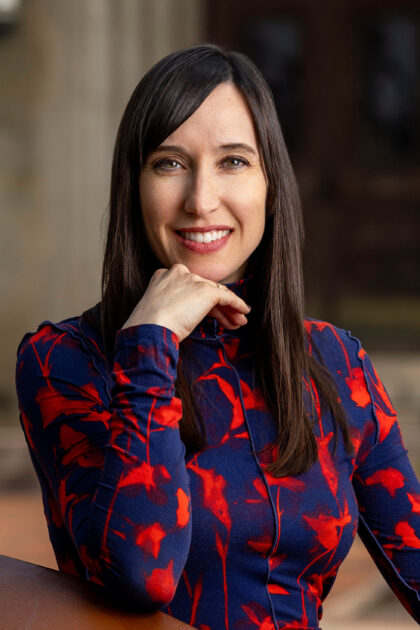
With a collection of more than 13,000 works, representing cultures from around the world and across millennia, there is no shortage of opportunities to wow a first-time visitor to the Memorial Art Gallery (MAG). So, why does Sarah Jesse, the Mary W. and Donald R. Clark Director of the Memorial Art Gallery, choose to bring new visitors to see William Partridge’s marble statue Memory?
It’s a lasting symbol of the museum’s roots.
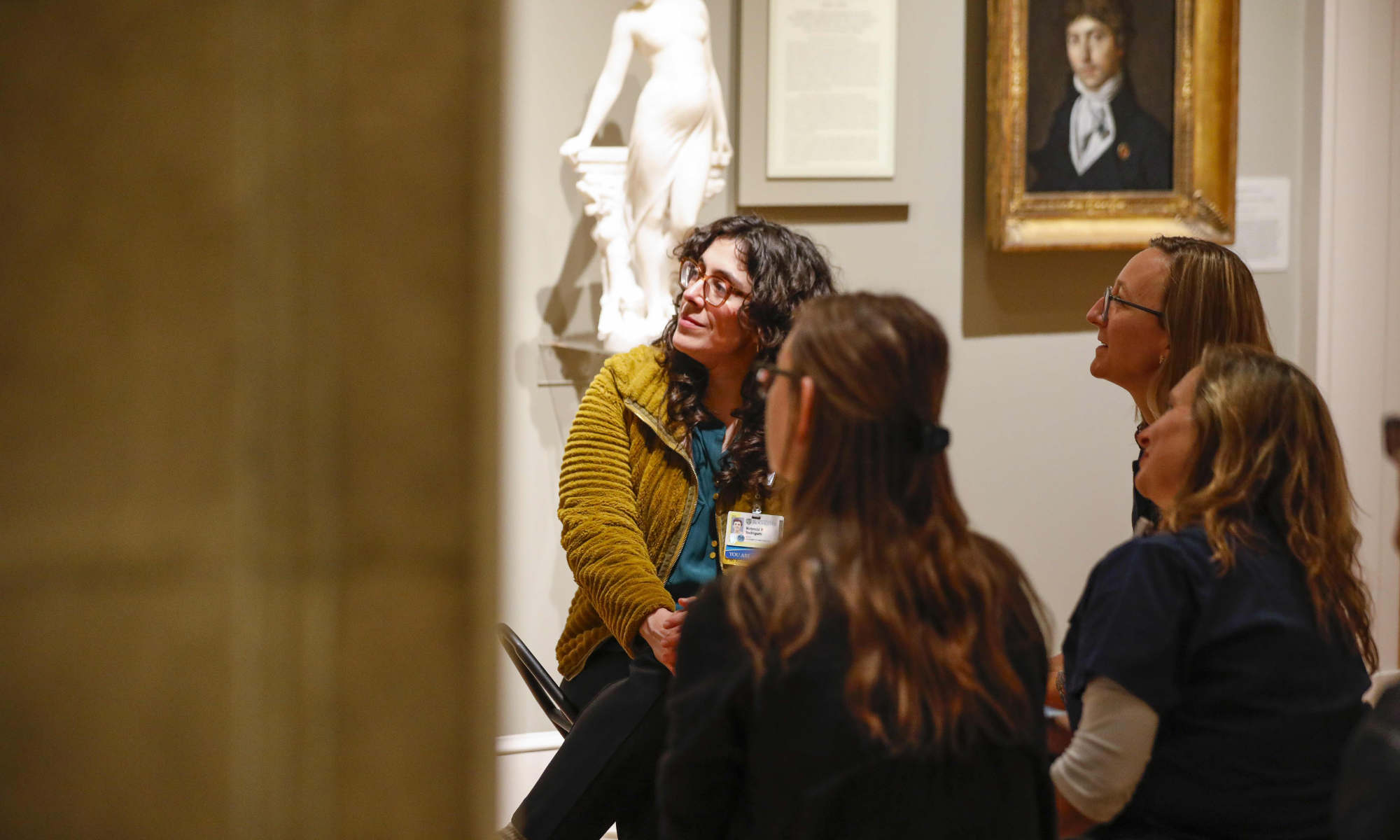
Commissioned by MAG founder Emily Sibley Watson, Memory—depicting a woman hugging an urn—memorializes Watson’s son, James Averell, while communicating her grief. The sculpture stands among Renaissance and ancient art on MAG’s second floor, near the entrance to the original 1913 building, which is also a memorial to Averell. Watson gave the building to the University of Rochester with the proviso that it be used as “a means alike of pleasure and of education for all the citizens of Rochester.”
The MAG has taken its adherence to Watson’s stipulation to a new level with the Free For All Forever Challenge. Jumpstarted by a $3 million commitment from civic leader Abby Bennett, URochester Trustee Doug Bennett ’06S (MBA), the Sands Family Foundation, and MAG, the challenge seeks to build an endowment that enables free admission to the museum.
Jesse discussed the fundraising challenge in a Leadership Conversation that touched on topics such as access to art, industry trends, and connection to the community.
Here are five takeaways.
Accessibility is a matter of practicality and perception.
Since 1940, Oberlin College students, faculty, staff, and community members have had the opportunity to rent a random piece of artwork from the Allen Memorial Art Museum for $5. That’s how Jesse got to spend a semester as an undergraduate student with a Robert Rauschenberg print hanging in her dorm room. It was also part of a seminal experience that shaped her view on how museums should serve communities.
Expanding access to MAG has been one of Jesse’s top priorities since she arrived in February 2024. Knowing the MAG to be a genuine civic treasure and learning how many people love it led her to ramp up outreach to those who have no relationship to the museum.
“We have placed a lot of emphasis on programs that eliminate practical barriers, like fees, and perceptual barriers that lead to people thinking a museum isn’t for them, or they don’t belong.”
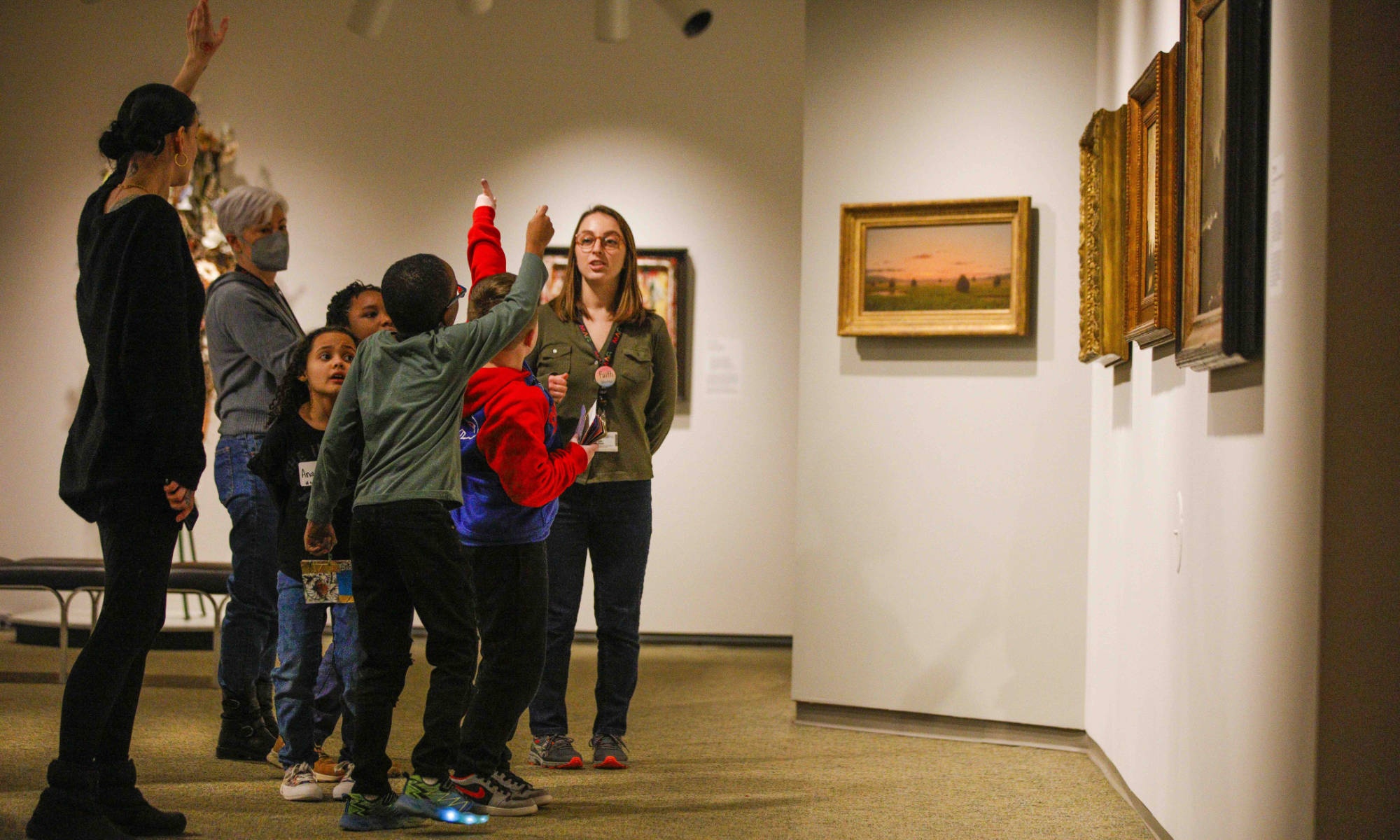
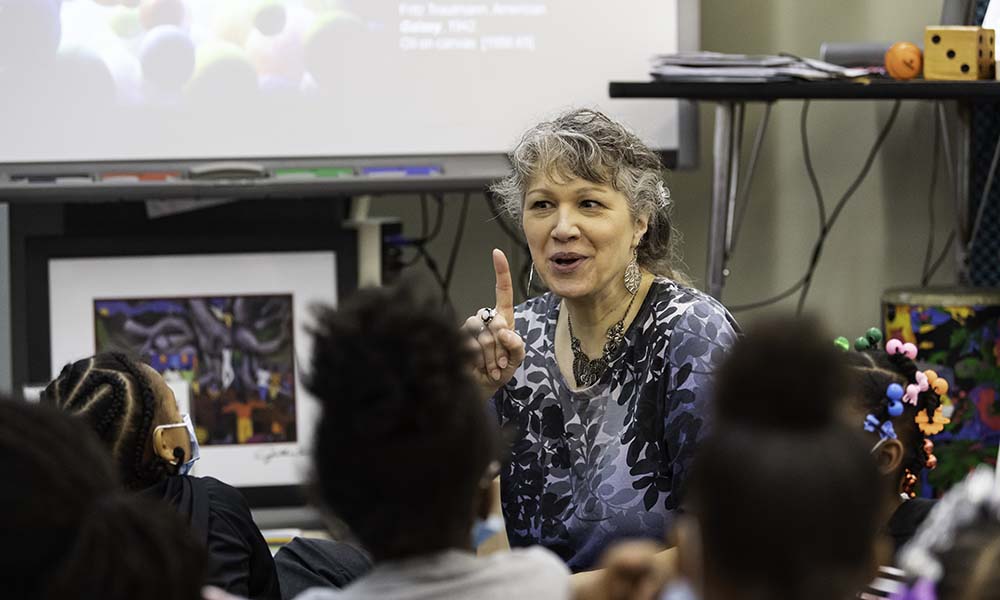
One of the most fruitful examples of those efforts is a partnership with the Monroe County Public Library System, which placed passes for free admission at all 32 of the system’s branches. There’s also the partnership with the Rochester City School District (RCSD), where students receive a 90-minute MAG visit once a week for four consecutive weeks each year, from Grade 2 to Grade 4.
Jesse shared a story of an RCSD student who touched a piece of artwork on his first visit because he was so excited to be at MAG. He then wrote the museum an apology letter, vowing to never do it again. The same student burst into tears on the last day of the program because he was so sad to be leaving the teaching artists. MAG gave his family a pass to visit whenever they want. Jesse shared the story because the desire to have community members visit MAG again and again was the impetus for the Free For All Forever Challenge.
Collections can deliver Boundless Possibility.
One of the core beliefs that URochester’s 2030 strategic plan, Boundless Possibility, was built around is that the University’s future is inextricably linked to the city of Rochester. By committing to economic, educational, social, and cultural partnerships, the University can perpetuate the conditions that keep the city and region just and vibrant. “Just” and “Vibrant” resonated with Jesse.
“I think that’s MAG’s sweet spot. We expand worldviews. We nurture empathy and acceptance for differences through exposure to other cultures. And a community that enjoys that enrichment, creativity, and connection is a community that thrives.”
MAG, as described by Jesse, is a quintessential encyclopedic museum in that its holdings satisfy most checklists. Egyptian sarcophagus? Check. Renaissance armor? Check. Japanese woodblock prints? Check. The work of Monet? Rembrandt? O’Keeffe? Check. Check. Check. The reason the museum has such incredible breadth and depth is its second director and first curator, Gertrude Herdle Moore and Isabel Herdle, respectively. Knowing that some of their fellow citizens might not ever leave Rochester, the Herdle sisters developed a collection that would expose them to art from around the world.
Today, museums across the US are facing the reality that great collections come with great responsibility. Jesse touched on this, noting the growing practice of “institutional critique.”
“There’s a sense that we need to reckon with the exclusionary practices that have led to a perception of elitism and really examine the bias of the art history canon.”
Right now, MAG is rethinking its American art galleries, including reexamining what “American art” means and how it can tell a more nuanced narrative. Jesse noted that museum patrons are currently seeing MAG curators experiment with gallery storytelling through anchor objects. For the longest time, the American art collection was anchored by a marble sculpture called The West Wind, which, in the context of the gallery, could be interpreted as a symbol of manifest destiny. Jesse is thinking about how patrons’ perceptions and consumption of the gallery might change if the first piece they saw was a Mesoamerican ceremonial object. This is one example of how MAG is not only diversifying its collections and storytelling but also interrogating the biases of the art-history canon.
At any given time, MAG is only displaying about eight percent of its collection (which is normal for institutions like MAG), so Jesse and MAG’s curators have plenty of options for experimentation throughout the museum.
Greater capacity is the key to growth and stability.
One question Jesse frequently gets is, “Are you going to expand the museum?” People see the big empty field behind MAG, and they, understandably, see opportunity. Jesse admits even she was enchanted by the idea when she first arrived. But the work she and her team have put into their five-year strategic plan has made it clear they must first take care of the existing structures.
“Museums have to be physically beautiful to work their magic and convey to people: this is a place of consequence. This is a place of ideas. It’s an elevated realm.”
Enhancing and beautifying the gallery spaces is among the MAG’s focus areas moving forward. Jesse pointed out that the first-floor galleries used to have floor-to-ceiling windows. She sees opening those up again as a way to help make the first floor as physically inspiring as the second floor.
For Jesse, the path to growth—and stability—starts with bolstering MAG’s capacity. Capacity begets great programming, and great programming leads to better visibility among the community, creating a larger network of people who care about and invest in the museum. The more people who invest in the museum—primarily as members—the more MAG can do.
The strategic plan and the Free For All Forever Challenge are driven by MAG’s desire to be a more generous institution. That being said, MAG also exists because of the generosity of its community. People are often surprised to learn that every single object in the museum’s collection was a gift of some sort. In fact, a huge reason MAG has a world-class collection is the Marion Stratton Gould Fund. The fund was established by MAG board member Hannah Durand Gould in 1938 with a $365,000 bequest, which would be the equivalent to $7.1 million today.
Any support given to MAG today, including memberships, counts toward For Ever Better: The Campaign for the University of Rochester.
MAG is both balm and wellspring.
In November 2025, the New York Times published a piece by critic A.O. Scott that highlights a poem by Robert Hayden called “Monet’s ‘Waterlilies.’” Many people sent the article to Jesse because, at the time, MAG had a Monet waterlily painting. But Jesse knew it was also because of this excerpt: “Art can’t save us from anything, but we need it as a reminder of something better—of a world that is the antithesis of what we inhale with the news.”
Jesse shared that there was a day when a visitor paused to put on her coat at the front desk, and as she did so, she sighed deeply and said, “That was just what I needed today.”
“I think more than ever, people are turning to MAG as a space of creativity, beauty, community, and joy.”
Jesse is thinking about the many roles MAG plays in the community, especially given the implications of a successful Free For All Forever initiative. MAG will attract many more first-time visitors, many of whom may be unsure about how to view art or otherwise engage with what the museum has to offer.
“First-timers” represent an important MAG demographic for Jesse as she wants people to fall in love with the museum. She aims to stoke those feelings by embedding opportunities to make art, read, and socialize within the galleries.
However, MAG is more than an oasis for weary souls. As an academic museum, it occupies a unique hybrid space, simultaneously a civic institution and university resource. Because of its location, it’s currently easier for the museum to serve the public than the academic community. Jesse is working on that.
Jesse would love for URochester students to have the kind of relationship with MAG that she had with the Allen Memorial Art Museum at Oberlin. She knows it’s a tall order. An early win for that student connection was making sure the museum is a destination for University shuttles. Another way she aims to move the needle is by working with faculty to see where MAG can be integrated into coursework.
Research is an under-recognized MAG role in the academic sphere. Curators are actively doing original research in art history. Jesse cited the work of Jess Marten, who is working on an exhibition that will give overdue recognition to a woman artist, Maria Oakey Dewing, who was widely dismissed for her penchant for painting flowers.
Enjoy MAG.
Historically, museums focused on the stewardship of their collections—an inherently flawed practice because if done perfectly, collections would remain locked away, never seeing light (or being seen). But, as museum directors wrote in an open letter supporting the Louvre’s director in the wake of a spectacular heist, “Museums are neither bastions nor safes. While creating a safe environment for art and its audiences, their raison d’être lies in their openness and accessibility.”
For more than two decades, museums have shifted from object-centered institutions to people-centered spaces for education and engagement. The MAG is all-in on the latter. Jesse sees sharing MAG’s collection as MAG’s most important mission.
“I just want people to come enjoy this resource. It is for you, so take advantage of it.”
Jesse encouraged those who haven’t become members to do so and to remain members even after they meet the Free For All, Forever goal. She explained the predominant reason museums are hesitant to eliminate their admission fees is that admission is a perk of membership, and those memberships are critical to the museums’ health.
“Membership is a sign of health in the community,” she says. “So, I really hope when we go free, we see more members than we have ever had because they’re excited to be part of an institution that is doing such important work for the community.”