The professor emeritus and former director of the Institute of Optics leaves a legacy of innovation and mentorship.
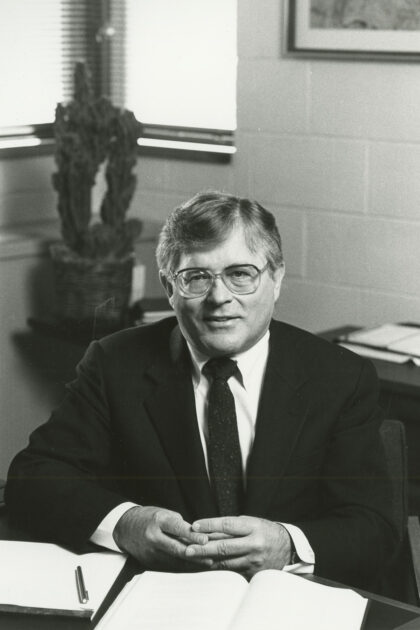
Professor Emeritus Nicholas George, who served as professor of optics and of electrical and computer engineering at the University of Rochester for almost 38 years, died on September 12 at age 98. Colleagues and friends remember him as a brilliant researcher, strong mentor, and a leader who forged connections from the lab to the marketplace.
Prior to his retirement in 2015, George was the Marie C. Wilson and Joseph C. Wilson Professor of Electronic Imaging and director of the Institute of Optics from 1977 to 1981, helping to significantly expand the Industrial Associates program. He was also the founding director of the University’s Center for Electronic Imaging Systems, now the Center for Emerging and Innovative Sciences.
Michael Morris, a professor at the Institute of Optics from 1982 to 2001, says his former colleague embodied “excellence in research mentoring, interpersonal skills, and program management during a period of unprecedented growth for the Institute.”
Adds Morris, “His office door was always open, and he had a keen sense of humor and thrived on engaging in stimulating one-on-one discussions (and debates) with both colleagues and students. He was unique and will certainly be missed.”
George pioneered basic research in holography with the discovery of the holographic stereogram. He also invented the ring-wedge photo detector and developed the first robot vision device to sort medical X-rays, a long-standing challenge in the field. Additionally, he is credited with being the first person to develop a theory for the space and wavelength dependence of speckle (a pattern that appears when many waves of the same frequency, for example from a laser, interfere), which has been applied to remote sensing of satellites and space debris. He published more than 130 papers, held more than a dozen patents, and was also a fellow of Optica, the SPIE, and the IEEE.
“Professor George was unparalleled in program building, was a tireless advocate for the Institute of Optics, and was a committed mentor to many of our distinguished alumni,” says Thomas Brown, the Dr. James C. Wyant Professor in Optics and director of the Institute of Optics. “His leadership laid the groundwork for today’s many successes at the Institute.”
Over the course of George’s long teaching career, he advised more than 50 graduate thesis students. In honor of his commitment to graduate education, the Nicholas George Endowed Fellowship in Optics was created at URochester in 2013. Two years later, the Nicholas George Endowed Professorship in Optics was established through a gift from Milton Chang, a former student of George’s at the California Institute of Technology, with additional commitments from George’s colleague Joseph Goodman, the William Ayer Professor Emeritus at Stanford University, as well as Morris and his wife, Ruth.
Susana Marcos, who holds the professorship named for George, met him at his home in California shortly after joining the University and recalls him as “a distinctively sharp and curious individual, eager to learn about my research and generous in offering his advice.”
“I felt deeply honored to be bestowed the Nicholas George Professorship of Optics, and profoundly grateful for the generosity of his students,” Marcos says. “Every day, I draw inspiration from Nicholas George’s contributions to optics and to the world.”