Unabashedly analytical
From markets to management, Simon Business School researchers and students apply rigorous analysis to advance ideas with real-world impact.
Business done better at URochester

When people hear the word “monopoly,” they often picture a single company dominating a market—maybe even the board game version, with one player scooping up all the properties. But in today’s economy, monopoly power is both less obvious and more complex. At the University of Rochester’s Simon Business School, Jeanine Miklós-Thal, the Fred H. Gowen Professor of Economics and Management, and Elena Prager, an assistant professor of economics, study how businesses gain, maintain, and sometimes abuse that power—and why it matters for everyday life, from buying plane tickets and grabbing lattes to downloading apps and securing jobs.
“For a long time, antitrust law in the United States has codified the idea that monopolies are bad for consumers,” says Prager. “We worry about prices going up, we worry about product quality degrading and people having fewer choices and being able to buy less. But that’s not the only set of harms that can happen.”
Strictly speaking, a monopoly is a market with just one firm selling a particular good or service. But in practice, this does not happen often. In most real‑world markets, the concern is less about a single, pure monopoly and more about firms that hold substantial monopoly power—also called market power—because customers lack enough good alternatives.
Economists, therefore, spend at least as much time thinking about monopoly power as they do about one‑firm monopolies.
Even where multiple companies exist, warning signs of monopoly power include:
Modern markets provide a range of examples of monopoly power—some rooted in history, others unfolding now:
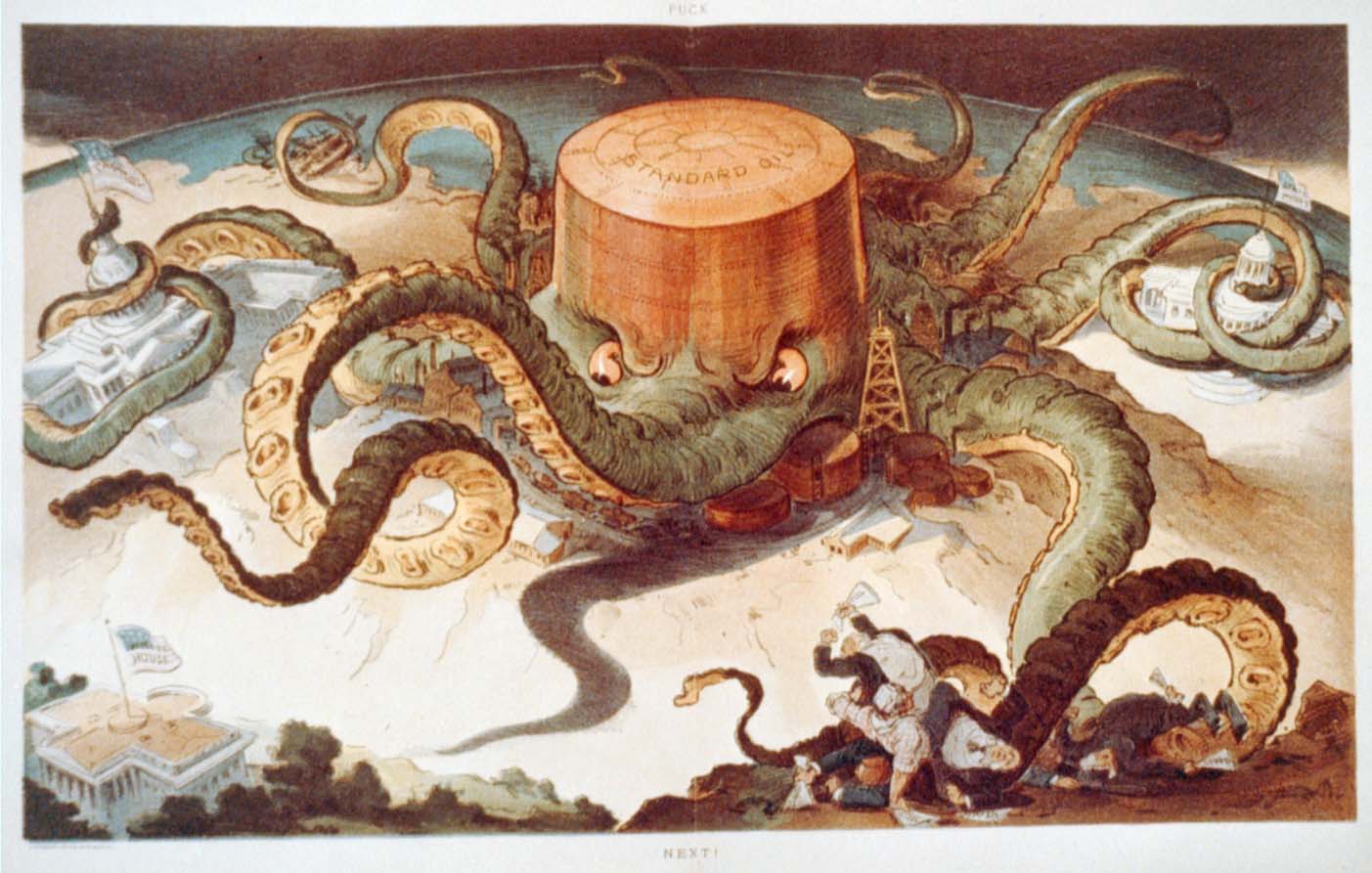
“In practice, what’s more likely is that a handful of companies have a dominance and grip on a market,” Prager notes. But big, she emphasizes, does not automatically mean monopolist: “What really matters is what you are big in.”
Prager highlights Amtrak as an example. It is by far the biggest passenger rail system in the US, and for long‑distance rail travel, it’s the only game in town. “But taking Amtrak is not the only way to get from point A to point B,” Prager says. Travelers between Rochester and New York City, for instance, can drive, take a long‑distance bus, or fly. “It’s really how easily consumers can switch from the product that you sell to some other product that meets the same needs or a similar set of needs.”
Sometimes a group of firms can behave as if they were one dominant player. A classic example is a cartel, where companies that are supposed to compete instead coordinate their strategies—for instance, by fixing prices, allocating customers, or carving out geographic markets among themselves. “If they’re making strategic decisions together, they’re functioning like a monopoly,” Miklós‑Thal explains.
Cartels are illegal in most jurisdictions because they undermine genuine competition and hurt consumers. Famous cases have involved international cartels in chemicals—such as the lysine cartel featured in the 2009 Hollywood movie The Informant!—or the global air cargo cartel colluding to fix fuel surcharges instead of truly competing.
“In many digital markets, the problem isn’t high prices for consumers,” Miklós‑Thal notes. “Instead, the problem can be weak privacy and consumer protection, or high prices charged to advertisers on the other side of the platform.”
Even though consumers still pay for internet access and devices, many large online platforms—such as search engines or social networks—offer free services on the user side while exercising substantial market power over advertisers, app developers, or sellers. “If a tech firm has a very dominant position,” Miklós‑Thal explains, “consumers may not have a real choice, even if their data is being used in ways they dislike.”

Sometimes a company simply builds a much better product or service and pulls away from competitors. “A firm may come up with a great invention that’s hard to copy or just offer exceptionally good service,” Miklós‑Thal says. A local grocery chain that consistently outperforms rivals can reflect this kind of success.
“Monopoly ‘on the merits’ is not something we want to discourage,” she emphasizes. “We want firms to be allowed to gain market power by innovating and serving consumers well.”
On the other hand, some industries are shaped by substantial fixed costs that make it inefficient to have many competing providers. Economists call these natural monopolies. Examples include:
“The question then becomes,” Miklós‑Thal says, “how do we design policies so that, even in those cases, consumers are treated well?” Some countries, for example, allow multiple train companies to run services over tracks owned by a single public or private infrastructure operator, creating competition “on the rails” even if the physical network is not duplicated.
“Even without explicit coordination, if several competitors use a common algorithm, it might lead them to set prices more similarly.”
Finally, network effects that benefit digital platforms can drive monopolies: The more people use a service, the more valuable it becomes to each user. Social networks become more useful as more friends, family, and organizations join. Smartphone operating systems attract more app developers, which in turn draw more users, reinforcing the leading platforms.
“In markets with strong network effects, you often end up with a small number of dominant firms or even one,” Miklós‑Thal notes. That pattern helps explain why search engines, app stores, and ride‑hailing services tend to consolidate around a few global players.
Economists generally worry less about the existence of market power and more about how it is acquired and defended. “We’re most concerned when market power is gained through mergers that eliminate competition, or maintained through anti‑competitive practices,” Miklós‑Thal says.
Monopoly power can also shape workers’ wages, job options, and bargaining power.
“In my own work, I spend a lot of time thinking about these less traditional harms of monopolies,” Prager says. “In particular, I think a lot about labor monopsony.” Monopsony is the mirror image of a monopoly: Instead of one seller dominating buyers, it is one major buyer dominating many sellers. “Now, instead of having one single company selling stuff, it’s one single company buying stuff—and the stuff doesn’t have to be a physical good,” she explains. “It can be something like the labor of a potential worker. If I am the only employer in town, I can offer you pretty lousy working conditions and low wages—and you might still come work for me because you have nowhere better to go.”
The same competitive pressures that help consumers in product markets apply on the labor side for workers: more options usually mean better pay and conditions.

In the United States, agencies within the Department of Justice and the Federal Trade Commission enforce a variety of antitrust and consumer protection laws. But in reality, the federal government has relatively few tools to break up monopolies once they exist. For that reason, most modern antitrust policy focuses on:
“Firms have strong incentives to increase profits,” Miklós‑Thal says. “Society needs institutions in place to ensure that happens through better products and innovation, not by limiting competition.”
With new artificial‑intelligence tools and pricing algorithms, a major concern is that competing firms may rely on the same software to set prices.
“Even without explicit coordination, if several competitors use a common algorithm, it might lead them to set prices more similarly,” Miklós‑Thal points out.
Early research and enforcement actions are exploring whether this kind of “algorithmic collusion” could undermine competition in markets ranging from apartment rentals to gas stations to online retail.
So, does the classic board game actually resemble a monopoly?

“If you had a government in the board game Monopoly,” says Prager, “it would likely start to block mergers by players who already own too much stuff.” In other words, no one player would be allowed to completely dominate the board. “What instead happens in this game—which of course does not have a government, just players—is that a particularly successful or lucky player can keep just buying more and more properties until they own the entire block. And that allows them to jack up the rent prices on everybody else in the game.”
Monopolies today are less about a single company visibly owning everything and more about subtle forms of power: how it is gained, used, and protected, and whether consumers and workers still have meaningful choices in a dynamic market. If the original Monopoly Man paid homage to the industrial tycoons of the early 20th century, today’s economy features a shifting cast of platforms, brands, and employers all vying for control of the board. For economists like Miklós‑Thal and Prager, the real question is how to rewrite the rules so that competition, innovation, and fairness still have a chance to win.
 Jeanine Miklós-Thal
An expert on game theory and advanced pricing, Miklós-Thal conducts research into industrial organization, digital economics, competition policy, and personnel economics. Her work has focused on cartel pricing, pricing strategies in intermediate-goods markets, the impact of marketing strategies on consumer quality perceptions, and reputational incentives in labor markets. Miklós-Thal serves as a contributor and associate editor of Management Science and the RAND Journal of Economics.
 Elena Prager
Prager is an economist with expertise in antitrust enforcement, collusion, health insurance design, and healthcare prices. As part of her research on antitrust, she has written award-winning work on employer market power, including the effects of employer mergers on workers and the precursors to employer collusion. Prager’s research focuses on policy-relevant topics and is frequently cited by the Congressional Budget Office, Department of Justice, and Federal Trade Commission. She has presented at public-facing policy events and been interviewed by news outlets, including NPR and the New York Times.