How light can fight abdominal infections
 Lindsey Valich
|
Senior Communications Specialist
Lindsey Valich
|
Senior Communications Specialist A light-activated therapy being tested at URochester could give doctors an antibiotic-free way to target stubborn abdominal infections.
Antibiotics have transformed medicine, but they don’t always work reliably. And as bacteria become increasingly resistant to such drugs, researchers are searching for new ways to treat infections.
At the University of Rochester, one promising approach doesn’t involve developing another antibiotic. It involves using light.
By combining a common blue dye with low-powered laser light, Timothy Baran, an assistant professor of imaging sciences, biomedical engineering, and optics at URochester Medicine, and his colleagues are testing whether a treatment called photodynamic therapy can destroy bacteria inside the body without relying solely on antibiotics.
What is photodynamic therapy?
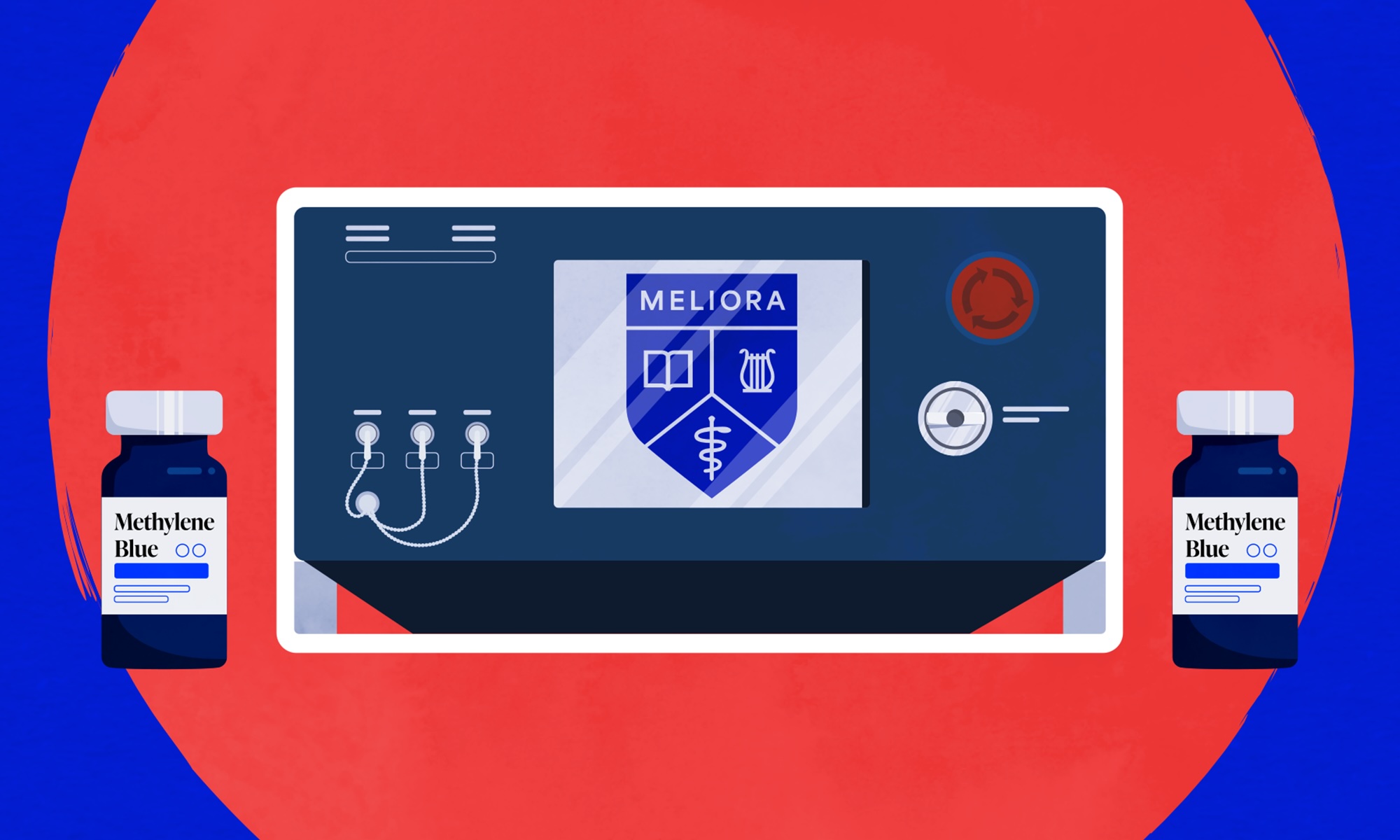
Photodynamic therapy (PDT) is a medical treatment that uses light to activate a light-sensitive drug called a photosensitizer. Once activated, the photosensitizer sets off a chemical reaction that produces highly reactive oxygen molecules capable of damaging or destroying the targeted cells.
PDT has been used for decades to treat certain cancers, including some skin cancers, as well as other medical conditions. Baran and his colleagues are investigating how the same basic principle could be used to target bacteria and treat infections.
“PDT uses visible light to activate an otherwise harmless dye, letting us selectively kill bacteria,” Baran says. “This approach is not specific to certain types of bacteria, making PDT more broadly applicable and less prone to resistance than conventional antibiotics.”
When PDT met an appendectomy
For patients with perforated appendicitis, surgery removes the appendix, but it doesn’t always eliminate the infection. Bacteria can remain trapped inside the abdomen, leading to persistent infection that can form abscesses. These swollen pockets of pus are difficult for antibiotics to completely clear—and may even require complex drainage procedures, prolonged antibiotics, or even additional surgeries.
Baran and his colleague Nicole Wilson, now at the University of Oklahoma, wondered whether PDT could offer a better approach.
PDT involves surgeons first delivering the drug methylene blue directly to the infected area. They can do this via the same port used during surgery or the catheter already in place to drain an abscess. The methylene blue is allowed to sit for about 20 minutes, giving bacteria—including strains that are resistant to antibiotics—time to absorb the dye.
“We’re looking not only at how we can make this work, but how we can mass deploy this.”
Surgeons then thread a thin fiber optic through the catheter and shine low-intensity red laser light onto the infected tissue. The light activates the methylene blue, triggering the chemical reaction that destroys nearby bacteria. Because the light only activates the dye, the healthy surrounding tissue is largely unaffected.
The treatment itself takes only a few minutes and has been shown in lab experiments to eliminate more than 99.9 percent of bacteria.
“Antibiotics can take days or weeks to have an effect, assuming they can get there in the first place,” Baran says. “Photodynamic therapy is more or less instantaneous. We’re targeting bacteria directly, so it can happen much faster.”
Unlike antibiotics, PDT attacks bacteria in a completely different way. That means PDT could become another tool for treating infections that are difficult, or even impossible, to treat with conventional antibiotics.
Putting PDT to the test with clinical trials
Photodynamic therapy itself isn’t new. Baran and his team, however, are among the first to evaluate the approach in human clinical trials for abdominal infections. Baran works closely with physicians, interventional radiologists, and microbiologists across URochester and credits the collaborative environment for helping move the technology from the lab to patients.
“I have direct contact with clinicians who are also colleagues,” Baran says. “We see each other routinely. This has allowed us to bridge that gap between fundamental research and the clinical space.”
Regular collaborators include Ashwani Sharma, an interventional radiologist at URochester Medicine, who serves as a clinical investigator on trials, and microbiologist Martin Pavelka, a microbiologist who cultures patient samples to evaluate how well PDT eliminates bacteria.
Promising lab results led Baran and his colleagues to test the approach in patients. In a Phase 1 clinical trial, their primary goal was to determine whether the treatment was safe. Patients reported that the procedure was not painful, and researchers saw early signs that PDT could help infections resolve quickly.
The FDA has now approved a Phase 2 clinical trial, where Baran and his team will evaluate PDT in a larger group of patients to better determine how well it works.
‘Another weapon in the arsenal’
Although the team’s current clinical studies focus on applying PDT to abdominal infections, Baran sees opportunities to expand the technology much further. His lab has shown that PDT can eliminate bacteria in tissue samples collected from pediatric appendicitis patients, laying the groundwork for future pediatric studies. He also hopes to collaborate with breast surgeons at URochester Medicine to explore whether PDT could be used to treat breast abscesses.
Another goal is widespread adoption of the procedure. Most hospitals typically already have methylene blue since the drug is used to treat a common blood disorder. Baran and his team are investigating whether hospitals can also use existing equipment, including light sources such as bili lights—which are used in neonatal intensive care units to treat jaundice—for PDT treatments.
“We’re looking not only at how we can make this work, but how we can mass deploy this rather than just having it be some niche thing that exists at a big medical center,” Baran says.
If future clinical trials confirm PDT’s effectiveness, Baran hopes the therapy could become another tool for treating infections at a time when antibiotic resistance is becoming an increasing global threat.
“Antibiotic resistance is becoming more and more common,” Baran says. “Antibiotics might not work as well in years to come, so photodynamic therapy is another weapon in the arsenal.”