
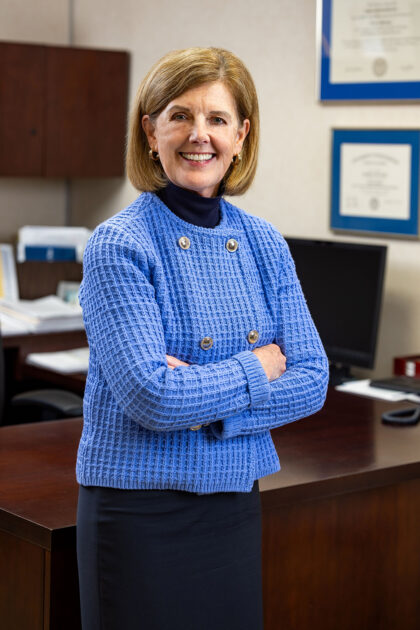
Kathy Parrinello, the CEO of Strong Memorial and Highland Hospital, talks about expanding and enhancing care in and outside the hospital.
Academic medical centers are constantly striving to do three very difficult things at the same time: deliver world-class, cost-effective care; train a new generation of clinicians; and push the standard of care through research. Today, more than ever, delivering on each mission is complicated by federal and state policy changes, a significant reduction in federal funding, and increasing labor costs and expenses.
University of Rochester Medicine is one of about 225 academic health systems across the country that are pivoting and evolving, reshaping how they heal, teach, and discover. And how it continues delivering healthcare of the highest order is being guided by Boundless Possibility, URochester’s 2030 strategic plan. At Strong Memorial Hospital and Highland Hospital those efforts are being led by Kathy Parrinello ’75N, ’83N (MS), ’90W (PhD), the president and CEO of both hospitals.
Parrinello has been with URochester Medicine since 1975. Starting at Strong, she worked in nursing through the 1990s and then moved into central administration and eventually became Strong’s chief operating officer. Now the president and CEO of two hospitals, Parrinello offered a glimpse into her corner of URochester Medicine in a Leadership Conversation.
Here are five takeaways.
‘System-ness’ is Meliora.
Most of today’s academic medical centers have moved from providing care through a single hospital to operating as multi-campus health systems composed of specialty hospitals, centers, and research institutes. Parrinello explained that evolution began at URochester in the late 1990s. Strong was becoming increasingly crowded, while Highland had room to grow. Rather than expanding Strong, the University began thinking strategically about how to work collaboratively.
What started as taking advantage of natural synergies between two Rochester hospitals became the foundation for expanding access to care regionally. URochester Medicine embraced affiliation with smaller, rural hospitals—such as those in Canandaigua, Dansville, Wellsville, Hornell, Geneva, and Penn Yan—to maintain strong community hospitals close to home for residents across the Finger Lakes and Southern Tier, with access to highly specialized care in Rochester.
Parrinello calls this “system-ness” and pointed to URochester Medicine’s cancer care as one of its best outcomes. (In his Leadership Conversation, David Linehan, the CEO of the Medical Center, dean of the School of Medicine & Dentistry, and senior vice president for health sciences at URochester, also talked about the concept of system-ness, which he described as “using all the pieces on the chessboard.”)
“Healthcare is very, very complex these days. It takes teams of highly trained individuals—oftentimes with very specialized skill sets to provide optimal care for our patients.”
Parrinello spoke of system-ness as both ethos and aspiration. It’s being one team with one purpose and a shared commitment to delivering high-quality care at the right level, in the right place, seamlessly. But it’s also striving to be ever better at doing it.
The goal isn’t more space; it’s better care.
Overcrowding in emergency departments is a national problem with local complications. In 2001, within months of Strong completing renovations to its current emergency department, one longstanding community hospital announced it was closing and another significantly downsizing. These changes put a strain on all remaining emergency departments in Monroe County, including Strong, which today provides care for more than 110,000 emergency patients each year in a space designed for 66,000.
The Strong Expansion Project is URochester Medicine investing in a structural solution to an issue the community has faced for years.
When completed, the new nine-story patient tower will give the hospital more than 650,000 square feet of new, modern space and more than triple the size of the hospital’s Emergency Department (ED). Another important feature is the addition of more than 100 inpatient beds.
“Patients are often waiting to get to beds. Moving patients when they need to be admitted is the real key to managing overcrowding in the ED.”
Parrinello made it clear that the tower isn’t just about more space (or beds); it’s about the right space. The new tower will provide one critical care bay designed for treating high-intensity trauma cases and another critical care bay for patients who need immediate medical intensive care for cardiac or neuro emergencies. Children in need of emergent care and patients experiencing mental health crises will also be treated in environments that are better suited for their needs.
URochester Medicine is taking another, more innovative approach to capacity issues by moving care beyond hospital walls. A new program that Parrinello is particularly excited about is Hospital at Home, an option for patients with acute needs who can be safely and effectively treated in their home with daily visits from care teams and telemedicine connections to the hospital.
“It’s been really exciting. Once families become more competent and confident in providing care in the home, readmission rates tend to be lower because they know they can reach out to their provider and get the services that they need.”
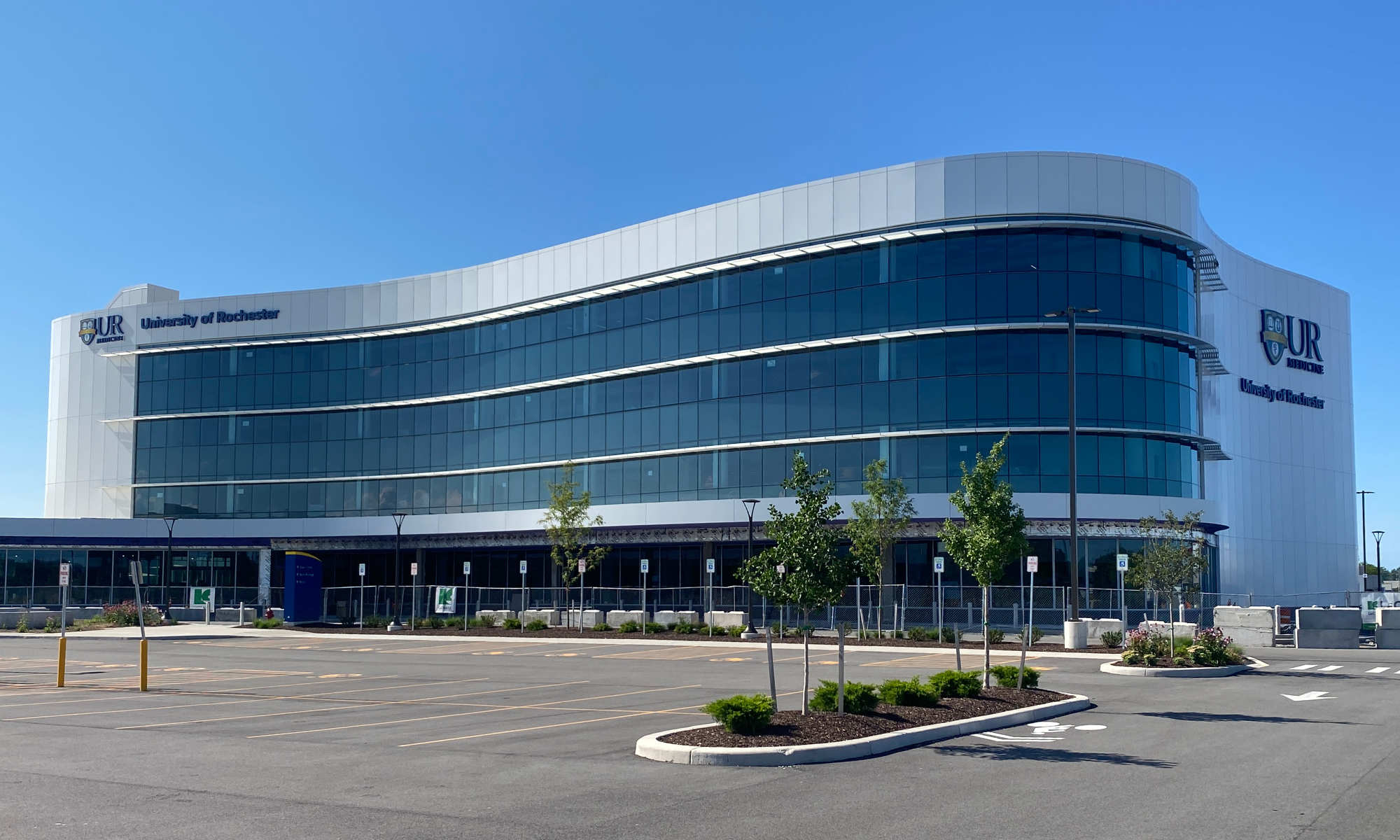
Hospital at Home is a new form of inpatient care, but patients can also receive a whole array of more medically advanced services in outpatient settings. Parrinello noted that leadership is continually thinking about how URochester Medicine can maximize efficiencies and patient convenience in roughly 250 off-site clinical locations, including the Saunders Center for Orthopaedics and Physical Performance in Henrietta.
Strong’s expansion is for staff, too.
Parrinello explained that the expansion project was also designed with employee well-being in mind, and simply starting construction provided a much-needed morale boost to faculty and staff in Strong’s perpetually overcrowded ED.
“Watching that building be built is really encouraging, because we owe it to our teams. We need to make sure they have the right spaces to work in so they can provide the best care to patients.”
But there’s more to well-being than providing staff members with the space and time to have meals, exercise, and recharge. Parrinello noted that Craig Rooney, URochester Medicine’s inaugural chief well-being officer, is working with IT teams and clinical leaders to design more efficient workflows. Parrinello added that part of creating efficiencies is making sure they have the right personnel and the right patient-to-staff ratios. Rooney is helping there as well.
Currently, Strong is staffed to care for around 950 patients every day, and frequently more than that, despite having only 897 licensed beds. The expansion will drastically improve the working conditions for staff and the privacy and comfort provided to patients. Although the incremental increase in overall patient volumes will be gradual given the current volume, Parrinello said more nurses and clinical support staff will be needed to serve the much larger facility. Recruitment plans are being developed to ensure the hospital is fully staffed when Phase 1 of the expansion project opens in May of 2027.
Policy and funding remain wildcards.
Forces beyond the hospital’s wall have the potential to reshape URochester Medicine’s care far more than the current expansion project. The One Big Beautiful Bill Act, signed into law on July 4, 2025, cuts $1 trillion from health programs over a period of eight years, including $120 billion from the Supplemental Nutrition Assistance Program (formerly “food stamps”).
Additionally, if the legislation continues as projected, an estimated 10 million people will lose their health insurance coverage, which is especially worrisome to Parrinello.
“For healthcare providers, that’s scary. When people lose insurance, it’s very difficult for them to get scheduled appointments with a provider. If they have no insurance and no ability to pay, what do they do? They come to the ED.”
With Josh Farrelman, the vice president for government relations, Parrinello and other leaders have been working closely with legislators to ensure URochester Medicine’s interests are reflected in New York State’s budget, which goes into effect this fall. They are also working with local government leaders and community partners to help area residents understand and comply with changing eligibility requirements for Medicaid and SNAP.
The future is bright and more automated.
When’s the last time someone talked about the future without mentioning AI? This isn’t one of those times.
Acknowledging that there are reasons to be cautious, Parrinello believes AI will be a transformational technology in healthcare. She called out Gregg Nicandri, the inaugural chief digital and innovation officer, who is leading URochester Medicine’s new Digital Strategy and Innovation Office. Nicandri and his team are charged with helping the health system leverage AI and other emerging technologies to help providers and clinical teams work more quickly and efficiently.
Qualified Health is also helping the hospitals’ digital leadership teams determine how best to use AI to create efficiencies and improve patient care. Parrinello shared an existing example of that: DAX, an AI-powered documentation tool that uses ambient listening. Unburdened by notetaking, physicians using DAX—with the patient’s permission—can now shift focus solely on the patient. It’s also a big win for provider wellness.
“We’ve heard doctors say this has changed their lives. Because physicians see patients back-to-back-to-back, they often spend their evenings with their notes. It’s the work after work—that’s a stressor.”
The potential applications for AI are exciting, but Parrinello is moved more by conversations that tackle fundamental questions Strong and Highland face.
How do we provide better care in off-site locations closer to patients’ homes?
How do we build stronger synergies across the network?
How do we make sure we’re leaving room to focus on learning and innovation?
As her teams work to answer those questions, Parrinello is inspired by the improved success both hospitals have had recently in recruiting clinicians, nurses, and support staff in the wake of the pandemic.
“A lot of people left healthcare jobs during the scary pandemic times,” she said. “Now, we’re seeing a resurgence in interest with many more healthcare students and applicants for jobs in healthcare, and I’m very, very excited about that. I love the energy that comes with new people coming into our organization.”