An engaging and approachable teaching style in chemistry earned him URochester’s highest award for undergraduate instruction.
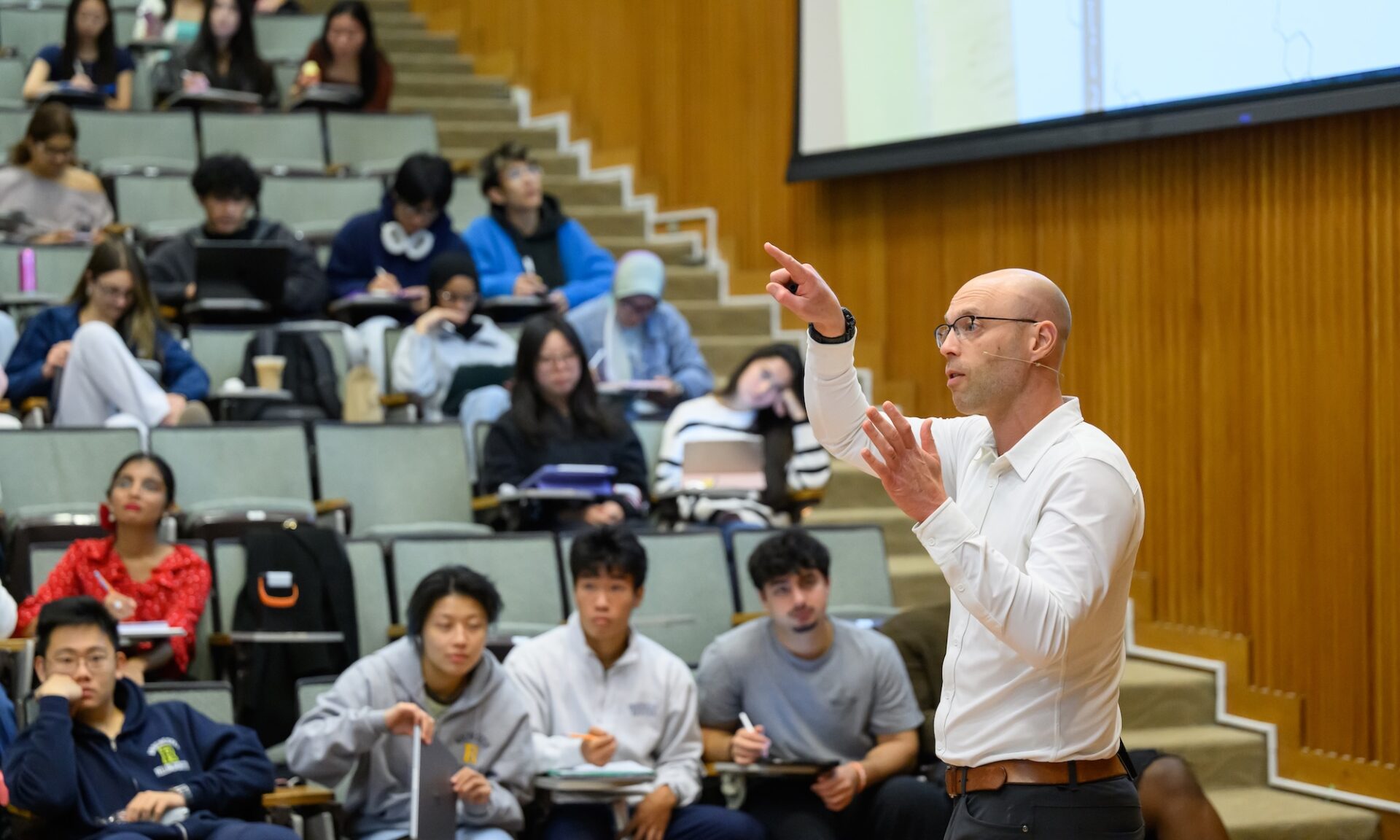
As Benjamin Hafensteiner ’03 stands at the front of Hubbell Auditorium in Hutchison Hall, he builds every chemistry lecture like a story.
“When I’m teaching, I try to connect the dots,” says the associate professor of instruction in the Department of Chemistry at the University of Rochester. “The story arc of the lecture foreshadows what is to come next and highlights the layers of understanding that each topic builds on and to.”
Hafensteiner’s approach to instruction is fueled by a passion for helping people, and his teaching style earned him this year’s Goergen Award for Excellence in Undergraduate Teaching, the University’s highest award for teaching.
“Ben is a dedicated instructor and innovator in education whose enthusiasm, skill, mentorship, and innovations in the classroom and beyond have positively impacted the educational experience of thousands of URochester students,” says Kara Bren, the Richard S. Eisenberg Professor of Chemistry and chair of the department. “The respect that he earns from his students is reflected in his having been selected as the Undergraduate National Sciences Professor of the Year by the URochester Students’ Association twice.”
Bit by bit, putting it together
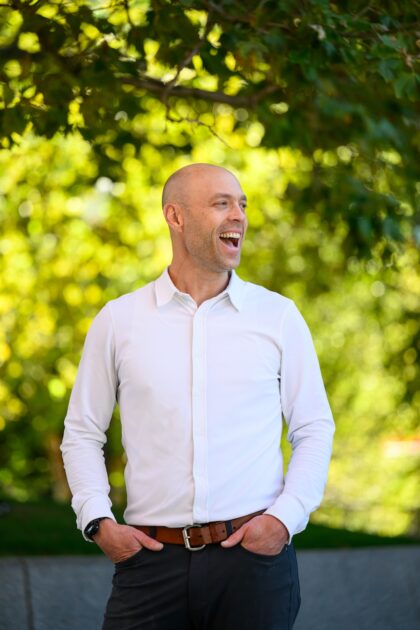
Hafensteiner began his college career at URochester as an undergraduate student in 1999 with designs on attending medical school after graduation. Those career aspirations would change after taking an organic chemistry class with Jack Kampmeier.
“I loved the way he taught,” Hafensteiner says, adding that Kampmeier — a professor emeritus of chemistry and former University dean who died in 2011—skillfully explained why the fundamentals of organic chemistry worked as they did, and how principles were interconnected.
“It was so satisfying to me as a student. It was the first time my job wasn’t just memorizing. I had to work hard to be good at that class. But it was effort that translated into understanding. And when I understood it, I could apply it.”
Like his former teacher, Hafensteiner’s approach to instructing is to share “the why” with his students. Nothing makes him happier than seeing the light-bulb moment when a student grasps a concept, especially during his group office hours—his favorite part of his job.
Colleagues praise his commitment to helping students succeed.
“Despite teaching courses that many students initially view as among the most challenging requirements in the curriculum, he creates a learning environment that is both rigorous and supportive,” says Ellen Matson, the Marshall D. Gates, Jr. Professor of Chemistry. “His classroom presence is engaging and approachable, and he fosters a culture in which students feel comfortable asking questions, seeking help, and actively participating in their own learning.”
Between chalk and a hard place
A framed poster in Hafensteiner’s office features an image of him smiling while gazing at the loaf-of-bread-sized eraser as he cradles it in his arms. The photo caption reads: My emotional support eraser.
“I get bent out of shape when I can’t find that thing,” he says.
That eraser, and the chalk that goes with it, is a critical component of his instruction and ability to connect with students.
“I teach with chalk because I can pace a lecture much more effectively than when using slides,” says Hafensteiner, who uses three large chalkboards in his lecture hall. “And if I am drawing on the board, I am close to the speed at which students are drawing in their notebooks as they are taking notes.”
Erasing the chalkboard provides an additional benefit: a pause in which to ask, “What questions do you have?” It helps him spot areas where students may be struggling, and he uses that information to structure future lectures.
He’s also not above filling the respite with a story about his kids, or his latest musical obsession, in the hopes of “eroding the ‘sage on the stage’ stereotype and letting students see me as the quirky, normal human I am.”
But student success is what drives Hafensteiner, and at the start of every school year, he shares with them a simple but important message.
“I try to say something along the lines of ‘this class is you and me against the book… we’re here together to try to figure this out.’”
What URochester students say about Ben Hafensteiner
“In a lecture hall filled with around 300 students, Dr. H managed to make every student feel like they were receiving a private lesson. His lectures were filled with simplified, paced explanations and a genuine desire to clear any confusion students may have. He would leave no question unanswered, offering every opportunity to listen and clarify in a way that kept the class running smoothly.”
—Yasmin Soufan ’28, biology major“Having the opportunity to learn from Dr. H as both a student and a workshop leader has made a significant difference in my academic journey, for which I am deeply grateful.”
—Penelope Chen ’27, biological sciences major“Dr. H made me want to teach. Not just to explain content, but to truly teach. To help students feel capable, to make difficult ideas approachable, and to create the kind of learning environment where people leave believing more in themselves than they did when they entered.”
—Grace McInerney ’28, clinical and traditional sciences major