A new partnership between the Eastman School of Music and Rochester’s Monroe County Jail explores what can happen when people are given the chance not just to listen to music but to create it themselves.
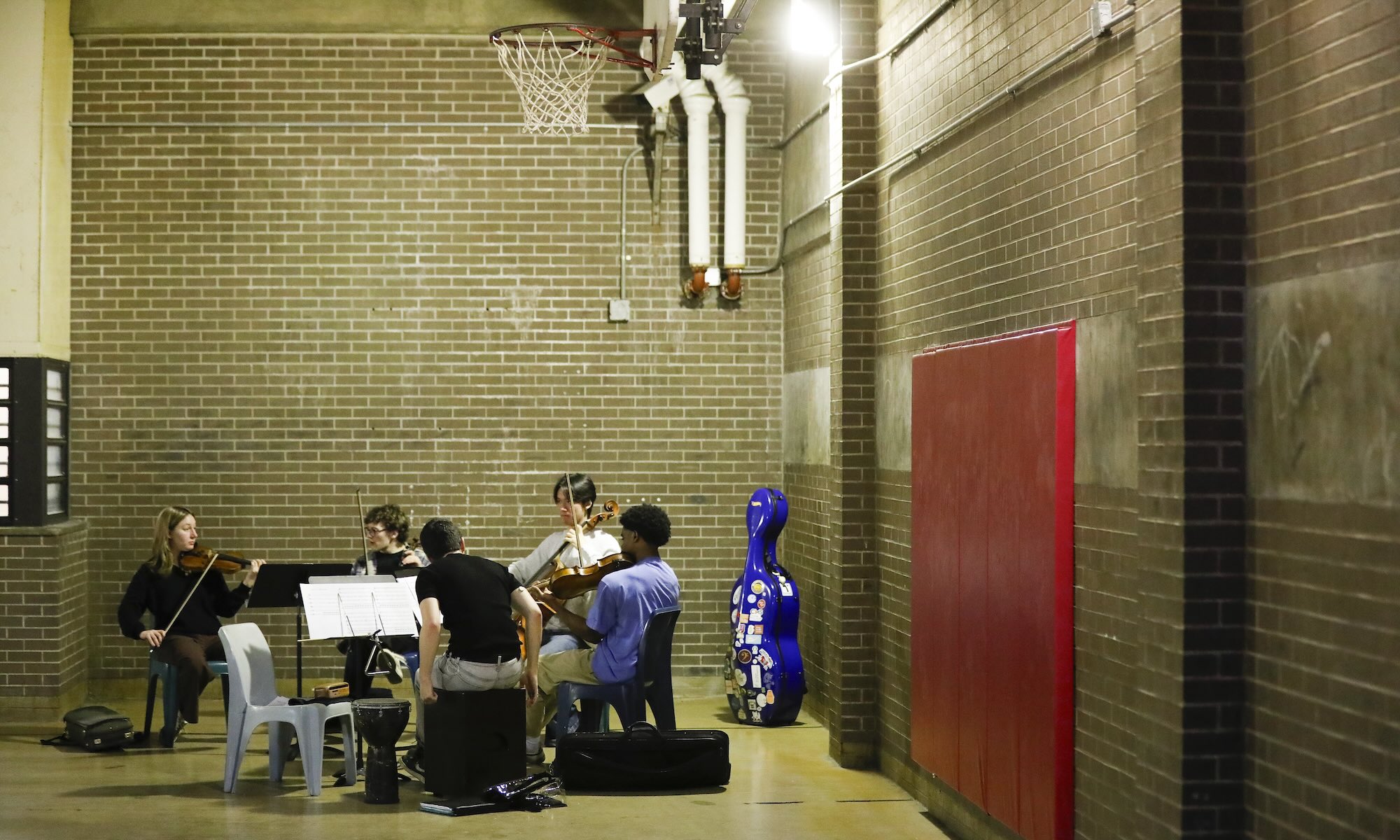
The decommissioned gymnasium at the Monroe County Jail—a massive concrete facility one block west of the Genesee River in downtown Rochester—is not designed for chamber music. Fluorescent lights flatten the brown brick walls. Exposed pipes crisscross the ceiling. A basketball hoop hangs over a scuffed floor.
But on a warm spring morning in April, plastic chairs scraped against the linoleum as a student string quartet and percussionist from the University of Rochester’s Eastman School of Music unpacked their instruments: violins, viola, cello, triangle, cajón, woodblock, and doumbek.
The cellist tested a scale. The percussionist tapped the triangle. A bright metallic ping ricocheted through the room. Laughing, the violinists adjusted their music stands. The musicians were warming up, but they were also waiting.
Down the hall, a corrections officer was escorting Micah (whose full name, like those of the other incarcerated individuals, is being withheld to protect his privacy) from a classroom in the drug rehabilitation unit. Together, they passed a security desk and institutional walls the color of tapioca, only occasionally brightened by letter-size printouts of motivational sayings. One read, “You can’t change the past, but you can write your future!” Another: “Smile and laugh as often as you can! It’s good for the soul.”
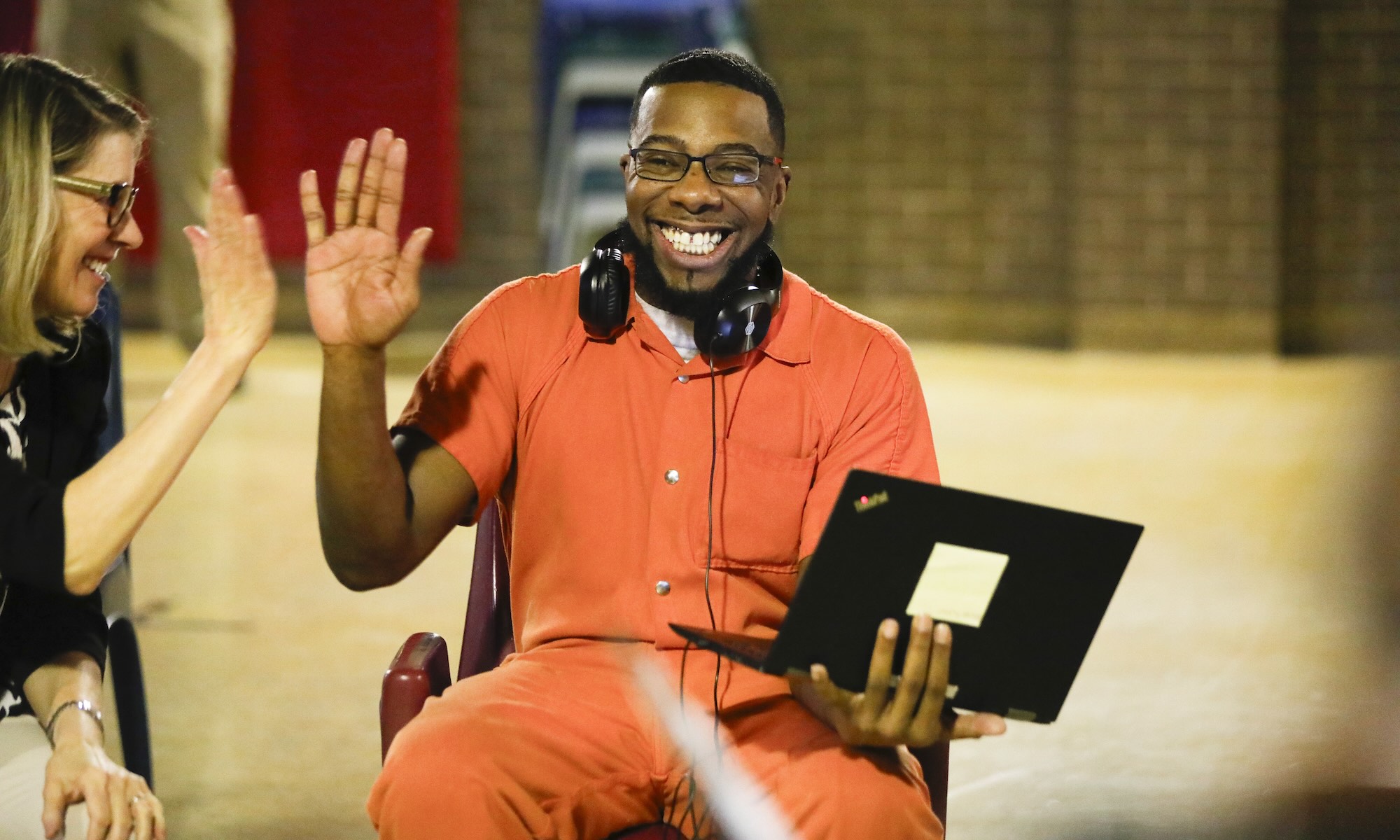
Micah seemed to have taken that latter advice to heart. Tall and athletic, with closely cropped hair, rectangular glasses trimmed in red, and a neatly kept beard, he entered the gym grinning easily, revealing the gap between his front teeth. He picked up a laptop from one of the chairs and sat down.
Elinor Freer, an associate professor of piano and chamber music at Eastman, leaned over his shoulder. Colored lines stretched across the screen in shades of blue, green, and orange. They resembled a child’s drawing more than a musical score. But they were music. Micah’s music.
Micah had been revising the piece, experimenting with rhythm, melody, pacing, and texture. Now, for the first time, he would hear it performed live by the Eastman students.
Israel Anselme ’27E, Felix Harkness ’27E, Aiden Hughes ’27, ’27E, Amelia Posner-Hess ’26E, and Elin Schlichting ’25E (MM) raised their instruments. Freer nodded. The lights flickered. The opening phrases emerged cautiously before gathering momentum. A triangle flashed above the strings. The music slowed, then accelerated, circling back toward its opening ideas.
Freer listened intently as Micah nodded, almost imperceptibly. “I think your plan to bring the opening back at the end and come full circle is good,” she said as they evaluated what they heard. “Yeah, just like life,” Micah answered. “Now I need to finish it.”
Later, as the musicians began another run-through, Micah rocked gently with the rhythm, unable to suppress his awe. “I wrote this,” he said, more to himself than anyone else.
“Music has always been a healing force for those who listen to it as well as those who compose it.”
Finding their rhythm
A month earlier, Micah had never written a piece of music. Neither had four other men from the jail’s drug rehabilitation program. Twice a week, they opened their laptops and met with Freer and the Eastman students not simply to listen to music but to create it.
Working side by side in sessions they dubbed “Music Mondays” and “Music Fridays,” the incarcerated students sketched rhythms, debated tempos, revised melodies, discarded ideas, argued over endings, and slowly assembled original compositions for string quartet and percussion using Hyperscore, an intuitive visual composing program developed at the Massachusetts Institute of Technology’s Media Lab.
The pilot for an Eastman course called Breaking Barriers grew from a deceptively simple question: What happens if music education inside a jail becomes something more than a performance?
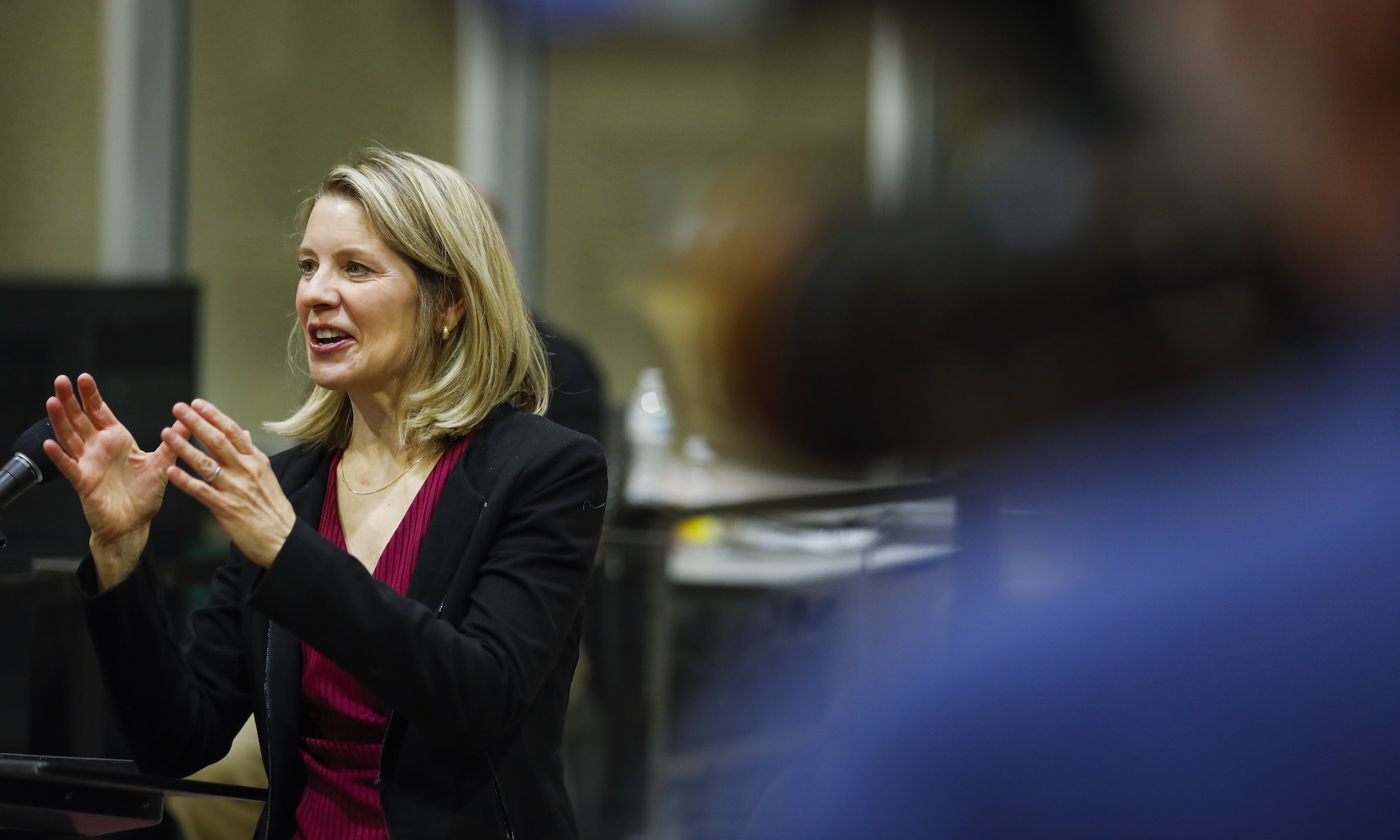
Freer had spent several years bringing Eastman musicians into places where classical music rarely ventures: homeless shelters, treatment centers, and the Monroe County Jail itself. Those encounters, part of an outreach initiative called ROC City Concerts, often produced emotional reactions from listeners. But they ended the same way every time. The musicians packed their instruments, while the audience stayed behind.
Then Joel Yager, the director of drug and alcohol rehabilitation for the Monroe County Sheriff’s Office, posed a different challenge. The incarcerated men he worked with weren’t simply asking to hear music anymore. They wanted to learn how to make it.
For Yager, that shift—from listening to creating—was central to the program’s potential. “Music has always been a healing force for those who listen to it as well as those who compose it,” he says. “This program created a format for participants to tell their story through music. Nothing could be more impactful or therapeutic.”
Freer also believed that the process of composition offered something performance alone could not. To compose is to make choices, to revise, to collaborate, to pivot, to stay with something long enough to finish it. Those skills matter not only in music but also outside it.
“The idea behind ROC City Concerts was to use music to heal, uplift, and foster human connection,” Freer says. “But this pilot lets us share music’s transformative powers in an even more concentrated way by teaching and practicing life skills through the process of composition.”
She began the incarcerated students’ composition study by looking at rhythm. “One thing that inspires composers is everyday sounds,” Freer told them.
Together, they listened for the rhythms of the rehabilitation unit: washing machines chugging in the distance, doors clanging open and shut, keys jangling on officers’ belts, voices overlapping in the halls. The students spent their first few sessions learning how to copy and then graphically notate the sounds, eventually layering and then looping them. Hyperscore allowed them to draw the rhythms as colored lines rather than learn traditional notation, which can take years to master.
From there, the focus shifted to making melodies. Listening to examples ranging from Beethoven to Rihanna to Bruno Mars, students tried their hand at composing short musical motifs and then developing them. They sketched these short ideas—bits of rhythm and scraps of melody—on their laptops, then worked week by week with Freer to develop them into pieces for strings and percussion. As the class progressed, they learned about elements of musical form, timbre, range, dynamics, and other sophisticated concepts.
“The beauty of Hyperscore is that it uses a very low entry point for students of any age to learn about the basic elements of music and to then compose a fairly sophisticated piece of music,” Freer says.
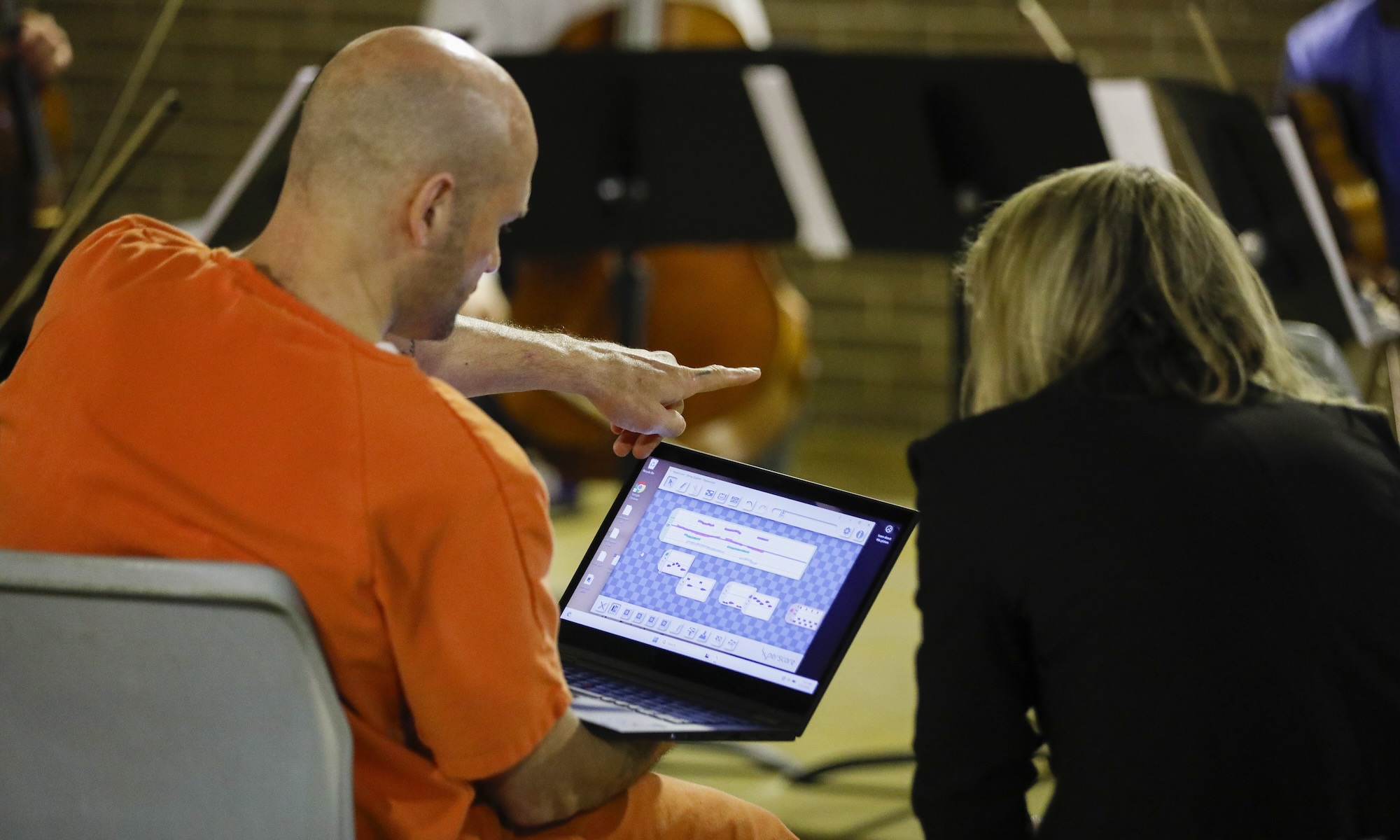
As the Eastman students tried out the composers’ ideas, Freer moved among the groups asking questions rather than prescribing answers: What did they want a section to feel like? Where should the energy change? Should a passage sound smooth and mellow—or “caffeinated and manic”? The musicians might play the same phrase several ways until the composer heard the version that felt right.
On workshop day, when the string quartet and percussionist performed the full works in progress for the first time, Dan carried himself with the assurance of someone accustomed to listening closely. Bald, with a neat white beard and vivid blue eyes, he leaned forward with his laptop balanced across his knees.
As the musicians rehearsed his composition, he frowned slightly. When something didn’t sound the way he anticipated, he raised a hand and asked questions. His eyes moved from the screen to the musicians as he described the sound he was chasing. Not louder or faster, exactly, but different. The musicians conferred, presented a couple of alternatives, and then played it again. Dan responded, “Yeah, that’s it!”
Damien listened first and spoke second. Wearing oversized headphones, he studied the primary colors of his composition before quietly explaining the effect he wanted to create. “I like catching people off-guard,” he said, with a sheepish expression. A few moments later, the quartet arrived at one of those unexpected turns, and Damien leaned forward and watched the musicians almost as carefully as he listened to the music itself.
Striking a chord
For decades, correctional facilities across the United States have experimented with arts education, from theater productions and creative writing workshops to painting classes, poetry circles, and prison choirs. Researchers have found that these programs can foster self-expression, improve emotional regulation, strengthen communication skills, and encourage participants to see themselves in ways not defined solely by their convictions.
In New York, Rehabilitation Through the Arts has spent three decades offering arts programs in correctional facilities that span music, theater, dance, visual art, poetry, creative writing, and other forms. It reports that fewer than 3 percent of its participants return to prison within three years, compared with a national recidivism rate of more than 60 percent. Participants also often pursue higher education after joining the program, and hundreds of alumni have gone on to careers in social work, advocacy, academia, entrepreneurship, and other fields through which they give back to their communities.
John Blackshear, a forensic psychologist and URochester’s vice president for University student life, has spent decades working with people accused or convicted of serious crimes. In discussing that work, he points to the importance of what he calls “restorative experiences”—relationships and experiences that can help people recover a sense of their own value.
“Music can help people reconnect with something they’ve lost.”
At URochester, efforts to create educational opportunities for incarcerated individuals extend well beyond music. Since 2015, the Rochester Education Justice Initiative (REJI) has provided higher-education opportunities for incarcerated and formerly incarcerated students in western New York. Today, REJI administers associate degree programs in partnership with SUNY Genesee Community College at Attica, Groveland, and Wyoming correctional facilities as well as a URochester bachelor’s degree program at Attica. It also creates pathways for formerly incarcerated students to continue their education after release.
Freer, for her part, is careful not to overstate what a pilot program like the one she designed can accomplish. “It would be unrealistic to say four weeks changes a person’s life,” she says. “But music can help people reconnect with something they’ve lost. For someone who has lost their sense of self and their sense of humanity, music can help them begin to recover that.”
It can also offer a different way to experience learning. Composing an original musical work demands listening, collaboration, persistence, and trust—skills and qualities not often exercised in a correctional facility.
ROC City Concerts had been largely one-directional: Eastman students and faculty performed for incarcerated audiences. Breaking Barriers instead makes the Eastman students and Monroe County Jail participants a team, working together to create something new.
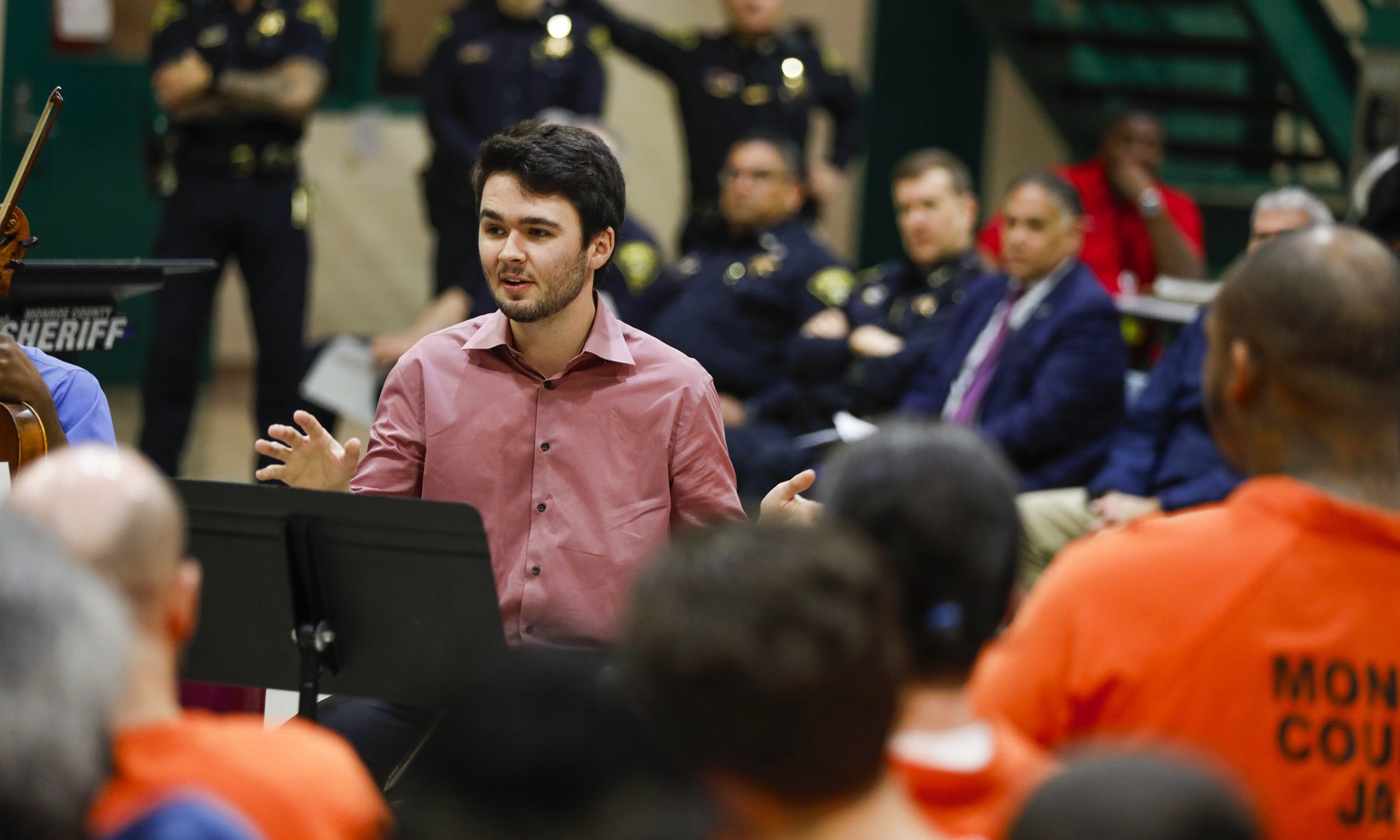
For the Eastman students, that collaboration calls for more than musical skills. Freer says it also requires social and communication skills, an awareness of social justice issues and the lives of incarcerated individuals, and the use of specialized software and technology—not to mention “a large dose of courage and vulnerability.”
“I still think our number one job as faculty is to get our students playing, composing, teaching, and writing at the highest levels,” she says. “But at some point, we should give students the opportunity to wonder if it might be about something bigger than that. And my hope is that this course will provide that opportunity.”
Freer saw that broader exchange take shape after one class, when the two groups stood at their respective elevator banks, separated by bars. One of the participants, Frank, had suggested that the Eastman students listen to a violin line in a particular rap song for melodic inspiration. “Uh, I don’t think she should listen to that,” Schlichting said, pointing at Freer.
“Oh, I know,” Frank said, grinning. “Don’t listen to the lyrics. Especially in front of your professor! Just the music.” Laughter ensued on both sides of the bars.
Something old, something new
As concert day approached, the Eastman students admitted to feeling unusually nervous. “We wanted to honor what they’d written,” says Posner-Hess, a violinist from Chapel Hill, North Carolina. “It wasn’t our music anymore.”
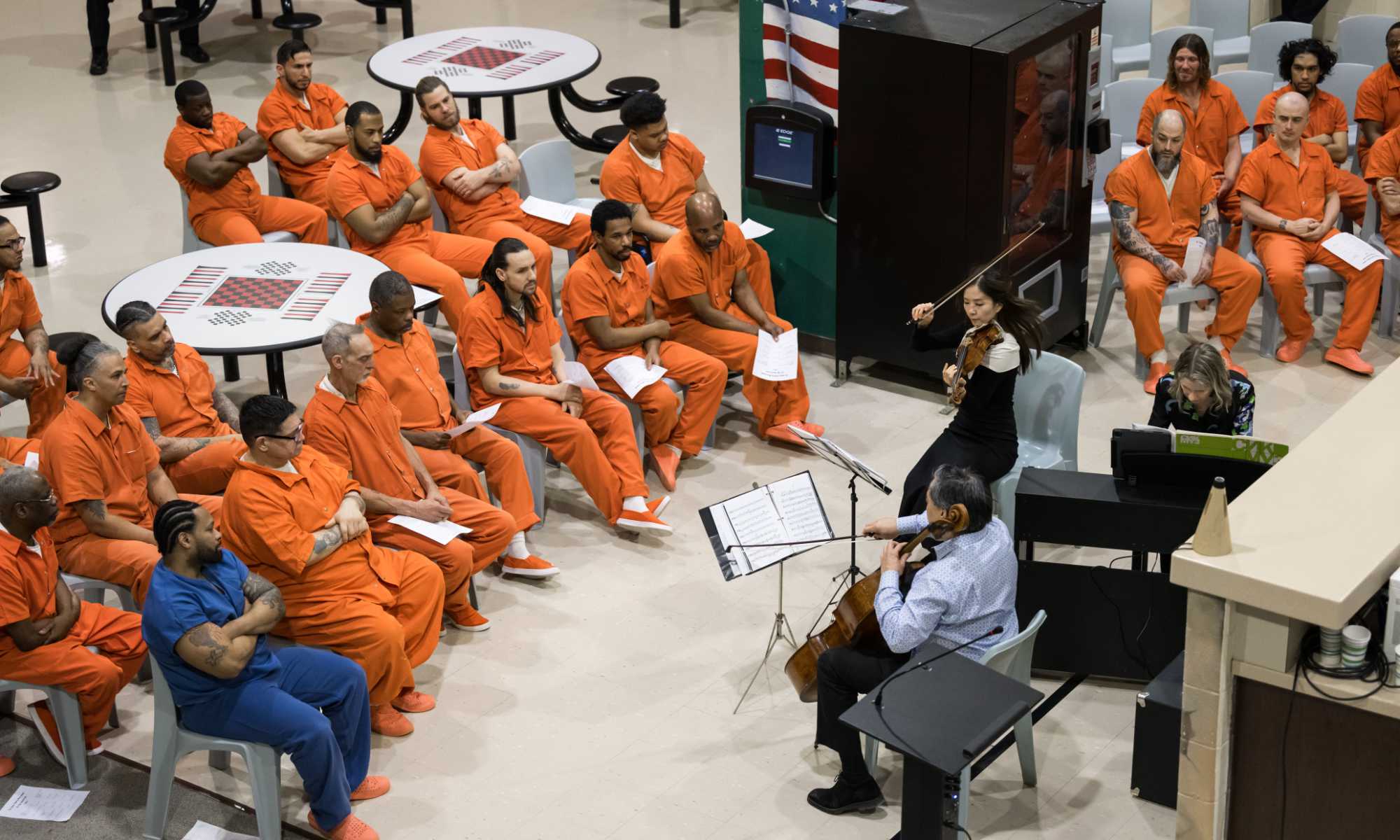
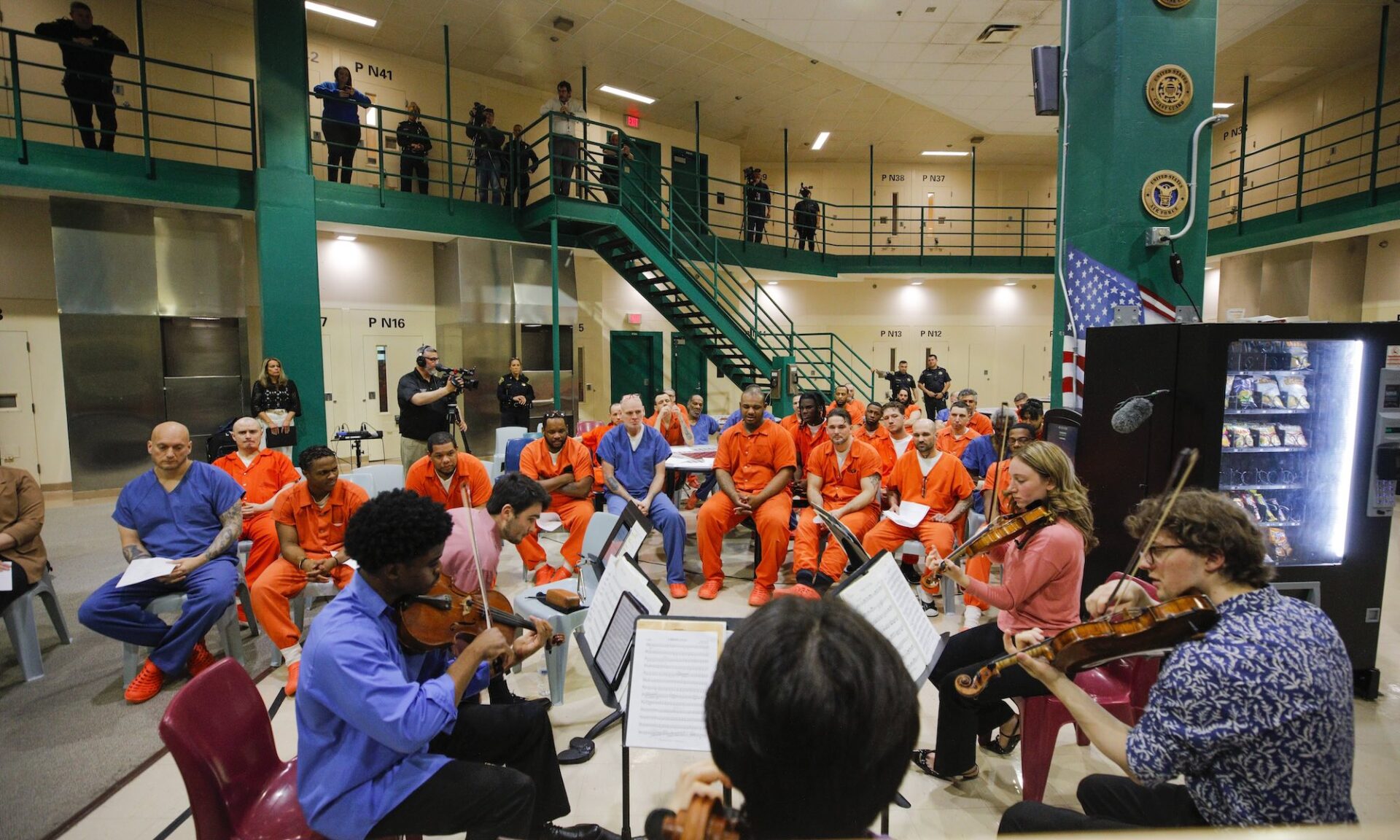
The Breaking Barriers finale, held on a Friday morning in May, unfolded not in the gymnasium where the program had begun but in the atrium inside the drug rehabilitation unit—a bright, open gathering space lined by two tiers of cells. In the center stood vending machines stocked with colorful packages of instant ramen. Scattered across the room were tables whose checkerboards were printed directly into the laminate.
One by one, the cell doors opened. Men dressed in jail-issued tangerine scrubs filtered into the atrium, greeting one another and lingering briefly along the railings before finding seats. Conversation drifted through the room until the Eastman students settled in with their instruments.
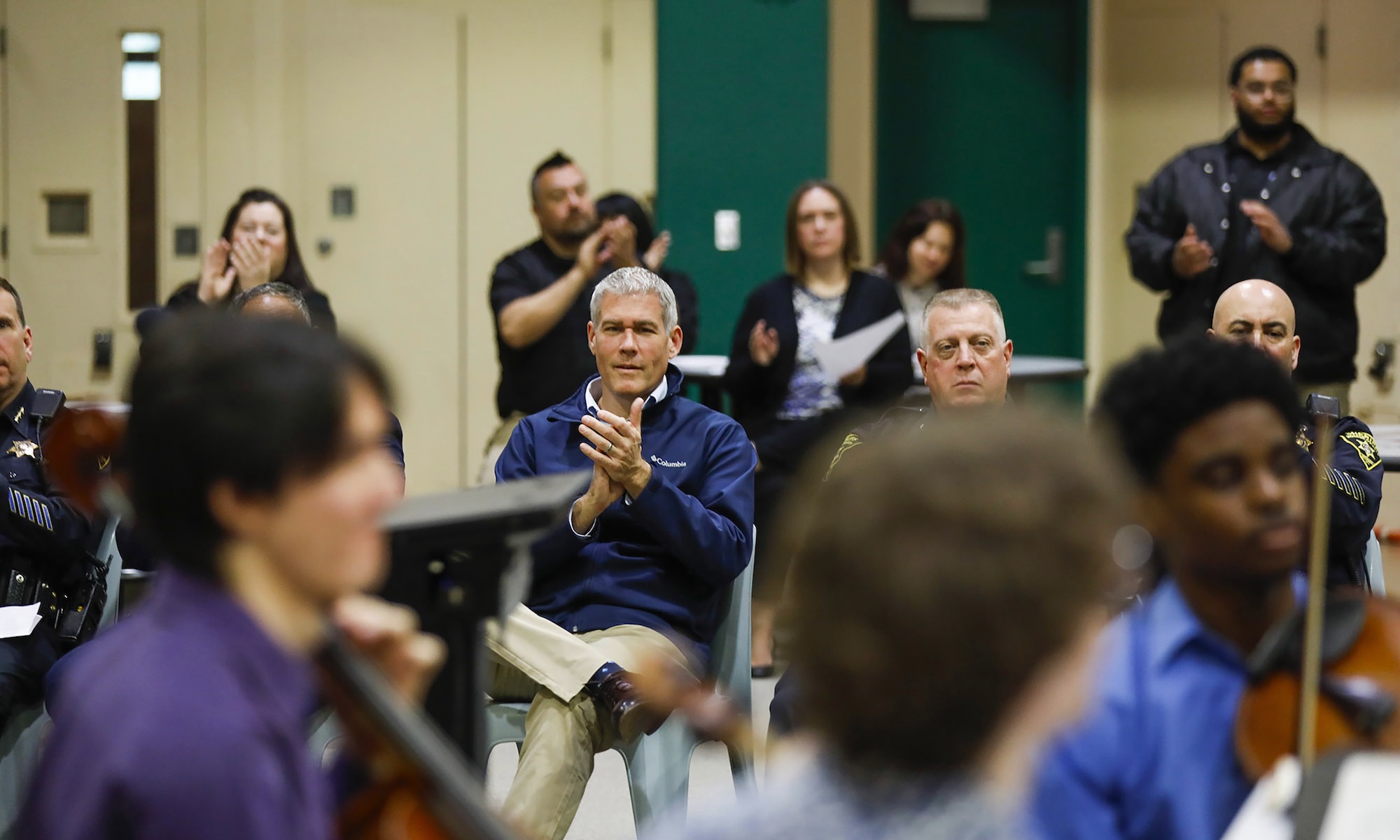
Freer welcomed the audience—about 30 men seated on plastic chairs, with jail staff along the edges of the atrium and on the walkways above—and introduced the morning’s program: “Something Old, Something New.” It would pair established repertoire with original works written over the previous month by men living in the jail.
First came “something old”: the quartet and Hughes performed works by Astor Piazzolla, Scott Joplin, Mozart, and Camille Saint-Saëns. Then came the “something new.”
“At each and every class, these new composers brought something of themselves,” Freer told the audience. “It’s not really about the music. It’s about practicing life skills: making decisions, working collaboratively, seeing a project through to the end. They learned from one another, and I learned even more from them.”
Each composition revealed a different musical voice. Josh dedicated his piece, “Breaking Through Barriers,” to “the new me.” Frank, who had spoken about addiction and how difficult it had once been to finish anything, described what it meant to complete something he could be proud of.
As the students played his piece, “Surrender,” Frank’s shoulders relaxed. “There was this gorgeous melody just floating around in Frank’s brain,” Freer told the audience, “and now we all get to hear it.” Frank broke into a smile, a dark curl falling across his forehead, as applause echoed off concrete walls and steel railings.
Damien’s composition, “Magic Dame,” contained one of the concert’s surprises: a deliberate silence that fooled the audience into applauding before the piece was over. Damien grinned as the musicians resumed.
When it was Micah’s turn, he thanked the Eastman students “for bringing my ideas to life.” Freer described his piece, “Plaza North Score,” as “warm and vibrant with lush strings,” a style of writing that its composer did particularly well. When it ended, Micah stood, grinning widely, as the audience and his fellow participants cheered.
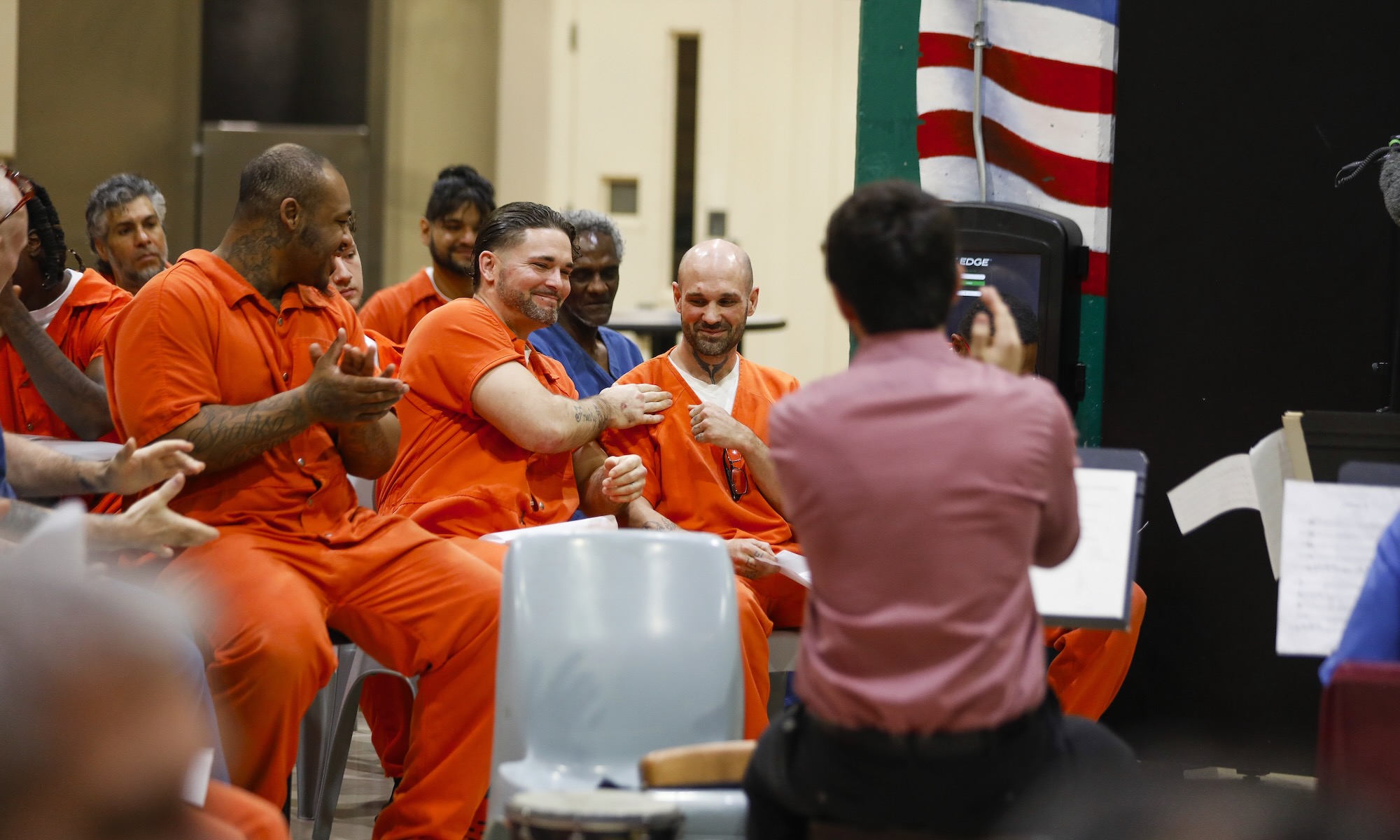
The concert closed with Eastman violist Anselme encouraging the audience to imagine a better place before the quartet performed a moving rendition of “Somewhere” from West Side Story. Then the musicians gathered for group photos, and the composers returned to their cells. Frank lingered by the narrow glass pane in his door, waving.
As the last of the music faded from the jail, participants on both sides reflected on what the experience had meant to them. Josh said it made him feel “important and recognized.” Frank said it had given him “a confidence I never had.” For Schlichting, a violinist, it was “probably the most meaningful project I have ever done at Eastman.” For Micah, who said the process had given him newfound confidence, the experience reinforced a simple idea: “Music brings people together.”
Freer is leading another four-week pilot this fall with incarcerated women and a new group of Eastman students. In spring 2027, Breaking Barriers will become a for-credit course in Eastman’s chamber music department.
“Experiences like this provide such important opportunities to harness the power of the arts to help people reconnect with their humanity and succeed once they’re on the outside,” Freer says. “It’s a great privilege to show them how to use music as part of that journey.”
This story appears in the fall 2026 issue of Rochester Review, the magazine of the University of Rochester.