
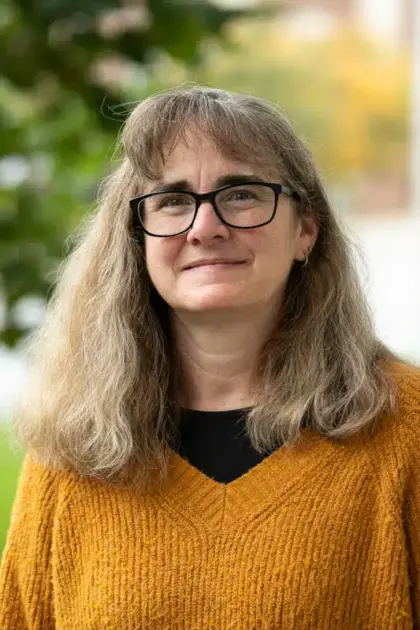
Elaine Sia, URochester’s inaugural leader for academic excellence, discusses teamwork, curriculum, and value.
A University of Rochester degree does not come easy. Even the brightest, most dedicated students can veer off track or find themselves dangerously overwhelmed. Consider the following hypothetical URochester students:
- Student A, a first-year, is shocked—and devastated—by their poor performance on a heavily weighted mid-term exam.
- Student B, a sophomore, has spent two semesters exploring a variety of disciplines, despite having declared a major.
- Student C, a junior, is exhausted and increasingly anxious about managing a 20-credit schedule.
Each circumstance could needlessly lead to the student transferring or not graduating. However, with the right support systems and guardrails in place, these situations could largely be avoided altogether. Providing the framework that ensures URochester students’ success is among the responsibilities of URochester’s inaugural senior vice provost for academic excellence, Elaine Sia.
Sia, a biology professor, is focused on building and leveraging partnerships across schools and units. Working closely with the faculty, deans, and other senior leadership, she aims to strengthen the quality and impact of URochester’s academic programs, research, and student success initiatives.
Established by Provost Nicole Sampson in 2025, the new position carries a portfolio that complements the work of John Blackshear, the vice president for student life. Together, Sia and Blackshear give the University a two-pronged approach to improving students’ competency development, academic outcomes, sense of connection, and wellness, as outlined in Boundless Possibility, the 2030 strategic plan.
January 1 marked one year since Sia was appointed. She joined Joe Testani, the deputy to University President Sarah Mangelsdorf, for a Leadership Conversations webinar to discuss her first year in the role and how she will continue to facilitate an exceptional learning environment.
Here are five takeaways.
Teamwork makes the academic dream work.
At URochester, the shorthand for this concept is “One University,” a collaborative philosophy that undergirds every aspect of the institution’s work, including academic excellence. Sia aims for her team to serve not only as a bridge between student-facing systems (e.g., advising services and the Learning Center) and faculty-facing systems (e.g., the Teaching Center). By cultivating connections among these various offices, the University opens itself to innovative faculty support, more flexible learning pathways, and the creation of more interdisciplinary degrees.
And because this role is University-wide rather than specific to any one school, Sia is working not only to bridge systems, but also to establish a network that facilitates efficiencies and removes barriers.
Having been a faculty member since 2000, Sia is especially well-suited to serve as connective tissue between learning and teaching. However, she’s not looking to make decisions on things like curriculum and policy in a vacuum.
“It’s really helpful when people want to get involved and share their experience and expertise.”
Sia said there’s a big role for faculty to play in this space on committees and working groups, and she encouraged their direct input and feedback, a point she punctuated by sharing her office hours.
Additionally, Sia noted that she and Blackshear have spoken at length about building stronger structural connections between their teams—that could take the form of committees or scheduled check-ins. An example of success here is knowing exactly whom to contact when a student is in trouble.
Sia also discussed her team’s partnership with student life on a new first-year experience course. Sia and her student life partners are putting together a program that creates an established community connecting first-year students with the offices and people who help them to feel comfortable, welcome, and confident that they have what they need to succeed, starting on day one.
Retention and graduation rates are indicators, not goals.
These are numbers Sia thinks about in her sleep, particularly in terms of what the University is getting right and wrong. For example, the reasons a student transfers to a different school tend to be very personal, yet there are also big common factors, such as academic struggles, a lack of a sense of belonging, or not seeing a return on their investments of time and money.
At a time when many families are struggling financially, the value of a URochester education needs to be clear to undergraduate students, many of whom are considering competitor schools and those in the SUNY system.
“We think they’ll know they’re learning all of these wonderful skills as part of a liberal arts education. But they don’t always know.”
Sia wants to bake the value propositions into the curriculum and make them more apparent in the learning process. Another approach to retention is treating the symptom where it lives; here, Sia looks for faculty to provide answers to questions such as:
- Where are students struggling?
- Can we look at curricular modifications or fixes that will help students complete programs more effectively or faster?
- What support can we provide to nurture student success?
- How do we conduct early interventions to get students back on track?
Some interventions might include an advisor helping a student determine whether they have chosen the right path and, if necessary, course-correct.
Sia noted that one of the things she plans to focus on in the coming year is how the University can shine a light on and celebrate the individuals and teams who go beyond showing up and teaching by developing programs and resources that can serve as best practices.
Experiential learning is learning by doing—and more.
Experiential learning is one indicator of success for the strategic plan’s education goal. URochester aims to ensure that all students have at least two high-impact experiences—such as research, internships, mentorships, or community-engaged learning—that develop practical competencies. Sia noted that she came into this role with great confidence that URochester students are already averaging more than two. (Some of that confidence came from being the mother of two URochester alumni.)
The challenge for Sia and her team is building the experiential learning infrastructure that makes “bookkeeping” easier and clearer. To that end, Sia acknowledged the work done to define “experiential learning” before her appointment.
“All we want is to be able say what it means to do experiential learning here, so students can go to employers or grads schools and talk about what they gained from their experiences.”
And here is what they’re saying:
Experiential learning is a dynamic, multi-sensory teaching and learning process where individuals co-design and navigate unique challenges through cycles of trial and error. It reaches beyond traditional lecture and exam formats, blending planned and unplanned elements, encouraging experimentation, embracing uncertainty, and relying upon continuous reflection and adaptation. In effect, participants are “learning by doing.”
That is only one part of how Sia’s team is currently talking about experiential learning. Their comprehensive “definition” includes additional principles: reflection and feedback, an authentic audience, and holistic and transformative growth.
The blandest work is the most critical.
Odds are low that many who attended the webinar did so to hear Sia discuss the University’s adherence to rules and regulations. However, the work she does in this area is critical because it ensures that URochester can continue to operate as a university and confer industry-recognized degrees.
Early on, Sia briefly touched on accreditation and compliance, highlighting the need to be thoughtful and to plan carefully for how the University will define success for new programs. She noted that thinking has been balanced by several conversations with program directors and department chairs who have creative ideas for new opportunities.
“We are at a moment when people are really thinking about what our students need and what we can give them in this age of AI that they can only get here.”
Regarding accreditation, every eight years, URochester must reaffirm its institutional accreditation with the Middle States Commission on Higher Education, which was last done in 2024. Accreditation ensures URochester’s students have access to federal financial aid, researchers have access to federal funding, and the institution’s degrees have credibility.
Sia touched on the Rochester Curriculum and how undergraduate clusters can pose challenges regarding New York State Education Department requirements. URochester students’ freedom to explore their interests isn’t unlimited. Ultimately, the University must ensure that state-defined standards for knowledge in required domains are being met.
Be vocal. Be engaged. Be enthusiastic.
After a year of analyzing URochester’s academic landscape and reviewing data, Testani asked what’s on the horizon from a tactical perspective.
Sia offered that her team is working to reduce silos and improve coordination across units, departments, and programs. She specifically called out student advising as an area where she’s looking to develop stronger connections. She would like to see more people reach out to advisors, especially in programs and departments with many students and very specific requirements. In general, her primary tactic is openness and a readiness to meet with any and all faculty and staff looking to solve problems.
Sia also shared a conversation she had with some of her team members. They were discussing the state of higher education and how it has created a time of austerity and, in some ways, a crisis for institutions across the country. It unlocked a deeper issue.
“Something happened to us all during the pandemic that I think has fragmented our community, and in some ways, put a damper on our enthusiasm for our shared endeavor.”
Faculty come to the University for the scholarship, but the students come for the educationa nd experience. They come to be taught and inspired by experts in their fields in a hands-on setting. Sia explained that these interactions have meaningful and lasting effects. That’s why, for her, student-facing spaces need to be a priority. One person or one thoughtful, 10-minute conversation can make an enormous difference in a student’s path, outlook, or connection to URochester.
“I think that’s the key,” Sia said. “We should focus on experiences that make all of our students—master’s, undergrads, PhDs, all of them—feel like this is a place where they can thrive. We need to remember how to love what we do.”