
President Sarah Mangelsdorf reflects on Boundless Possibility’s progress and its continued evolution with the University.
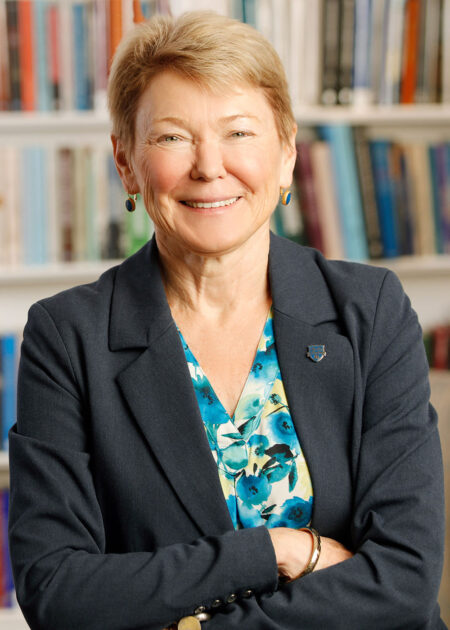
Before she was the president of the University of Rochester, before she was provost at the University of Wisconsin–Madison, before she was a dean at the Weinberg College of Arts and Sciences at Northwestern University or the College of Liberal Arts and Sciences at the University of Illinois at Urbana–Champaign, Sarah Mangelsdorf was a professor of psychology.
As a professor, Mangelsdorf frequently had to disabuse people of the belief that commencement marked the beginning of her summer vacation. It wasn’t true for her then (that’s when she did all her academic writing), and it isn’t true now as URochester’s president.
For starters, the University’s fiscal year ends June 30, so even after the pomp and circumstance of graduation fades, more than a month’s worth of financial work remains. Plus, research labs run year-round. The hospitals don’t close. In many ways, URochester administration is a 365-day job.
But the summer rhythm is different—especially since the University is in the middle of its $1.75 billion comprehensive fundraising and engagement initiative, For Ever Better: The Campaign for the University of Rochester. Over the last three months, Mangelsdorf has attended several alumni events across the country as part of an effort to raise critical University funds and to cultivate a deeper connection with the URochester community.
For Ever Better’s aspirations are rooted in URochester’s 2030 strategic plan Boundless Possibility, which will hit its midpoint early next year. In a Leadership Conversation, Mangelsdorf shared her perspective on the strategic plan’s progress and why she still believes in its objectives as the University adapts to challenges she and other planners couldn’t have anticipated.
Here are five takeaways.
Tough times don’t last; tough universities do.
To say these are difficult days for higher education would be a profound understatement. URochester and other universities across the country face heightened financial pressures, compounded by continued uncertainty around federal research funding. Plus, an enrollment cliff has created a new, serious existential challenge. These and other issues have forced institutions—many wealthier than URochester—to make hard staffing and investment decisions.
Mangelsdorf didn’t minimize the worrying state of higher education and the University’s place in it. But she did put it in perspective.
“There were times that were more stressful and harder on our institution, and we survived all of it. We’ll survive this.”
Last year, URochester celebrated its 175th anniversary. That period spans the Industrial Revolution, a civil war, two world wars, two global pandemics, a depression and recession of the “great” variety, the birth of the atomic and information ages, and enormous political and social change.
That rough historical catalog illustrates the president’s point, one that she is uniquely qualified to make, having guided URochester through the COVID-19 pandemic: the University has seen a lot of hard times and is still here.
Mangelsdorf offered the optimistic view that pandemics, depressions, recessions, and other forms of adversity are not permanent states.
URochester has some adversity advantages over peers.
The idea that the current headwinds won’t last is comforting, but only so much, given the effects they’re having on the University. Hiring has slowed. Graduate student funding is getting harder to come by.
Mangelsdorf acknowledged the financial squeeze that faculty and staff are feeling and the psychological toll it takes on the URochester community. People want to feel like they’re part of an institution that is vibrant and thriving, that it’s charging forward. The president believes the University is moving forward, just not as fast as its leaders would like. (See: headwinds.)
Mangelsdorf also pointed out that URochester is faring better than others. There are colleges and universities around the country that aren’t hiring anyone, faculty or staff.
Some of URochester’s distinctive features have positioned the University to weather the storm better than others.
One example is the University’s commitment and ability to engage freely in transdisciplinary research. In the early days of funding constraints, URochester committed $8.5 million to research centers poised to address some of humanity’s most pressing and complex challenges. URochester’s physical footprint feeds into this.
Mangelsdorf shared that when the Accreditation Board for Engineering and Technology (ABET) was most recently on campus, they were practically gushing that biomedical engineering students can simply walk across the street to do hands-on medical research. To understand why, look no further than two of the universities where Mangelsdorf previously served. Northwestern University’s medical center is 12 miles from its main campus. Although Wisconsin–Madison is one contiguous campus, it’s two miles wide, so the medical center isn’t exactly a walk across the street for everyone.
The River Campus’s proximity to the Health Sciences Campus can’t be overemphasized as a facilitator for transdisciplinary research and collaboration. Ophthalmologists can work with faculty in brain and cognitive sciences. Clinicians studying aging can work with biologists.
Obviously, none of this eliminates the financial and policy pressures URochester faces, but it does give the University assets to draw from as it confronts them.
Boundless Possibility has always been a living thing.
As Mangelsdorf wrapped her second semester as president, COVID-19 hit hard. Around that time, the Board of Trustees urged her to start building the 2030 strategic plan. The president recalled telling the board that her priorities were public health and the University’s fiscal solvency. She would turn to the strategic plan when there was more stability.
The pandemic backdrop matters because even when the president and others dug into the particulars of Boundless Possibility, the world and University felt different. That is to say, the plan they were creating reflected what was important then and would continue to matter for the foreseeable future.
“If strategic plans are really going to work, they have to be living documents. They’re not just static things you write and don’t pay any attention to as the world changes around you.”
Artificial intelligence came on at a similar speed and pervasiveness as COVID-19, but unlike the pandemic, it’s not going anywhere. Fortunately, the plan accounted for this—in a way.
Although AI has advanced faster than Mangelsdorf or any of the planners could have anticipated, Boundless Possibility’s structure allowed the University to adjust without abandoning its priorities. And URochester has answered by naming Mujdat Cetin, a professor of electrical and computer engineering, the inaugural associate vice president and vice provost for artificial intelligence and forming an AI Council led by Timothy McGeary, the Andrew H. and Janet Dayton Neilly Dean of the University of Rochester Libraries, and Kathleen Fear, the director of data core in the UR Health Lab.
Boundless Possibility also says nothing about STELLAR or NSF OPAL awards from the National Science Foundation (NSF). And yet, URochester is receiving $15 million over two years to launch the NSF STELLAR Engine and up to $13.7 million to support the final design phase for a world-leading, high-power laser facility. The strategic plan was always meant to create the conditions that enabled URochester to leverage its strengths—in this case, optics and lasers.
Some challenges are bigger than URochester.
Sometimes agility isn’t enough. Many of the forces reshaping higher education—from federal research funding to immigration policy—are beyond URochester’s control. For Mangelsdorf, the most concerning are the restrictions affecting the international community.
For decades, most international students in F-1 status and exchange visitors in J-1 status have generally been allowed to remain in the US for the “duration of status” (D/S). Basically, if a student is properly enrolled at URochester, they are legally allowed to be in the country for as long as it takes to complete their academic program. That’s important for PhD students, who might need five or more years.
In July, the Department of Homeland Security finalized a rule to replace D/S with fixed admission periods of up to four years for F-1 and J-1 visa holders, set to take effect September 15. Mangelsdorf shared the relief that a federal judge has temporarily blocked it.
Mangelsdorf lamented the amount of policy that seems to target international students and faculty because universities are a sort of “superpower” for our country. People from all over the world come here to study, and it’s mutually beneficial to a great degree.
“It’s very important that we link arms to fight the good fight for higher education.”
Citing “strength in numbers,” Mangelsdorf emphasized the increasing importance of collaboration and advocacy. She pointed to the Office of Government and Community Relations and participation in national organizations such as the Association of American Universities (AAU) and the Association of American Medical Colleges (AAMC). The president noted that banding together with the AAU and AAMC provides opportunities to respond to policies collectively and, in some cases, take joint legal action.
There are more than 10,000 reasons to be hopeful.
If Mangelsdorf wants to feel better about the future, all she has to do is walk through campus. Students give her hope for the future.
The president shared her love of fall when students arrive and return. Their belief in their ability to make the world a better place is as palpable as their energy and enthusiasm.
“I love their optimism. And the world doesn’t change if people are just bystanders and don’t really engage. And our students are not passive in this world.”
Mangelsdorf pointed to the activities fair as proof of the students’ ambition and said it not only inspires her, but also shows their interest in making a huge difference after graduation.
The president has also been buoyed by the faculty. At a time when faculty members could be voicing concerns about what the fiscal constraints mean for them, many have only expressed worry about students having the resources they need to succeed. “And that tells you something about our faculty,” Mangelsdorf said. “So, even in these really challenging times, there are lots of reasons to be optimistic and thankful.”