As the warmer months approach, the University of Rochester’s grounds are undergoing a quiet but meaningful transformation. Sustainability in lawn care, once seen as an optional enhancement, is now a central focus of the University Horticulture & Grounds department’s work.
Today, 60% of the University’s lawns are maintained organically, and Horticulture & Grounds is steadily progressing toward its ambitious goal: to convert 100% of campus lawns to organic or natural care by 2027.
Goals and impacts
The shift to organic care allows the development of healthy soil from natural products rather than synthetic and manufactured chemicals. “My initiative over the next couple of years is going to be soil testing, true lawn care. What can we actually do? What does it look like to go organic?” says John McIntyre, the manager of Horticulture & Grounds, whose team is leading this transition. The department oversees all outdoor spaces on University property, including the Medical Center, River Campus, and offsite properties like the Memorial Art Gallery and the Eastman School of Music.
As emphasized by McIntyre, soil testing forms the foundation of this effort. By understanding nutrient levels, soil structure, and biological activity, the department can develop management strategies that promote healthier grass without synthetic fertilizers or pesticides. The result is a more resilient landscape that needs fewer inputs and supports better long-term ecological health.
In addition to changing from synthetic to organic lawn care, the team is implementing simple but highly effective practices that naturally strengthen the campus lawns:
- Higher mowing heights: Increasing the mowing height helps retain moisture and shade out weeds, reducing the need for chemical control. This is especially evident on Eastman Quad, where stronger grass can better withstand heavy foot traffic.
- Soil maintenance: Regular aeration and overseeding performed twice a year encourages deeper root systems, improves soil health, and boosts turf density.
One goal of the overall initiative is to improve student life. McIntyre remarks that it makes him proud when Eastman Quad is so “full of people” using hammocks, playing frisbee, or picnicking. “We want students to be able to enjoy these areas, and we want to know that they’re enjoying them in a very [environmentally healthy] way.”
Other sustainability efforts around the University’s landscape
Transitioning to natural lawn care is just one more item on Horticulture & Grounds’ growing list of sustainability commitments.
The transition away from gas-powered equipment is well underway, with 65% of power tools now electric, including line trimmers, shears, and chainsaws. This reduces emissions, as well as local air and noise pollution. The department has also been trialing electric robotic lawn mowers this past fall to further reduce emissions.
Furthermore, Horticulture & Grounds practices comprehensive material stewardship.
“All leaves and vegetative material are composted, and all hardwood is repurposed locally into mulch,” says McIntyre. This prevents a large portion of the University’s organic yard waste from going to landfills.
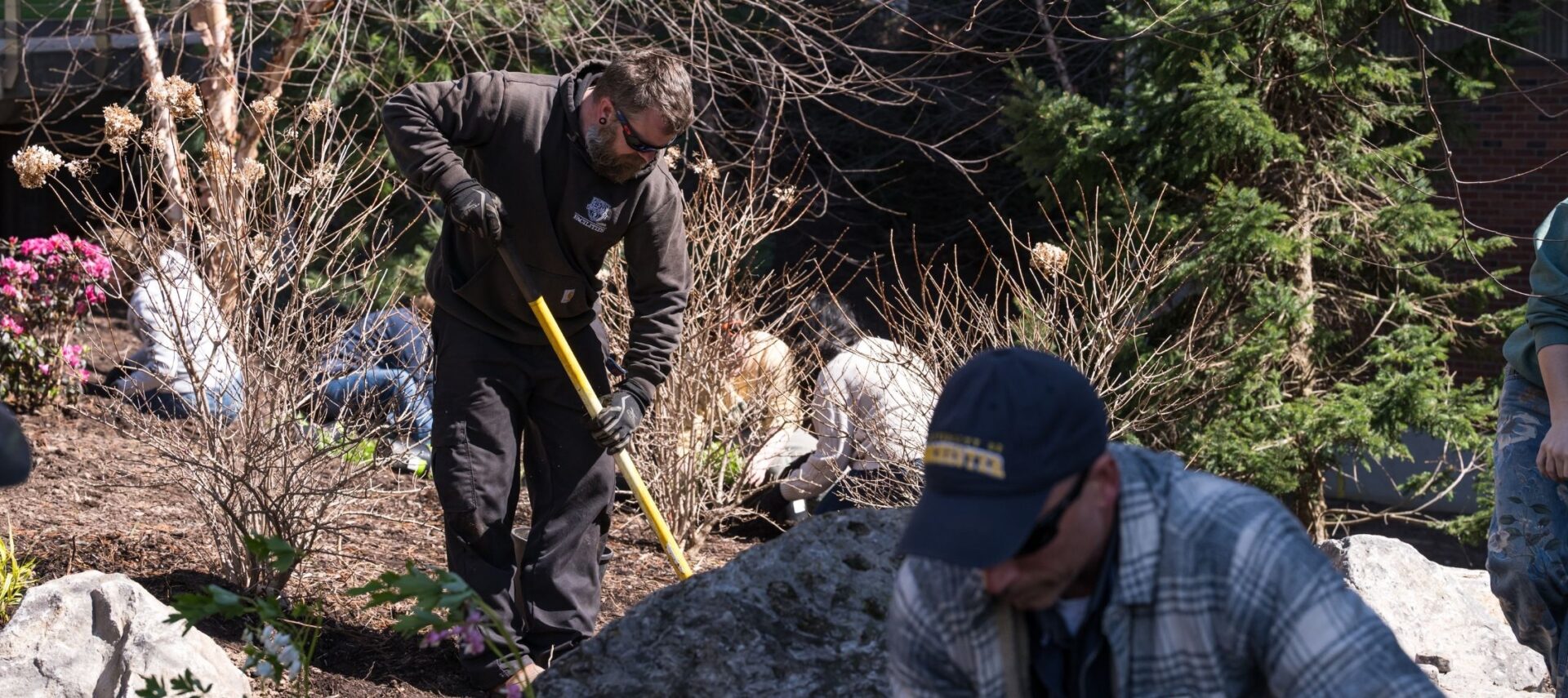
In the past few years, the department has also supported biodiversity in the University’s outdoor spaces. They have planted three pollinator gardens, two rain gardens, and changed 17 acres of lawn that was mowed weekly to a once-a-year cycle.
The University arboretum
The University of Rochester is a nationally recognized arboretum, featuring over 7,800 trees identified and mapped through an ArcGIS database. This system tracks the diameter and height of most trees, accounting for 212 different species across campus. Some of the most recognizable trees include:
- 12 northern red oaks (Quercus rubra) found lining Eastman Quad.
- The Goldenrain tree (Koelreuteria paniculata) located in the center of Wilson Quad.
Across the University’s campuses, care for the grounds has become care for the community itself. As students relax under the large oak trees of Eastman Quad, they’re part of a campus-wide effort to nurture both the landscape and the shared goal of a healthier, more sustainable community.
Written by Kylin Roberts, ‘26