Every year, the United States wastes an estimated 30-40% of its food supply, according to the U.S. Department of Agriculture. This loss accumulates across each stage of the food production and distribution process from factors like spoilage, improper storage or transportation, exposure to outside factors like insects or mold, or overbuying. Beyond the environmental toll of wasted land, water, energy, and the operational toll of wasted money and time, this often also represents a missed opportunity to feed people in need. Recognizing this challenge, the University of Rochester’s Campus Dining and Auxiliary Services has recently implemented a new food waste tracking and reduction initiative through a partnership with Winnow, just one of several initiatives taking place to reduce the amount of food waste generated by the River Campus, Eastman School of Music, and the University of Rochester Medical Center (URMC).
Winnow units in dining halls
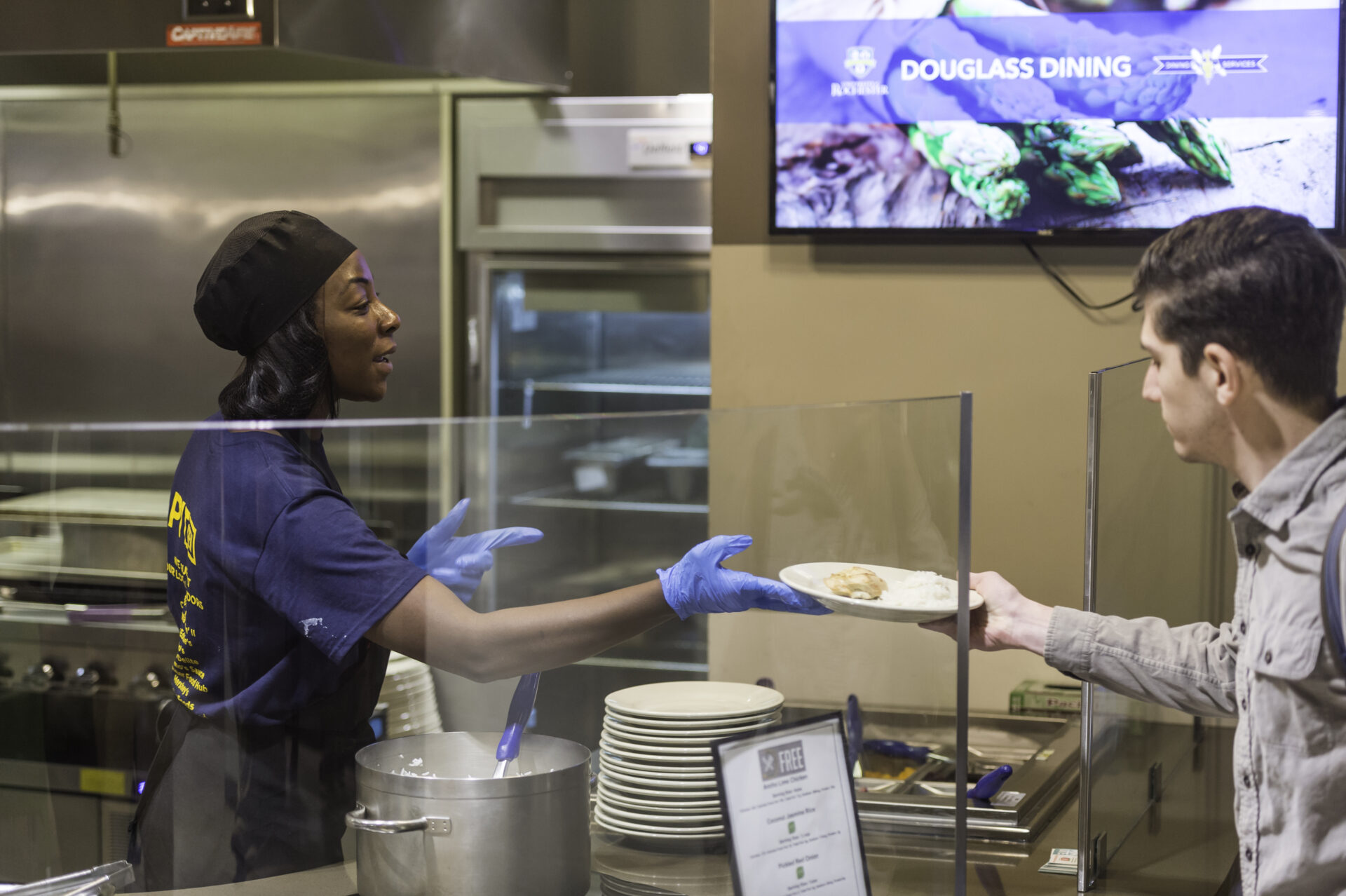
Eric Barker, the senior director of Campus Dining and Auxiliary Services, explains how Winnow, a University of Rochester partner, uses “cameras and a very intuitive AI software” to identify food scraps from the kitchen. This system informs employees how much food is thrown away, what the food is, and saves pictures for analysis. These pictures then allow managers to view the food that is being thrown away and ensure that it only consists of unusable food scraps. Back-of-house Winnow systems are currently in place in the kitchens at Danforth Dining Hall, Douglass Dining Hall, Eastman Dining Hall, The Pit in Wilson Commons, and the Douglass Commissary Kitchen.
In addition to the Winnow units in the kitchens, customer-facing units are planned to be installed in the all-you-care-to-eat facilities during the 2026 school year. Barker explains how the system works: “When a plate is placed under it, it will photograph the plate, [then] determine a dollar value of the food that was wasted…We’re hoping it will educate customers to know what’s being left there, and then it’ll also give us a better idea as to the value of [the] food being wasted.”
The benefits of Winnow
The Winnow units are about 92% accurate, and they allow managers to determine the most significant sources of food being thrown away. By analysing this data, managers will be better informed on the proper quantities of food they should be purchasing and serving. This will help to prevent wasted food at the source, which is the most preferred way to minimize environmental impact according to the EPA’s Wasted Food Scale.
Operationally, dining managers will be able to optimize the processes used by their employees such that food waste is minimized in the preparation and serving of food. When the customer-facing units are installed, the collective information will also give a better idea on where Dining can prioritize training and education based on the amount of waste being produced by the kitchen versus the students.
Other food waste reduction initiatives
In addition to the Winnow units, there are several other food waste reduction initiatives happening around campus. Usable food is donated to local organizations, with River Campus Dining donating an estimated 1.64 tons in 2025.
Unusable food scraps are also diverted through a commercial composting process at both Eastman and River Campus. Pre- and post-consumer food waste is collected and composted by the University’s waste vendor, and the resulting compost can be used as fertilizer. In 2025, Eastman Campus collected a total of 16.06 tons of organics, while River Campus collected 127.71 tons.
Further improvements are also expected. According to Eric Barker, the organics collection at Connections Cafe is in the process of being increased. Connections also uses a locally roasted coffee, reduces materials needed for shipping, and supports local, eco-friendly farming methods.
Reducing food waste at URMC
The University of Rochester Medical Center (URMC) also has several initiatives in place to reduce food waste.
According to Shelley Barker, Purchasing Manager for the URMC Food and Nutrition Department, “meal counts are reviewed three times a day, [and] items are prepped with recipes that are sized for the current levels [of patients] plus 5% for overportioning.”
In addition, unused products from the hospital’s tray line can later be sold at the cafe. URMC also aims for its menus to have a lower environmental impact. Their regular menu deemphasizes beef and instead consists mainly of chicken and vegetable-based food options. This allows the menu to be healthier and promote a greener environment, as beef production is a major contributor to greenhouse gas emissions.
URMC also runs a food donation program through Foodlink. Their pantry runs in seven units in the hospital, and ten affiliates outside the hospital. Bags containing shelf-stable foods such as pasta, rice, canned goods, and more are donated to food insecure individuals. The food in these bags can feed a family of four for about three days, according to Shelley Barker. URMC staff assemble and box these bags to deliver to offsite locations. On average, 409 bags are distributed per month.
The University of Rochester, including URMC, will continue to make strides to mitigate food waste and use sustainable practices with food handling and distribution. Current and future initiatives will not only reduce food waste, but also reduce the University’s carbon footprint, cut unnecessary spending, and provide broader educational and training opportunities through the analysis of food waste data.
Written by Raelen Green, ‘28