When UR Medicine Imaging Sciences faced the costly task of replacing several aging MRI scanners, they chose an unconventional path: rebuilding the machines onsite instead of buying new ones. The decision has cut costs, minimized waste, and prevented hundreds of tons of carbon emissions—a notable achievement in one of healthcare’s most resource intensive fields.
If the healthcare industry was a country, it would be the fifth-largest emitter on the planet, falling between Russia and Japan. Of the many fields of medicine, radiology is one of the most energy-intensive owing to its dependence on sophisticated imaging equipment. A single MRI scanner has an average energy consumption of 111,000 kWh per year, an amount equivalent to that produced by 10.6 average U.S. households.
A costly problem meets an innovative solution
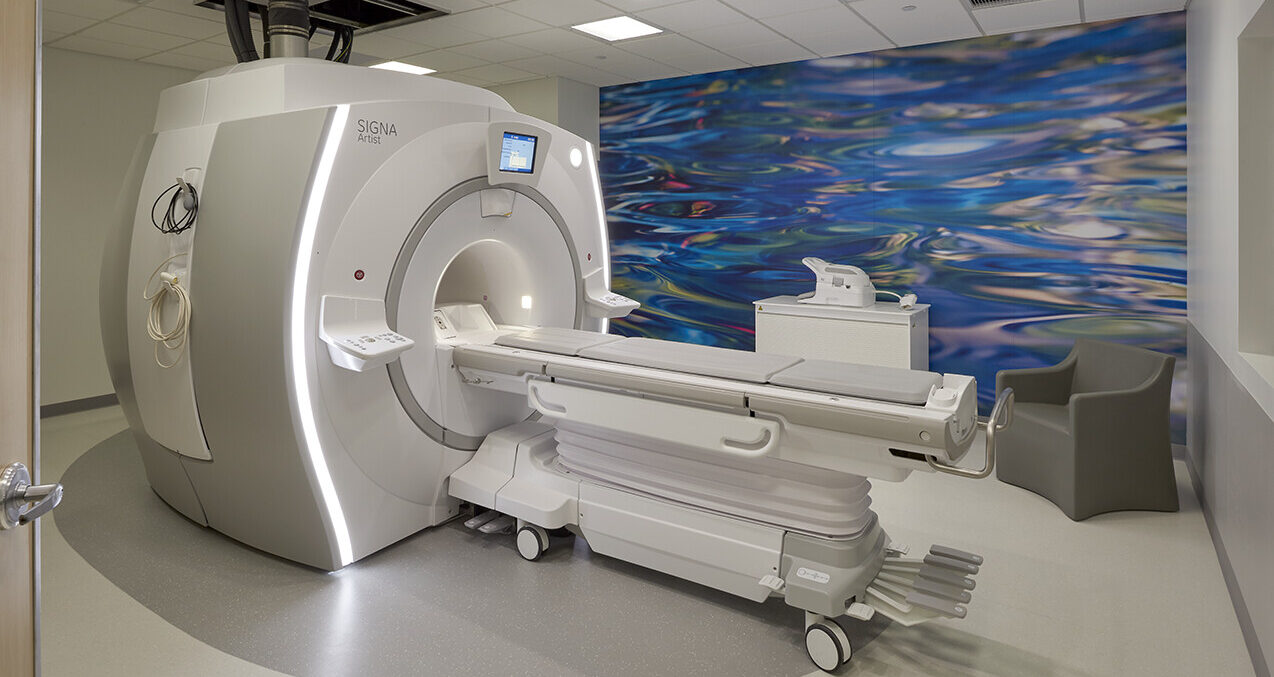
MRI scanners are made up of components whose lifespans don’t align. The magnet—the core of the system—lasts about 30 years. However, the surrounding technology evolves rapidly. According to Dr. Eric Weinberg, professor of Clinical Imaging Sciences and vice-chair of operations, this is the problem, but also the great thing about this technology. Its rapid advancement leads to better diagnostic capabilities, improved patient experiences, and greater efficiency for healthcare workers. On the other hand, keeping up with new innovations is financially daunting given the immense cost of purchasing and installing new scanners.
In 2020, UR Medicine Imaging Sciences determined that several MRI machines required updates owing to technological advancements in the field. When Weinberg consulted with the vendor, GE HealthCare, he learned that the machines could be remanufactured on site, keeping the existing magnet but upgrading the technology surrounding it. The cost was half that of buying a new scanner, yet produced a machine identical to brand-new.
“And then of course, the part that no one talked about, which I was quite interested in, was: What is the environmental impact of not throwing out the entire original device?” reflects Weinberg.
This initiative is part of the care alliance UR Medicine and GE HealthCare established last year to advance care and technology throughout the health system.
Environmental benefits of rebuilding MRI scanners onsite
URMC has refurbished five of six MRI scanners in need of updates, with the final machine scheduled to be worked on this year. Since this work began in 2020, GE HealthCare started keeping track of the environmental benefits of MRI refurbishment. Once work on all six machines is complete, UR Medicine Imaging Sciences will have avoided an estimated 288 tons of CO2 emissions and saved six tons of helium. Helium is needed to cool MRI magnets and is a rare, finite element that has experienced shortages in recent years.
The new technology installed during the rebuilding process also carries environmental advantages. Deep learning reconstruction, which harnesses AI to quickly remove noise from scanned images, allows the updated machines to consume 30% less energy. The result is better energy efficiency, higher quality images, and shorter scan times, improving the patient experience and allowing for maximized use of each machine.
Rebuilding onsite also drastically reduces material waste. “MR scanners contain hazardous materials like mercury and beryllium that can pose serious risks if not handled correctly, so we don’t really want more of those to go to the landfill,” says Dr. Jennifer Harvey, professor and chair of Imaging Sciences. Under GE’s program, 94-96% of system components are reused, harvested, or recycled.
Enhancing patient care
In addition to saving the institution millions of dollars, this approach also enhances patient care. The speed of the newly rebuilt scanners allows radiology technologists to care for more patients more quickly while securing higher quality images than ever before.
It takes anywhere from six weeks to a few months to “strip and rebuild the scanners” and upgrade the room. That is faster than installing a new MRI machine, primarily because of the improvements that are needed to support the technology, and the physical challenges of getting the system into the facility, which often includes opening walls or ceilings and use of a crane.
When a scanner is shut down for replacement, wait times for appointments get longer. But once completed, the Imaging team can catch up quickly. Weinberg says, at one location, MRI capacity was about 350 patients per month. After the upgrade, that number rose to 500 per month, because it takes less time to capture the needed images – a significant benefit for the community.
Department-wide sustainable practices
Rebuilding onsite is only one part of the department’s push towards being more environmentally sustainable. After an hour of idle time, scanners go into power saving mode (though this generally does not occur since days are booked with patient care). The machines are shut off at night and over weekends. Additionally, by switching to syringeless injectors for contrast—the substances used to highlight specific structures in the body—the department has reduced a considerable amount of waste in CT scanning.
“It’s a more efficient process,” says Weinberg. “There’s less contrast waste that’s going on, and there’s less plastic that you’re throwing in the garbage as a result.” This system is now the standard for all CT scanning across UR Medicine Imaging Sciences. Last year alone, the department conducted over 100,000 CT scans, making the reduction in materials quite significant. The team is looking to implement similar injector systems for their MRI scanners in the future.
Looking forward
By rethinking equipment use, reducing emissions, and embracing more efficient technologies, UR Medicine Imaging Sciences is helping shape a more sustainable future for radiology, one in which patients and the planet benefit together.
The key challenge, notes Harvey, is balancing the push for more earth-friendly practices with access to all of the constantly evolving science. The need for that balance is beginning to gain the attention of radiologists nationwide. “Our field is really embracing this now for the first time,” says Weinberg. “I think going forward, radiology is going to be very invested in this, as it should be.”
By Maryellen Zbrozek, Sustainability Programs Specialist