
URochester researcher William Renninger is named one of 21 new Moore Foundation Experimental Physics Investigators.
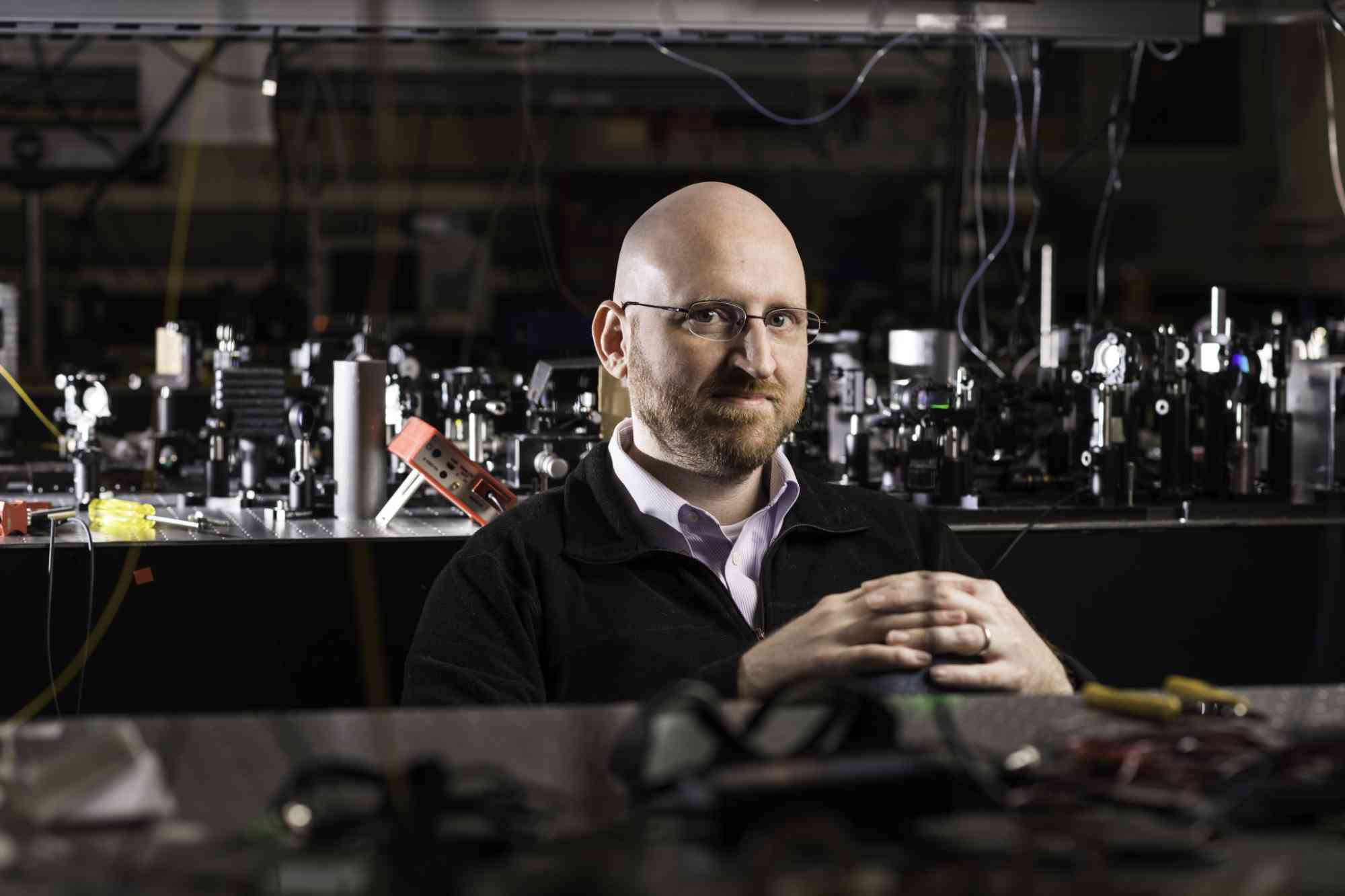
William Renninger, an associate professor at the University of Rochester’s Institute of Optics, is developing novel ways to couple light with sound, which could open new possibilities for quantum computing, high-speed networking, and dark matter detection. Renninger is one of 21 new investigators selected for the Gordon and Betty Moore Foundation’s Experimental Physics Investigators Initiative, which provides mid-career researchers $1.35 million over five years to support ambitious experimental research.
Individual units of light and sound have distinct properties that scientists use in modern physics and technology for extremely precise applications. Photons—particles of light—work well for high-speed, long-distance communication, while phonons—vibrations at their fundamental form—thrive at storing information and serving as bridges to other quantum systems.
Renninger intends to leverage the quantum properties of both light and sound to build more exact communication and sensing tools to study how matter behaves, from defects in crystals used in semiconducting materials to the limits of quantum physics.
“My lab aims to broaden how researchers use light to control and measure motion in systems that are currently hard to reach,” says Renninger. “We hope to produce better tools for optical signal processing, new ways to map hidden defects and energy loss inside materials, and experimental platforms for testing how large mechanical systems behave near the limits of quantum physics. I’m extremely grateful to the Moore Foundation for this support to our research program.”
Renninger’s project will link device engineering, precision measurement, and basic physics in one program. The project will focus on creating light-driven sound devices and measurement methods that can operate across chips, surface acoustic wave devices, and bulk crystals. The projects could provide researchers new ways to generate strong, narrow-band sound responses for signal processing or evaluate sensitivity to extremely weak signals such as those expected from ultralight dark matter.
The Experimental Physics Investigators Initiative also brings together its researchers as a cohort to exchange ideas and develop new collaborations, while providing support for mentoring and professional development.
Read the full list of the 2026 Experimental Physics Investigators on the Moore Foundation website.