Student entrepreneurs learn business by starting one
With professional guidance and proximity to assets, URochester students launch and build companies as part of their campus experience.
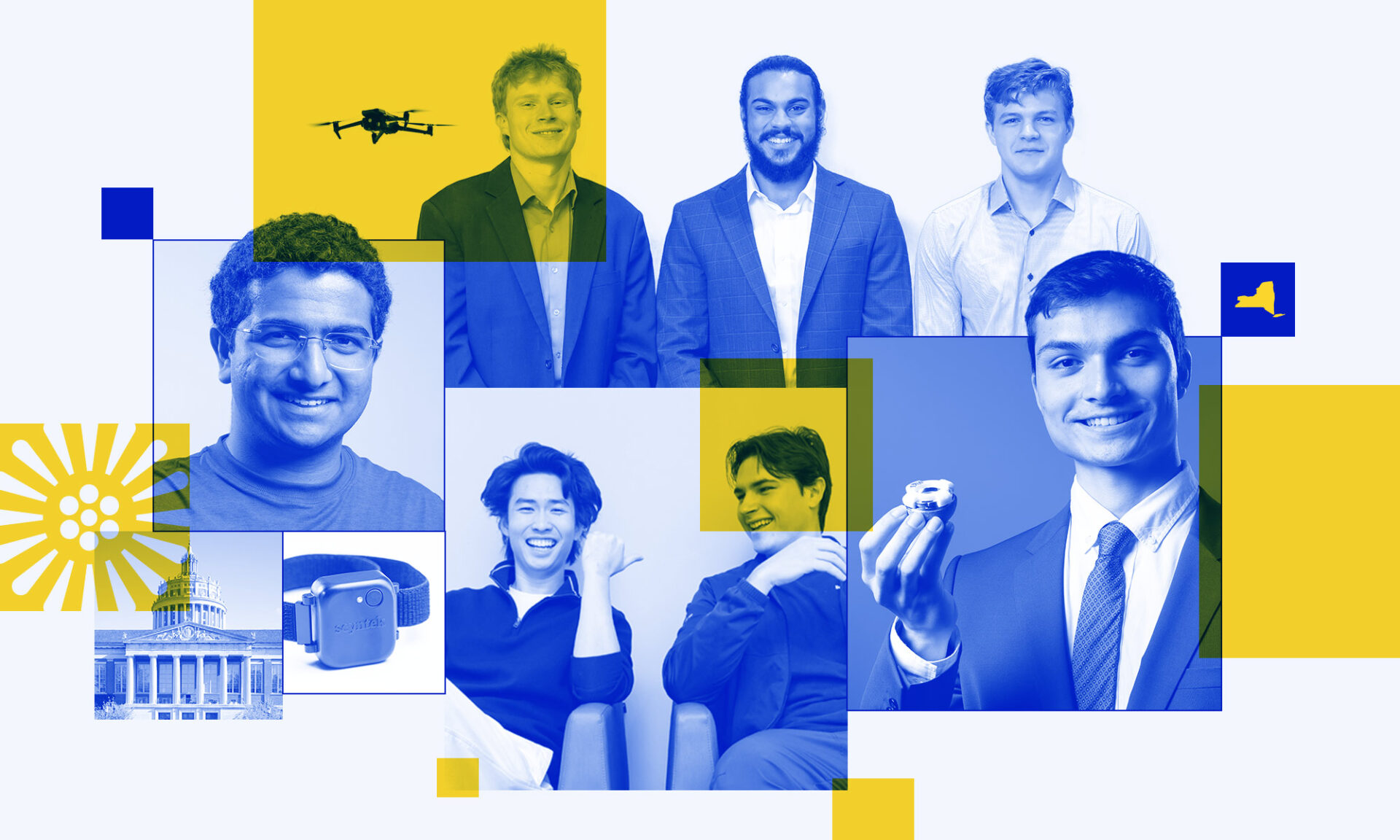
One idea began in an operating room. Another took flight after watching a drone clean a downtown building. Others grew from research on the brain’s self-cleaning cycle and the frustration of a broken-down car.
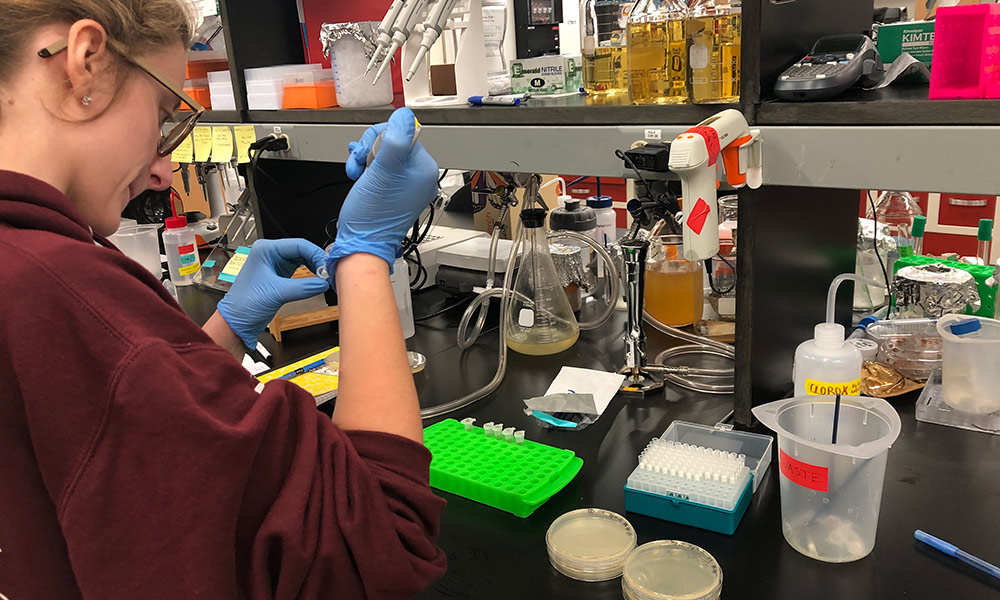
As different as they are, all four startups took root while their founders were still students at the University of Rochester last academic year, drawing on URochester’s courses, research labs, clinical partnerships, faculty mentors, and entrepreneurship programs to turn promising ideas into thriving ventures.
Those stories illustrate a growing culture of student entrepreneurship across the University. Over the last academic year, 116 business concepts took shape at the Ain Foundry Program at URochester’s Ain Center for Entrepreneurship and Innovation. The program helps students develop business ideas through mentorship, customer discovery, and hands-on entrepreneurial training.
Many of those ideas continued to gain momentum beyond campus. Twenty-two URochester teams competed in the New York Business Plan Competition last spring, with six teams advancing to the finals. Those numbers reflect a surge of entrepreneurial energy across URochester, as students transform classroom assignments, research discoveries, and customer conversations into ventures with real-world potential.
“What I love about our students is their willingness to get into ‘good trouble,’” says Rebecca Crocker ’24W (MS), director of the Ain Foundry. “They may sometimes have doors slammed, but they’re getting in spaces that most people aren’t.”
Students are now advancing to national competitions and accelerators while launching companies that span healthcare, artificial intelligence, advanced manufacturing, and emerging technologies. The student entrepreneurs profiled here, having earned top recognition at the NYPBC, continue to develop their ventures.
Topics on this page:
Guidus Medical: Helping surgeons seat hip implants correctly the first time
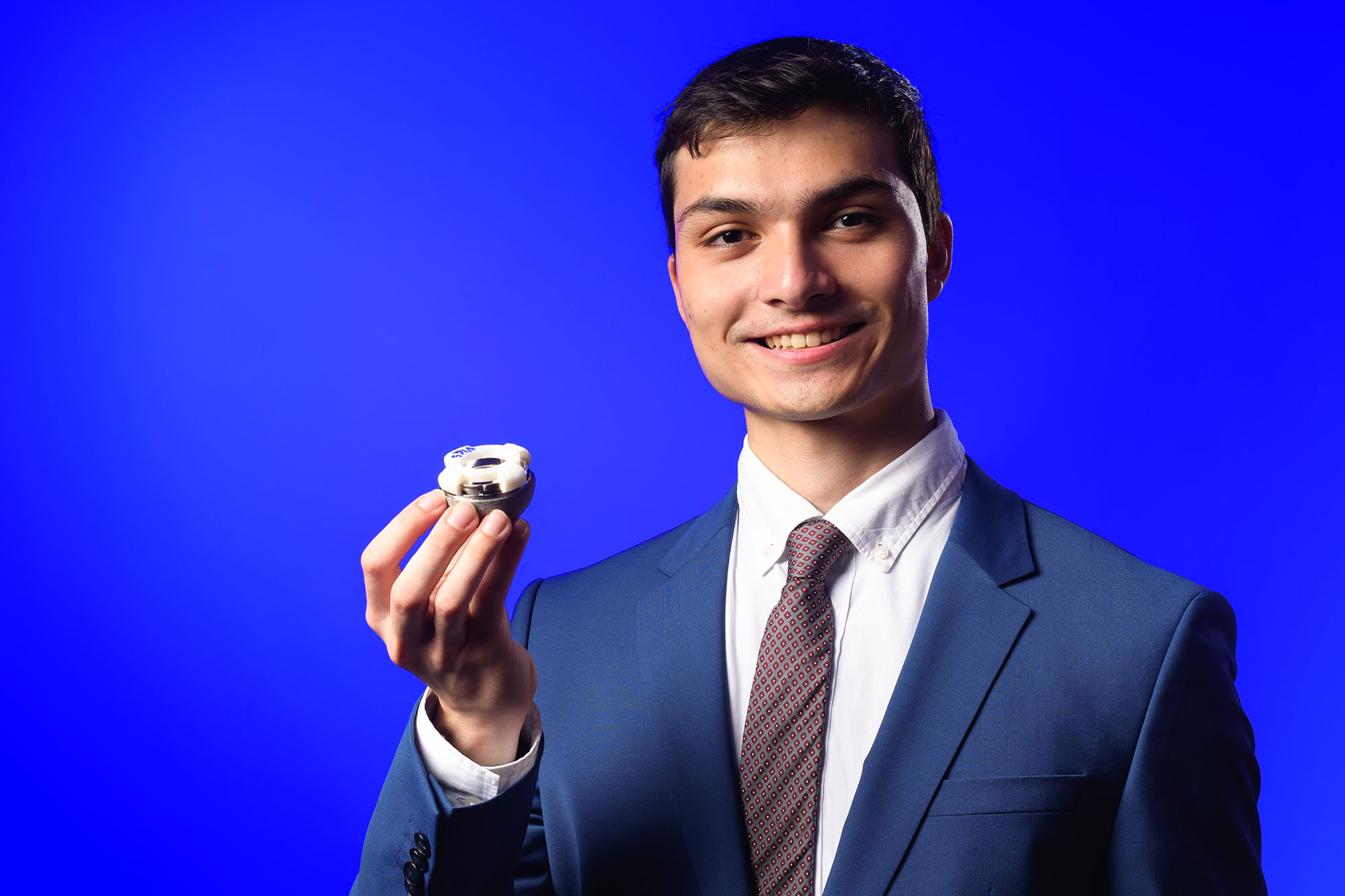
As a graduate student in biomedical engineering, Timothy Guida ’25, ’26 (MS) was not expecting to start a business. But he was eager to identify unmet clinical needs that engineering could help solve. As a master’s student with URochester’s Center for Medical Technology and Innovation (CMTI), Guida joined other students seeking experience in building prototypes of medical devices and bringing them to market. In the process, he spent hundreds of hours observing orthopedic surgeons at URochester Medicine’s Strong Memorial Hospital.
Guida’s faculty advisor Greg Gdowksi, a professor of biomedical engineering and the executive director of CMTI, encouraged him to join the program.
“Rather than developing technology in isolation, CMTI emphasizes the need to identify real clinical needs to produce devices that solve meaningful problems and, ultimately, improve patient care,” says Guida. “This need-driven innovation is truly unique to Rochester.”
Orthopedic interventions involve measurable forces, motion, stability, and performance. Translating engineering principles into devices that objectively improve patient outcomes is the most fulfilling work.”
Guida also credits URochester’s integration of engineering, business, and medicine with accelerating the project. Within a short walk, he could observe surgeries, prototype solutions, discuss commercialization with business students, and receive feedback from faculty mentors.
Guida’s conversations with orthopedic surgeons, both at Strong and at large health systems across the country, highlighted a recurring challenge. During dual-mobility hip replacement surgery, surgeons lacked a standardized way to confirm that the metal liner inserted into the artificial hip socket was fully seated. Misalignment can contribute to complications ranging from metal debris and tissue damage to revision surgery.
That observation evolved into Guida’s startup, Guidus (pronounced GUIDE-us) Medical, and his prototype for Align-a-Liner, a patent-pending surgical guidance device for one of the most technically demanding steps of a hip replacement. Drawing on his coursework in materials science, biomechanics, and medical device design, Guida developed a prototype that helps guide the metal liner into the correct position and helps surgeons confirm it has locked into place.
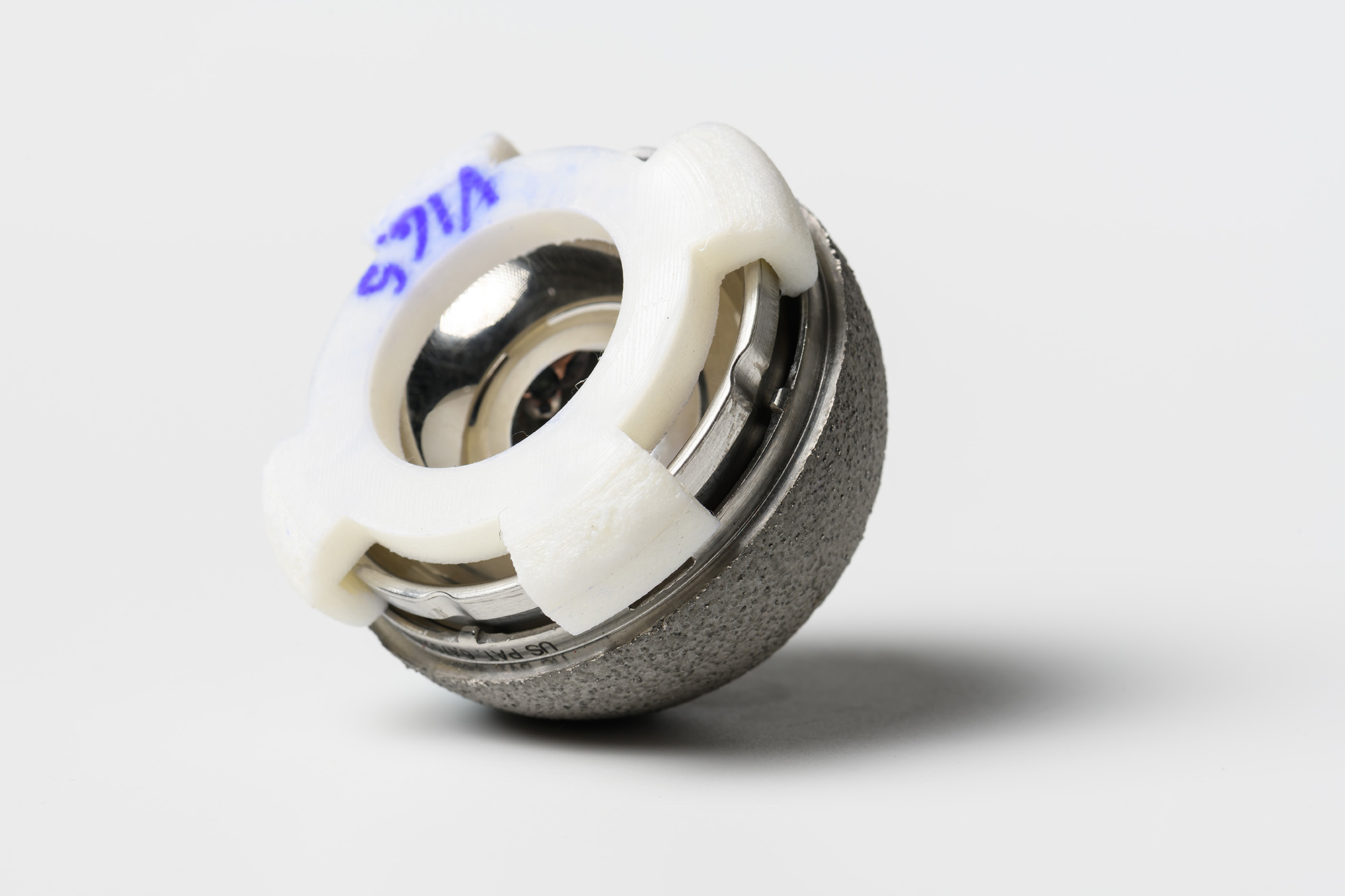
“In terms of entrepreneurship, orthopedics is a wellspring,” Guida says. “Orthopedic surgeons are among the most frequent end-users of medical devices. Orthopedic interventions involve measurable forces, motion, stability, and performance. Translating engineering principles into devices that objectively improve patient outcomes is the most fulfilling work.”
Through the Ain Foundry, Guida connected with MBA students and entrepreneurship mentors at Simon Business School, who helped him test the business model, refine his pitch, and think beyond engineering toward manufacturing, reimbursement, intellectual property, and FDA approval.
“I realized that even the best ideas need robust systems behind them,” says Guida, who will start medical school this fall.
Today, Guidus Medical is preparing for additional testing, advancing its intellectual property strategy, and exploring commercialization opportunities with industry partners.
Scyntek: Detecting blood clots earlier with a wearable device
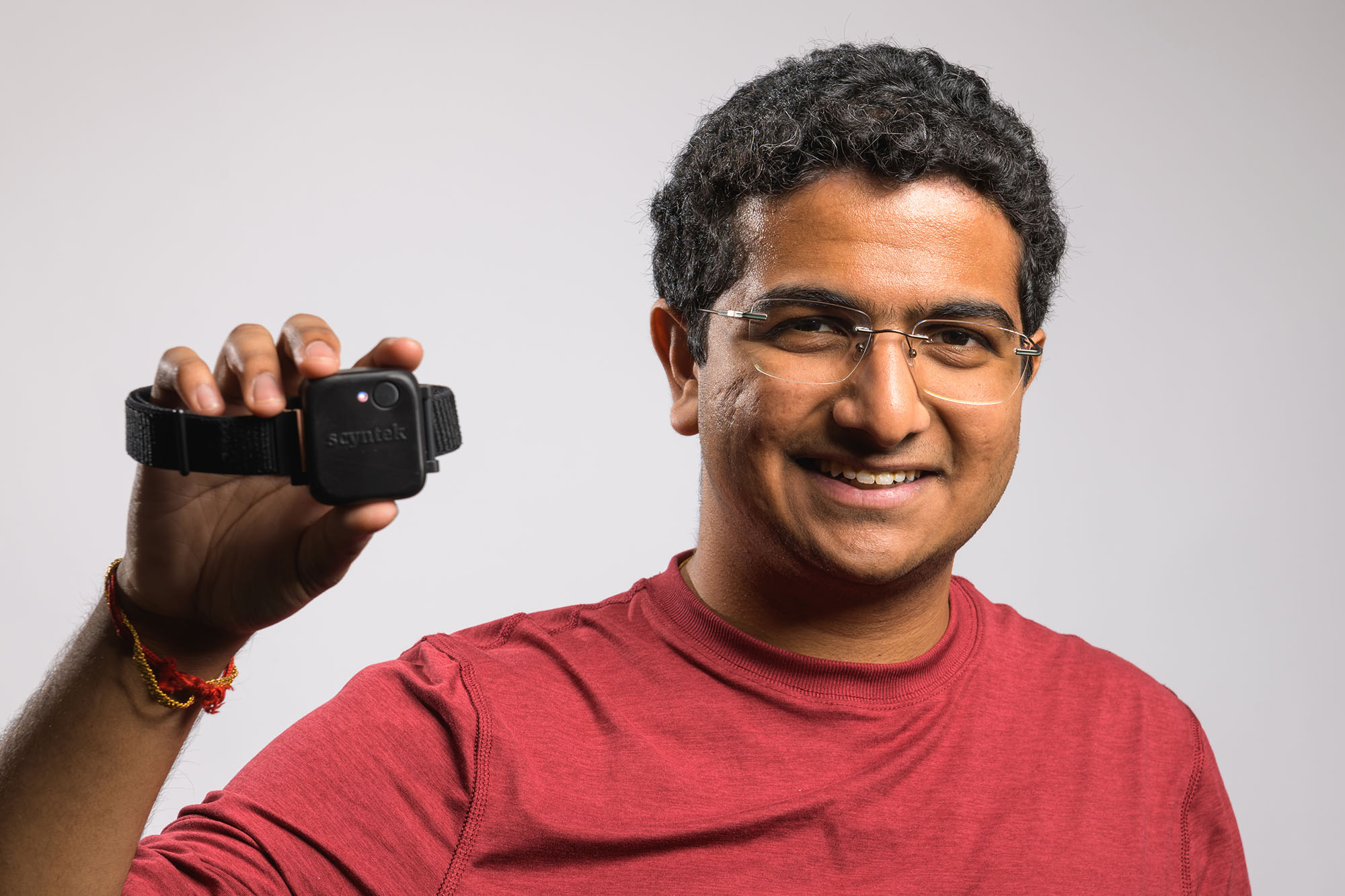
After finishing college in North Carolina, Karthik Ramakrishnan arrived at URochester for graduate school with coats, boots, and a business concept.
In 2024, Ramakrishnan cofounded Scyntek as an undergraduate. The venture had received support and vetting through the National Science Foundation’s I-Corps program, a rigorous testing ground for ideas in medical technology.
During customer interviews with nurses, physicians, surgeons, and patients, one problem surfaced repeatedly: deep vein thrombosis (DVT), a potentially life-threatening blood clot that often develops after patients return home from surgery.
Ramakrishnan chose URochester to pursue his doctoral studies with Douglas Kelley, a professor in the Department of Mechanical Engineering, who examines how the brain clears waste during sleep. While Ramakrishnan’s research and startup address different medical problems, they rely on many of the same principles for measuring fluid flow.
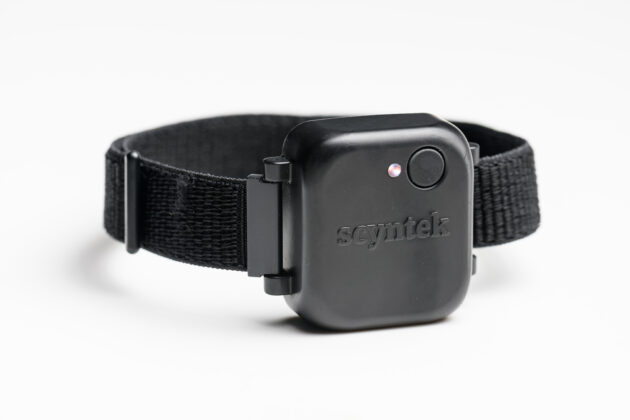
Synctek’s wearable device uses photoplethysmography (PPG)—similar to the technology in smartwatches—to noninvasively detect changes in blood flow that may flag a clot.
“Our goal is to make monitoring accessible and affordable,” says Ramakrishnan. “Patients can scan their legs in 60 to 90 seconds from home, reducing unnecessary hospital visits while helping identify people who need immediate care.”
Through the Ain Center, Ramakrishnan worked with Crocker and entrepreneur-in-residence Roberto Colangelo to hone Scyntek’s business strategy and connect with the UR Health Lab at URochester Medicine.
“The Ain Foundry has welcomed Scyntek with open arms from the moment I met them,” says Ramakrishnan. “They have been excellent in connecting us with mentors, both at Simon and in the field of venture capital, and funding opportunities.”
With positive responses from the US Food and Drug Administration, Ramakrishnan is advancing Scyntek toward clinical studies while refining its technology and business model.
DroneGurus: Identifying hidden flaws with AI-powered inspection

Guruansh Kohli ’26 looked toward the sky to expand his horizons.
The computer science and business double major was working as a valet in Rochester when he saw someone use a drone to power wash the exterior of a downtown building.
“That experience got me reimagining cities, especially Rochester,” Kohli says. “I stood on the sidewalk looking up, thinking of skylines as a whole new domain.”
That moment sparked DroneGurus, a company Kohli leads alongside fellow URochester students Nate Bogdan ’26, a digital media studies major who directs branding and communications, and Spencer Johnson ’26, the company’s chief financial officer. Together, they are developing AI-enabled drone technologies for building inspection, thermal imaging, infrastructure assessment, and autonomous systems.
But turning a spark of inspiration into a business took more than an idea.
“That class prepared me not just to run a business, but to build one.”
Kohli credits a class taught by Scott Walker, an adjunct faculty member at Simon Business School, for helping him shape the idea into a business.
“That class prepared me not just to run a business, but to build one,” says Kohli, who was selected for the Experiential Five (e5) Program that gives students a tuition-free fifth year to turn promising ideas into ventures.
Customer discovery, mentorship, and support from the Ain Foundry helped DroneGurus gain traction beyond the classroom.
As the team interviewed industry leaders, entrepreneurs, and potential customers—and ran simulations on the video game Minecraft—DroneGurus evolved into more than building-cleaning services. Today, the company is developing machine learning tools that use thermal imaging to identify façade cracks, leaks, insulation problems, and other structural issues, with applications ranging from commercial real estate to infrastructure and public safety.
But the student entrepreneurs aren’t just trying to improve drone technology. They also hope to reshape public perceptions of it.
“We often hear about drones in ways that make us uneasy,” says Kohli. “But we don’t hear about their benefits: how they can promote security and job growth and make our lives easier.”
Bogdan, a digital media studies major, hopes creative storytelling and splashy imagery, in the style of Red Bull campaigns, can reshape public perceptions of drones.
“We want people to think about what drones can do to help society,” he says, “rather than destroy it.”
OrbitPhone: Turning dealership expertise into better customer service
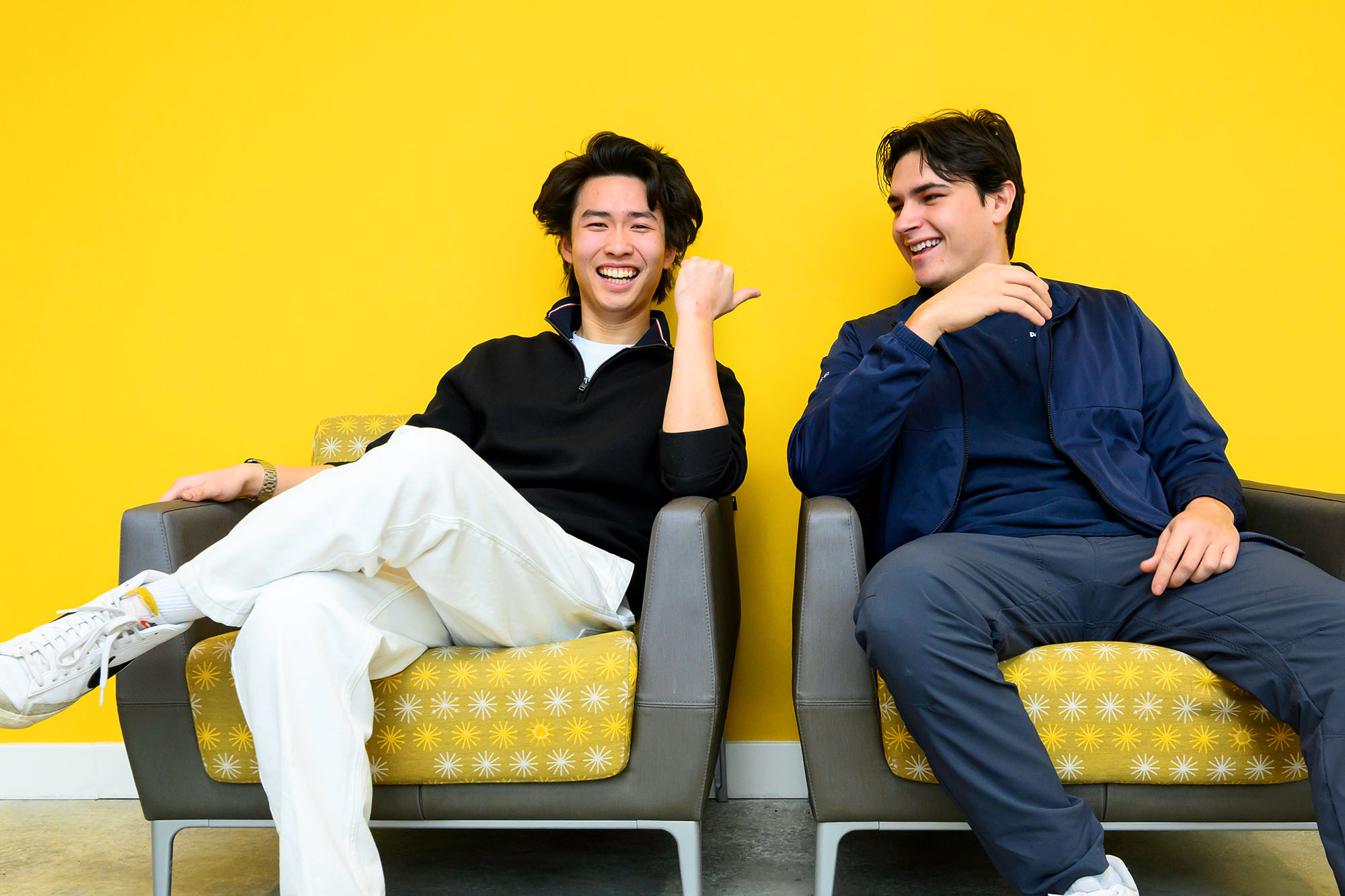
Walter McDonald ’27 and Stephen Lim ’27 discovered that entrepreneurship sometimes means walking away from your first idea.
The original version of their company, OrbitPhone, built AI-powered receptionists for small businesses. McDonald, majoring in computer science and finance, gained crucial experience in voice systems and natural language processing over the summer working for Soleo Communications, a position he secured through the summer internship program at the URochester-based New York State Center of Excellence in Data Science and Artificial Intelligence. After a few months of development, McDonald and Lim, a data science major, launched OrbitPhone last fall.
But then, generative AI exploded. Instead of choosing to compete in an increasingly crowded marketplace, the student entrepreneurs drew on the advice from the Ain Center to pivot and adapt to change.
Customer discovery led them to automotive dealerships, where they uncovered a much more specific challenge: helping sales teams answer detailed questions about inventory, vehicle specifications, and financing. Their first client, Ralph Honda, supplied its inventory data for McDonald and Lim to build a custom chatbot.
“The dealership solution is so nuanced,” says Lim, “that it only could have come from us asking around.”
Lim says starting a company like this is a dream come true, fusing his interests in both software programming and business. He says URochester’s open curriculum gives him the flexibility to pursue both paths, and he is glad to have found in McDonald a collaborative friend and business partner.
Today, OrbitPhone is developing AI tools that gather dealership-specific information to provide more accurate, personalized customer interactions.
The experience taught McDonald and Lim an important lesson: The best startup isn’t always the first one you build.
URochester student entrepreneurs learn by launching
Together, the startups illustrate the culture of student entrepreneurship at URochester. It is not something students wait to pursue after graduation but something they build alongside research, coursework, and campus life.
While the companies look different, each follows a remarkably similar process: Identify a problem, listen to customers, build a prototype, seek mentors, test assumptions, and improve. Each student-driven business evolved through connections between researchers and clinicians, engineers and business students, faculty mentors and alumni, classrooms and community partners.
The Ain Foundry regularly adds workshops, mentoring opportunities, and new programming based on student feedback, from subscription-based business models to using generative AI tools to build websites.
“Through our guidance and framework,” says Crocker, “the entrepreneurial mindset is fused into the student experience.”