Energy costs are rising, spurring businesses and homeowners alike to think twice about their energy use. The University of Rochester is no exception; its Energy Services group has been working for years to reduce and improve the efficiency of the University’s energy consumption—saving costs and reducing greenhouse gas emissions.
According to New York Independent System Operator, the 2020s have been characterized by energy price volatility owing to factors like the growth of natural gas exports, increasing demand from data centers and large industrial loads, and a transitioning energy grid. Seasonal changes, like the extreme winter weather New York has experienced in early 2026, also play a crucial role in energy price surges.
So, what can be done to reduce energy strain at the University, both to save costs and be conscientious consumers? University energy engineer Tim Vann answers common questions about the energy cost spike, what the University is doing to improve how it consumes energy, and how members of the University community can help.
How much are energy rates rising right now, and why is this happening?
Unusually extreme cold weather across much of the country has caused an increased demand for natural gas, causing its price to rise. In turn, this has caused the price of electricity to rise, as natural gas is the primary fuel for about half of the electricity generated in New York State.
For the University, our gas rates are locked in, so they are unaffected by short-term fluctuations. However, this is not the case for our electricity rates.
In January 2026, the average cost of electricity was up 50% compared to January 2025. At its worst, the electrical energy rate peaked at 29 times the average monthly price. So far, the average cost of electricity in February 2026 is up nearly three times the average for February 2025.
With these prices in mind, now is a good time to consider how we are using energy at the University.
If I’m not paying for electricity at school or work, why should I care about how much I use?
All energy production, especially from fossil fuels, comes with negative consequences. The more energy we consume at work, at home, in our schools, etc., the more energy needs to be produced.
All energy production creates some degree of pollution. Research consistently links air pollution, particularly from fossil fuel combustion, to respiratory disease, cardiovascular disease, and other adverse health outcomes. Reducing unnecessary energy use, even in small ways, contributes to a larger collective impact. That makes eliminating unnecessary energy use a win-win-win-win: Money is saved, pollution is reduced, human health is better protected, and the environment is healthier.
As an institution with a heavy focus on healthcare, reducing pollution aligns directly with our mission to support and improve health. We should treat energy as a precious resource, using only what we need. Energy that we don’t use today will be available tomorrow, and it will make tomorrow a better place for all.
Is the University asking employees to solve this problem through individual behavior changes?
No. However, we are asking employees to be aware of energy use and its cumulative impact on the budget, the environment, and human health, and then to reduce unnecessary energy consumption where possible. At the same time, the University will continue to tackle big energy projects.
Treat the University like your house. Turn off lights and equipment when they aren’t needed. Use energy, but don’t waste it.
How is energy use distributed across the University of Rochester’s operations?
About 75% of the energy used by the University is for heating, cooling, and ventilating buildings. The buildings that use the most energy are medical and research buildings, which use 2-4 times the energy of a comparably sized building. Buildings with heavy research or intensive patient care needs—like operating rooms—use the most energy, while office areas use the least energy.
You mentioned that the University is working on some big energy projects. Could you give examples of what changes are being made?
With the extreme weather we have been experiencing this season, one of the immediate operational changes has been implementing temperature setbacks where possible across the University.
In addition to managing operations to ensure the University has the power and heat it needs, a large portion of what Energy Services does make improvements in energy efficiency. Here are some of the projects we have been working on recently:
- Since 2022, we have been improving the efficiency of our cogeneration system, which is the single biggest consumer of energy. This is an ongoing process, with more changes expected this year.
- We have been and will continue to install new controls in our buildings for more efficient HVAC system operation.
- We are upgrading our chilled water system over the next three years to convert a portion of it from using natural gas to electricity, make the system more efficient, and significantly reduce greenhouse gas emissions.
- A Fault Detection and Diagnostics (FDD) system pilot was started two years ago with promising results. This system monitors HVAC system operation and suggests changes to improve comfort, decrease energy use, and reduce the need for maintenance. It is currently installed in over 1 million square feet of building space, and we are in the process of installing it in more.
- We have made investments into improving our energy metering, monitoring, and analysis systems and capabilities, which help us target and evaluate energy projects.
- In 2025, over a million square feet of medical buildings went through a commissioning process to identify energy and operational improvements.
That’s a lot of changes. Has the University’s energy use actually gone down?
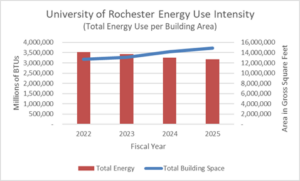
Yes. Since fiscal year 2022, we have decreased our energy intensity by 23%. Energy intensity is the amount of energy used in a year from all sources divided by the area of all buildings. Since we keep building and purchasing additional buildings, this is the fairest way to evaluate our energy consumption.
In absolute terms, our total energy consumption went down by 10% while our building area increased by 17%.
I understand that most energy goes towards heating and cooling buildings. I think my work area doesn’t need to be heated or cooled as much as it is, but I don’t know how to change this. What should I do?
If the temperature in your immediate workspace needs adjusting, contact the Facilities Customer Service Center to put in a temperature modification request.
One of the simplest and most effective ways to reduce heating and cooling energy is through well-aligned building scheduling. It is very typical for University buildings to be scheduled to be occupied longer than necessary because of uncertainty in building use.
If you know your building’s system is running longer than necessary, coordinate with your fellow occupants and then contact your building manager or the Energy Operations Group and have them adjust the schedule accordingly.
Uncertainty also causes inefficiencies in our ventilation systems. Spaces are typically ventilated based on how many people could possibly be in a room, not how many are actually occupying it. If you have information about how many people are in building spaces and you share that with the building manager and Energy Operations Group, they might be able to adjust the ventilation rate accordingly. This not only would reduce energy use, but also improve comfort; buildings that are overventilated typically feel cold and drafty, even in the summer.
Are there other impactful things I as an individual can do?
Be a champion for energy and resource conservation. Talk to your coworkers about energy conservation, about preserving natural resources and reducing pollution for our descendants. There are many people worldwide working on cleaner energy solutions, and this is making progress, but not using unnecessary energy is always better than switching to a cleaner energy source. Awareness is powerful.
If you have suggestions for energy or resource improvements, bring them up and talk about them with your coworkers. If your group thinks these are practical, discuss them with your building manager.
To learn more about energy conservation at the University of Rochester, visit the Energy Services website. Energy usage data by location is also available via the River Campus Energy Portal and Medical Center Energy Portal, available to everyone on an official University network.
For more resources on what you can do to be more sustainable at work, including energy-saving tips, check out the Sustainability Toolkit.