12 October 09 | Chad W. Post
Bookmark and Share

The Frankfurt Book Fair starts tomorrow, and in a few short hours I’ll be on a plane to Germany. (Hastily preparing for a Tools of Change panel I’m going to be on a mere six hours after I land . . .) Anyway, I will be blogging for the FBF site, and hope to update Three Percent with that info, but in the meantime, I thought we’d offer up a special treat this week and serialize the first few pages of Jan Kjaerstad’s _The Discoverer, translated from the Norwegian by Barbara Haveland. This is the follow-up to The Conqueror (although each book in the Wergeland Trilogy can be read independently of the others) and takes place shortly after TV-producer and Norwegian icon Jonas Wergeland has released from prison for the murder of his wife.

You can purchase the book from our site, either by itself as part of a subscription to Open Letter or as one of the titles in our special 2 books for $22 offer. It’s worth noting that as part of this special offer, you’re automatically entered into a drawing to win a free year’s subscription. So, without any further ado . . . _

Jupiter

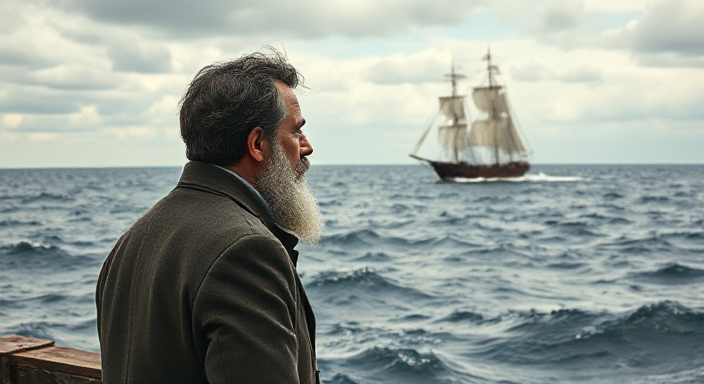
Behold this man. Behold this man, as he feels three tugs on the rope and slowly, after smiling uncertainly, proceeds to traverse, to edge out onto those dauntingly airy galleries. Behold this man as he inches across the rock face; see how with the caution of the novice he feels his way forward using all of his limbs, his whole body in fact, before shifting his weight from one foot to the other. I can sense how frightened, how truly terrified he is, and yet how full of the determination to do this, to see it through, make it to the top. And then, suddenly, as if something has ground to a halt, he freezes. He shuts his eyes. He looks as though he is listening to the wind, while at the same time concentrating hard, trying to place the scent emanating from the rock against which he is pressed. The bright sunlight glitters off the cliff face, sparkles in the runnels of meltwater. As far as I can see he is holding his breath. I have known it all along. This is the moment of truth. On a ledge, with a drop of hundreds of meters into the abyss only a step away. Here you live, or you die.

“This is a second I shall remember.”

Then he does the one thing I have begged him not to do. He half turns, while apparently hanging on tight with both hands. He looks out. Looks down. As if intent on defying something. Proving something. For a moment he seems to be completely dazzled by the Slingsby glacier far below. Or no, not dazzled, but stunned, panic-stricken. Psyched out, as they say. I refuse to believe it. That this man could be afraid of anything, a man who brought thousands of cars to a halt on Oslo’s Town Hall Square and who, by his mere presence, drew a cyclone to himself; a man who has been with three fair maids at once and who would not hesitate to dive to a depth of fifteen meters without an oxygen tank. Yet he hangs there, rigid. Still holding his breath. Or am I wrong? Does he bend down ever so slightly? I think—I know it sounds strange, but I almost believe he is trying to kneel.

One hand fumbles with the knot, as if he means to undo himself from the rope. “Sit!” I call sharply. “Don’t look down.” But he goes on staring, seeming more mesmerized than frightened now. Or infuriated perhaps, contemptuous. As if this were a set-to with Norway itself, a confrontation for which he has waited years—to stand on the edge of an abyss, without a safety net. I can see temptation written large on his face. He could let himself fall. He could realize the cliché which will forever be attached to his story: that of his downfall. The final, glorious headline.

“You’re perfectly safe,” I shout. “It’s all in your head.” I’m jittery too now, I check that the coil of rope is securely fixed around the sharp rock next to me. I know I can trust Martin, who has led the way, hammering in pitons at regular intervals, and is now out of sight behind some large boulders, a short rope-length from the bottom of the chimney. Martin has climbed everything from the Bonatti pillar to Ama Dablam. But never with such a partner, a man who—according to the newspapers—lost his head and shot a woman straight through the heart. I am uneasy. The uncertainty of the figure huddled against the rock face radiates towards me. I may have miscalculated. Perhaps I should have said no after all. Then he turns to me. His face is calm. I can see that he is breathing, drawing the cool mountain air deep into his lungs, hungrily. He smiles, even raises his hand in a wave, traverses onwards.

Behold this man. Behold this man, the bearer of a mystery.

The rest of the climb went well, remarkably well. Down by the stone cottage at Bandet earlier that day I had been worried. A couple of times on the way up the ridge, on the toughest, most exposed stretch, I had considered turning back. I could see that he was gasping for breath, he looked a little lightheaded. The air was keen and thin. Over one stretch we secured our passage with a length of rope—mainly for his sake—and when we started climbing again he dislodged a rock which went clattering down the mountainside, leaving a whiff of gunpowder behind it. An omen. His fleece clothes and the harness made him look like a child—truly, in this situation, like a helpless child. And, funnily enough, I felt responsible for him.

“Aren’t you a little afraid of heights?” I had asked him when we set out from Turtagrø that morning.

“I used to be. I’m a different person now,” he said.

We reached Hjørnet—the Corner, slipped off our rucksacks. It was early in the season, and there was more snow than I was used to. Wetter and dirtier. We wouldn’t be able to switch to climbing shoes. It went fine, though, with no great problems—even over the few meters of real climbing up the Heftyes Renne, transformed now into a chill, slippery, icy chimney.

We reached the top around midday. I shall never forget the look of triumph on his face, the way he stretched his arms up and out. To the spring sky. All those years inside. Down. And now, only a couple of years after that first intoxicating taste of freedom: on the roof of Norway. Right at the very top. Everything below us seemed much lower, markedly so. I heard him murmur, partly to us, partly to himself: “I never thought I would make it.”

And a moment later: “But I knew I had it in me.”

We sat down beside the little cairn. He studied the commemorative plaque fixed to the stone as if expecting to find his name inscribed there. There too. I took the landscape shots I needed. He said not a word, just sat there looking at the view, could not seem to get enough of this, the most spectacular panorama in Norway. The massive Jostedal Glacier, Galdhøpiggen and Glittertind and all the other peaks of Jotunheimen. Alpine forms with peaks and crests, carved and gouged out by the ice. “Organ pipes,” he muttered suddenly. “This has to be the world’s biggest organ, listen to the wind!” From the massif on which we sat, two jagged ridges wound off like petrified vertebrae. “What are they?” he asked. “Kjerringa og Mannen,” I said—the Woman and the Man—and instantly regretted it. A strange look came over his face.

Behold this man.

We prepared for the downward journey. Just as I was wondering how he was going to cope with the abseiling, he turned the wrong way, towards the sheer drop to Skagadalen. I was about to call out, but the cry stuck in my throat. He stretched his arms out to the sides, as if about to do a swallow dive.

Why did he do it?

One has to start somewhere, and a good, not to say almost perfect, departure point—or even, to stick with the climbing motif: viewpoint—from which to examine Jonas Wergeland’s life would be another stony edifice, another gallery, a hallowed hall, a room with walls of granite, and an autumn day in the 1980s—an autumn day which would bring with it deep sorrow and wistful joy, as well as a strange mystery, an incident bordering on the scandalous. Nor is it entirely inappropriate that Jonas should be at the organ, an instrument befitting his history and the power which for so long he had exerted over the minds, not to say the souls, of the Norwegian people. Jonas Wergeland is playing the organ, framed by its gleaming, monumental face, making the whole church tremble with his playing, making the very stone, the bedrock of Norway, sing. He is not an organist, but he handles the instrument almost like a professional musician; he is an organist by nature, he might have been made for this part, this pose. No wonder he once replied when asked, in Samarkand, what he did for a living: “I am an organist.”


Comments

Commenting is closed for this article.

....
Ni chicha, ni limonada
Ni chicha, ni limonada by David Unger
Reviewed by Rhea Lyons

The innovative works of legends like Borges and Cortázar not only defined a literary movement, they created an exotic and well-known image of Latin America and its people. A key element of works in the tradition of the magical realism. . .

Read More >

The Housekeeper and the Professor
The Housekeeper and the Professor by Yoko Ogawa
Reviewed by Will Eells

Contemporary Japanese literature is all too easy to stereotype. As far as the American reading public goes, the only books that come out of Japan seem to be under one of three genres. The first is the “bizarre things happening. . .

Read More >

The Wall in My Head
The Wall in My Head by Words Without Borders (eds.)
Reviewed by Jessica LeTourneur

I was born in the final decade of communism’s flailing grasp on the Eastern Bloc, and so what I know of the fall of the Berlin Wall and the collapse of communism has long been relegated to what I learned. . .

Read More >

Rhyming Life & Death
Rhyming Life & Death by Amos Oz
Reviewed by Dan Vitale

The short novel is a form in which writers typically exercise great control over their material, accepting the abbreviated length as a kind of challenge, working within that limitation to craft a tight, jewel-like story in which all the elements. . .

Read More >

The Tanners
The Tanners by Robert Walser
Reviewed by Monica Carter

In the most recent translation of Swiss writer Robert Walser’s work, The Tanners, we are reminded once again why Kafka and Musil were fans—his wit. And like everything in Walser’s writing, it is nuanced and subtle. Instead giving us. . .

Read More >

Dream of Reason
Dream of Reason by Rosa Chacel
Reviewed by Grant Barber

Rosa Chacel (1898-1994) sculptor, novelist, poet, essayist, feminist was born and died in Spain, with Brazil as a second home. She was a contemporary with the Generation of ’27, which included Garcia Lorca and Ramon Jaminez, and she was familiar. . .

Read More >

Hoppla! 1 2 3
Hoppla! 1 2 3 by Gérard Gavarry
Reviewed by Timothy Nassau

As frequently occurs, a few days ago I was browsing through a bookstore when something caught my eye. The book was Negative Horizon by Paul Virilio, which “sets out [his] theory of dromoscopy: a means of apprehending speed and its. . .

Read More >

The Confessions of Noa Weber
The Confessions of Noa Weber by Gail Hareven
Reviewed by Chad W. Post

For years now, Melville House has been one of the most exciting independent presses out there. The political books they’ve done are fantastic, the Art of the Novella Series is arguably one of the most genius marketing/editorial publishing projects. . .

Read More >

The Armies
The Armies by Evelio Rosero
Reviewed by Dan Vitale

Anne McLean’s translation of Colombian novelist Evelio Rosero’s The Armies is the winner of this year’s Independent Foreign Fiction Prize, given by Great Britain’s Independent newspaper to honor excellence in translated works of fiction published in the UK. (It’s McLean’s. . .

Read More >

The Skating Rink
The Skating Rink by Roberto Bolano
Reviewed by Chad W. Post

I’m as guilty as anyone for helping hype Roberto Bolaño’s two big books—“big” both in terms of reputation and size—that FSG released over the past two years. I loved both The Savage Detectives and 2666. I loved the heft,. . .

Read More >

Brazos Bookstore
Brazos Bookstore

Every month Three Percent features an independent bookstore. This month’s featured bookstore is Brazos Bookstore.