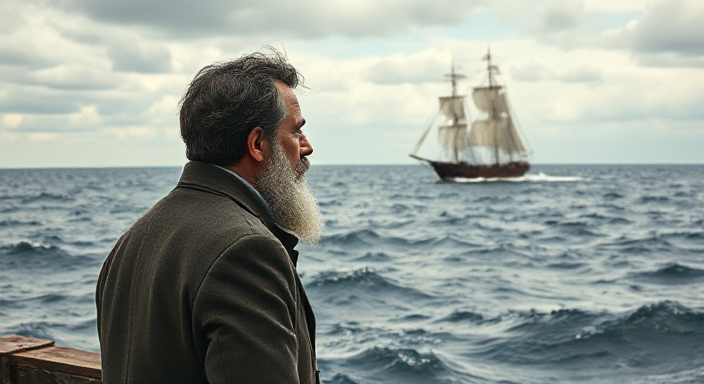
We who are alive in the age of the eBook may not be used to reading 675 page sea adventure tales. When we think of such novels—at least here on these shores—we probably think of James Fenimore Cooper and Herman Melville, venerable writers who penned some of the most enduring American classics of the genre. Though Denmark is one of the greatest seafaring nations in the history of the world, we typically don’t think of Danes when we think of the literature of the sea. Carsten Jensen’s fabulous first novel, We, the Drowned, should change that.

For three decades, Jensen has been one of the finest commentators in Denmark, distilling meaning out of everything, from political events to world developments, in his newspaper columns. With his deft touch, ordinary stones dazzle with sharp, brilliant light. Back when we still lived in Denmark, I eagerly anticipated the arrival of Politiken just so I could read his column. Over the years, many of these short pieces have been collected into books (and two of those titles have been translated into English).

But in We, the Drowned, Jensen gives us the big story. The inhabitants of the town of Marstal, on the island of Æro, have been seafarers for generations. They live and die by the code of the sea. Jensen writes in the communal first person plural, with its distinctive and authoritative “we” lending a familiar sense of intimacy, and starts his story in the year 1848. Like the docent in a fine museum, he then leads us through the next 100 years in Marstal’s history. That history is extraordinarily rich, and includes Denmark’s Three Years’ War (1848-51) with the Germans, two world wars, the rise of late capitalism and concomitant descent of the very life-blood of Marstallers’ lives, the sailing industry, and finally the ascendency of globalization (though the “g” word is not used).

Whew. That’s sure a lot.

And yet, though We, the Drowned explores a wide range of territory, it’s actually compact in the way only Jensen can make it. A lot of ground, and yes, water, is covered. But Jensen builds an impressive edifice out of the Marstallers’ lives. What happened to them, we could say, happened to all of us.

Though there’s a large ensemble cast, the narrative circles around several key characters. First, there’s Laurids Madsen, a sailor with near superhuman powers. On the very first page of the novel he’s blasted into the air when his ship explodes at the end of a losing battle against the Germans, but he survives. Returning to Marstal, his status exulted by his near-death experience, he’s revered. Eventually, however, he sours of life in Marstal. He signs on to another ship and never returns. Then the narrative shifts to one of his sons, Albert—who even as a boy resembled his father—and he takes up the seemingly hopeless cause of finding the man who deserted him. In Albert’s narrative we meet a host of strange but delightful characters: the brutal schoolteacher Isager and his whip (who teaches hardness but not much else); first mate O’Connor who’s even more brutal than Isager; the con man Anthony Fox and the dastardly Jack Lewis who gives Albert a shrunken head he claims is that of James Cook. Midway through all this, as if to personalize Albert’s search for his father, the point of view shifts to first person singular:

I signed on for Singapore and from there to Van Dieman’s Land, to Hobart Town, the last port where my father had been seen. But it wasn’t just his final port: it was everyone’s dead end—and if it wasn’t yours, it soon would be, if you didn’t get yourself out in time. Picture the workhouse in Marstal: that’s what Hobart was like.

In literature as in life, finding a runaway father often leads to disappointment. Such is the case here for Albert Madsen (though for readers the high seas quest is rife with adventure). Before long—and returning home to first person plural—Albert is an old man serving as a father figure to a young boy, Knud Erik Friis, and as a reluctant lover to the boy’s widowed mother, Klara. When Albert dies—literally frozen to death in his father’s lucky boots—he bequeaths his fortune to Klara. And so begins the final stage of this book, with Klara and Knud Erik front and center.

Klara, a woman who lost her husband when his ship went down, wants to punish the sea for all the damage it has inflicted on Marstallers’ lives—particularly the town’s women. Ironically, she wants to use Albert’s fortune, built on the waves of the oceans, to end Marstal’s dependency on sailing. She visits a powerful businessman in Copenhagen named Markussen and tells him of her plan. He responds:

“Have you heard of Xerxes, king of Persia?” he finally asked. “Xerxes got it into his head to punish the sea because a sudden storm arose and destroyed his fleet before a decisive battle against the Greeks. His method was somewhat unusual. He had the sea whipped with iron chains. I’d say, Mrs. Friis, that you’re a modern-day successor to Xerxes” [. . .] “I hope you understand that your plans will have fatal consequences for your little town.”

She understands that only too well. But does her plan succeed? Well, I won’t give it away. You can decide for yourself.

All told, We, the Drowned is a tour de force, a colossus, that gives Americans an opportunity to witness the gears of a great writer at work, turning the ordinary into the extraordinary. Richly translated by Charlotte Barslund and Emma Ryder so that obscure nautical terms like “ketch,” “old luggers,” “cutters,” “fore-and-aft schooner” flow naturally in translation. Sentence after sentence is strung together like bright bulbs of light. In his first work of fiction, Carsten Jensen creates characters with whom readers can empathize, and even the lowliest among them have real, identifiable motives behind their actions. This novel may be big and heavy, but it’s worth every single page.


Comments are disabled for this article.

....

We, the Drowned
By Carsten Jensen
Translated by Charlotte Barslund and Emma Ryder
Reviewed by K.E. Semmel
675 pages, Hardcover
ISBN: 9780151013777
$28.00
And the Hippies Came (Llegaron los hippies)
And the Hippies Came (Llegaron los hippies) by Manuel Abreu Adorno
Reviewed by Vincent Francone

Kids these days. They think they’ve invented everything. The McOndo writers and Crack Generation, who so proudly buck the Magic Realist tendencies of García Márquez, who seek to find a place within Latin American letters sans spirits . . .. . .

Read More >

Traveler of the Century
Traveler of the Century by Andrés Neuman
Reviewed by Chad W. Post

When I was about two-thirds of the way through Neuman’s very ambitious, very engrossing novel, Bromance Will Evans asked me what I thought the purpose the rapist had in this book. Not who the rapist was—something that’s held in suspense. . .

Read More >

Anatomy of a Night
Anatomy of a Night by Anna Kim
Reviewed by Jennifer Marquart

“At night Amarâq is coated with a darkness as viscous as unmixed colors, neither the fjord nor the mountains, valleys, lakes, or the river exist, there is only a black mass, a void that spreads across the landscape sporadically, pressing. . .

Read More >

Les aigles puent
Les aigles puent by Lutz Bassman
Reviewed by John Thomas Mahany

If you’ve been following any of the recent Antoine Volodine talk going around Three Percent—both on the blog or on the podcasts—and have heard his fans wax obsessive over all his alter author-egos, you’re probably starting to feel some Volodine. . .

Read More >

Red Spectres
Red Spectres by V. Bryusov/M. Bulgakov/S. Krzhizhanovsky et al.
Reviewed by Aleksandra Fazlipour

Muireann Maguire’s Red Spectres is a stunning and engaging collection of eleven Russian gothic tales written by various authors during the early Soviet Era, all but two stories of which are featured in English for the first time ever. These. . .

Read More >

El arte de la resurrección (The Art of Resurrection)
El arte de la resurrección (The Art of Resurrection) by Hernán Rivera Letelier
Reviewed by Jeremy Osner

“The small stone plaza was floating in the midday heat. The Christ of Elqui, kneeling on the ground, his gaze thrown back on high, the part in his hair dark under the Atacaman sun—he felt himself falling into an ecstasy.. . .

Read More >

There Once Lived a Girl Who Seduced Her Sister's Husband, and He Hanged Himself: Love Stories
There Once Lived a Girl Who Seduced Her Sister's Husband, and He Hanged Himself: Love Stories by Ludmilla Petrushevskaya
Reviewed by Brendan Riley

This slender, uncanny volume—the second, best-selling collection of stories by Russian author Ludmilla Petrushevskaya to appear in the U.S.—has already received considerable, well-deserved praise from many critics and high profile publications. Its seventeen short tales, averaging ten pages each, are. . .

Read More >