
Skip to content

Archive

1501–1510 of 3905 posts

four test tubes side by side, containing a graphene substance of different colors
Science & Technology
July 10, 2019

Will your future computer be made using bacteria?

Graphene is a revolutionary nanomaterial, the discovery of which led to a Nobel Prize. By mixing graphite with bacteria, Rochester scientists are making graphene easier and more environmentally friendly to produce, paving the way for future products and applications.

By mixing graphite with bacteria, Rochester scientists are making graphene easier and more environmentally friendly to produce.

topics: Anne S. Meyer, Department of Biology, featured-post-side, Materials Science Program, nanotechnology, research finding, URnano,
student pilots a small boat covered in solar panels on a lake during a race

Last year, Rochester’s Solar Splash team didn’t even make it to the college championships solar and electric boating. This year, a renewed focus on data science saw the team take home awards for innovation and most improved team.

This year, a renewed focus on data science saw the Rochester Solar Splash team take home awards for innovation and most improved team.

topics: data science, events, Hajim School of Engineering and Applied Sciences,
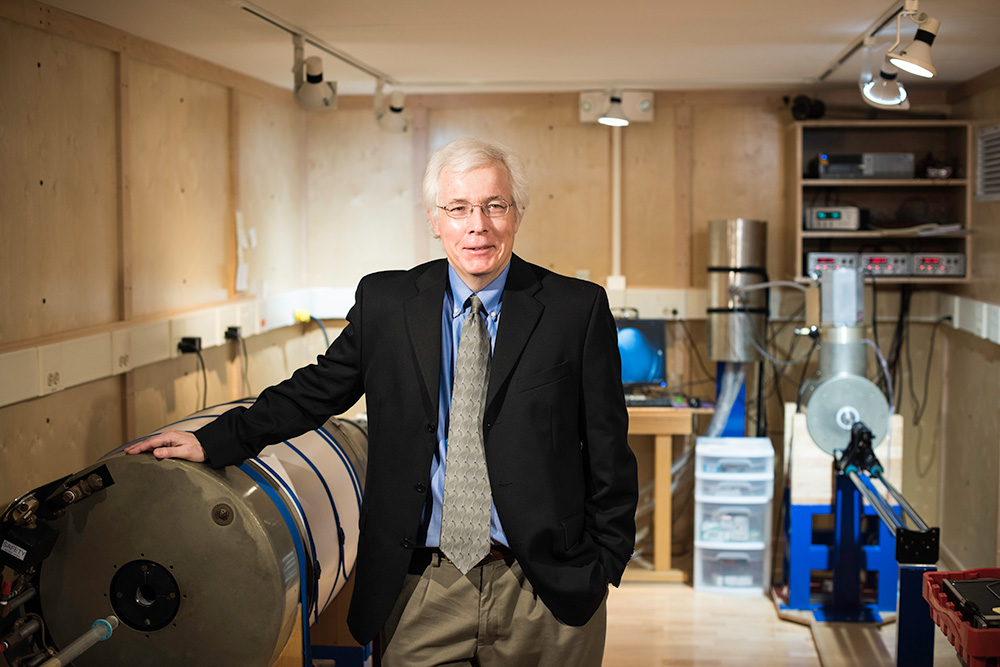
David Williams in a classroom.

Dean for research in Arts, Sciences & Engineering since 2011, Williams stepped down on July 1 to return full time to his research.

Dean for research in Arts, Sciences & Engineering since 2011, Williams stepped down on July 1 to return full time to his research.

topics: Arts Sciences and Engineering, Center for Visual Science, Institute of Optics, Laboratory for Laser Energetics, research,
technician holds a device in front of the eyes of a young child, who looks through the device

Ovitz and VPG Medical took home first and second prize in this year’s Luminate competition, the world’s largest startup accelerator program for optics, photonics, and imaging technologies.

Ovitz and VPG Medical took home top prizes in this year’s Luminate competition, the world’s largest startup accelerator program for optics and photonics.

topics: economic development, Institute of Optics, photonics,

New research from Rochester scientists explores why human beings are good at discerning moving objects and how we can train our brains to be better at this as we age.

New Rochester research explores why human beings are good at discerning moving objects and how we can train our brains to be better at this as we age.

topics: Department of Brain and Cognitive Sciences, Duje Tadin, featured-post-side, research finding, School of Arts and Sciences, vision,
group of people smiling and talking as they walk across campus on a sunny day.

Rochester’s new president promised she would spend considerable time on a “listening and learning tour” during the first part of her time as the University’s chief executive. President Sarah C. Mangelsdorf jumped right in early Monday morning with a two-hour tour of parts of the River Campus.

President Sarah C. Mangelsdorf jumped right in early Monday morning with a two-hour tour of parts of the River Campus.

topics: featured-post, Sarah Mangelsdorf,
portrait of four students.

For the second year, the University is sending a group to the University Scholars Leadership Symposium to learn about humanitarianism, social change on a global scale, and how to best respond to the needs of the marginalized.

For the second year, the University is sending a group to the University Scholars Leadership Symposium.

topics: Hajim School of Engineering and Applied Sciences, School of Arts and Sciences,
two protesters in Sudan, one holding a Sudanese flag

Why have civil wars and insurgencies occurred in Sudan and Uganda, but not Kenya? A new study finds the origins of ethnic violence in precolonial political organization.

A new study finds the origins of ethnic violence in precolonial political organization.

topics: Department of Political Science, research finding,
a teenager holds a crying emoticon over their face to symbolize expression of emotions and depression

A Rochester study shows that teenagers who can describe their emotions in precise and nuanced ways—saying ‘I feel ashamed’ instead of simply saying ‘I feel bad’—are better protected against depression than their peers who can’t.

Rochester research shows that teenagers who can describe their emotions in nuanced ways are better protected against depression than their peers who can’t.

topics: Department of Psychology, featured-post-side, research finding, School of Arts and Sciences, teenagers,
artist illustration of turbulent flows within magnetic fields
Science & Technology
June 26, 2019

Finding order in the chaos of turbulence

A new set of conservation laws developed by Rochester researchers are unique to the turbulent flows within magnetic fields, and could help explain the evolution of stars and galaxies.

topics: Department of Mechanical Engineering, Hajim School of Engineering and Applied Sciences, Hussein Aluie, research finding,