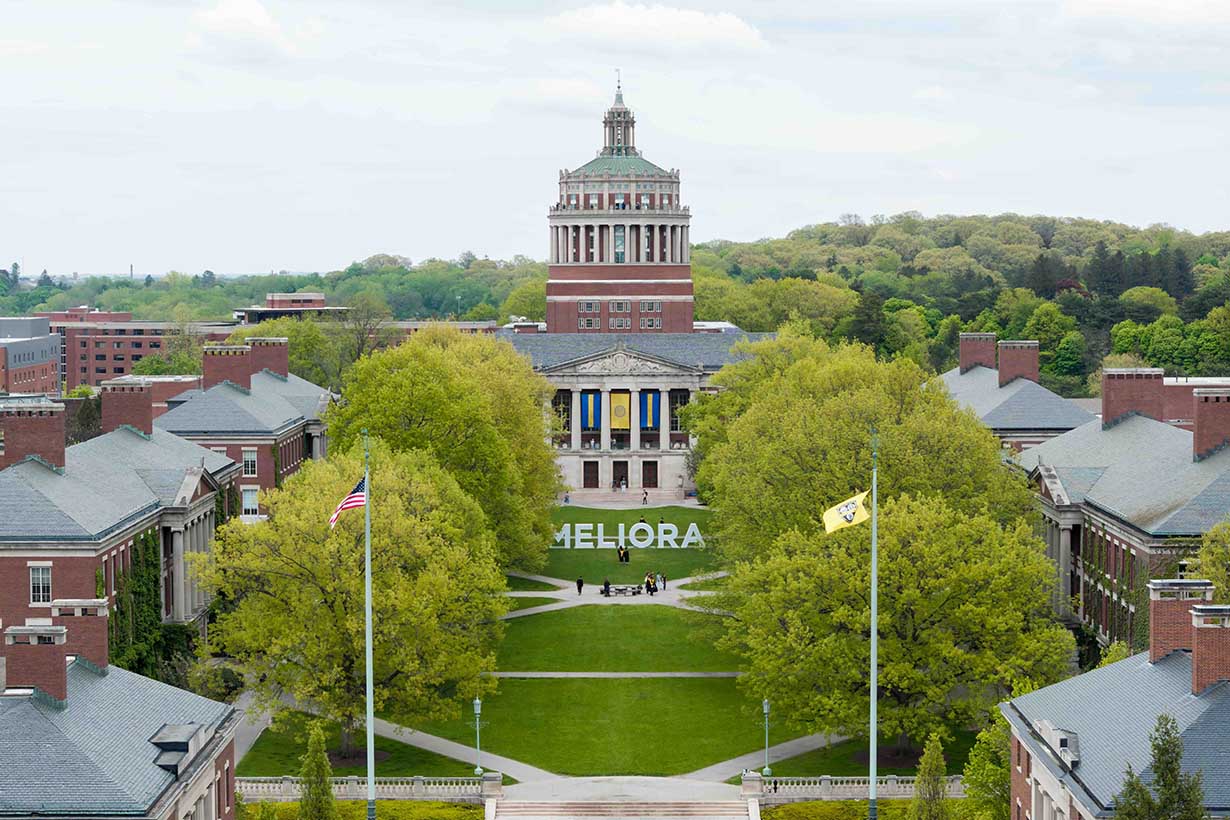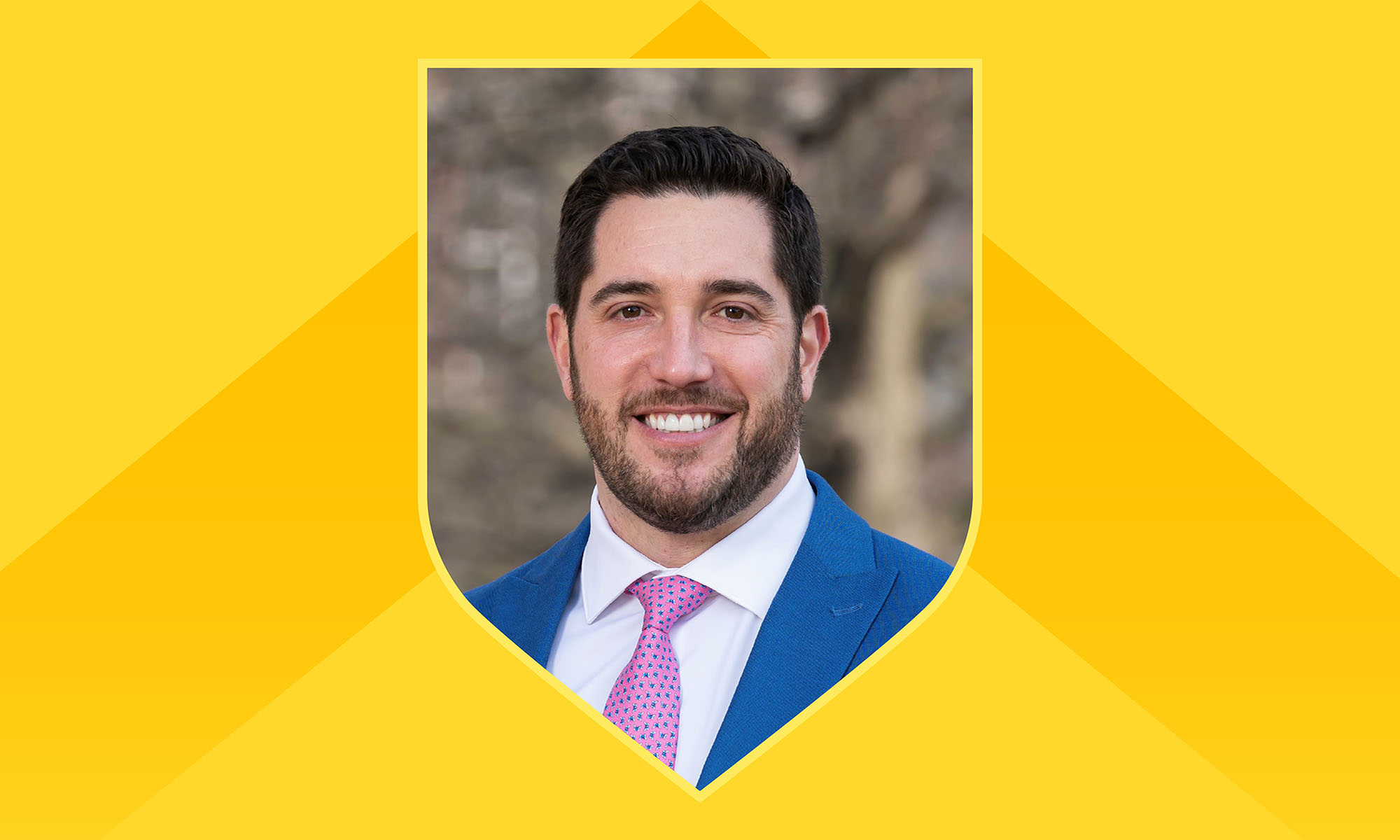

In a Leadership Conversation, two members of the University’s marketing and communications team discuss the strategy that is shaping URochester’s reputation.

It’s possible that a university’s image has never been more important than it is today, and that’s because the higher education environment has never been this fraught.
Starting this fall, universities are expected to spend the next two decades competing for a shrinking pool of college-aged students, bringing the concerns of the “enrollment cliff” to bear. With families struggling financially, there’s growing skepticism about the value of a degree. Geopolitical volatility has complicated global recruitment strategies for students and faculty. Federal policy changes have created many uncertainties for the future of research and healthcare.
The University of Rochester is meeting the moment with a refreshed brand strategy and identity. Launched in October 2025, the refreshed brand reflects URochester’s evolution while creating a new foundation to strengthen its global reputation—one of the five pillars of Boundless Possibility, the University’s strategic plan.
Sid Bhattacharya, the associate vice president for marketing, and Michelle Hildreth, the director of creative strategy and solutions, are two of the people from URochester marketing and communications (UMC) who were integral to URochester’s first brand refresh in almost 20 years. In a Leadership Conversation, Bhattacharya and Hildreth offered a behind-the-scenes look at their ongoing work on the brand, including multichannel national campaigns that aim to enhance URochester’s reputation worldwide.

Here are five takeaways.
Marketing isn’t an act; it’s a system.
Until 2023, URochester was primarily engaged in what Bhattacharya called “random acts of marketing.” That started to change when Page Hetzel was hired as the University’s first vice president for marketing and communications. Redefining the legacy position to include marketing paved the way for a marketing division, which began to take shape in September 2024 when Bhattacharya joined the University.
The primary goal of the marketing team was to re-envision URochester’s brand and develop ongoing initiatives to convey the University’s strengths for contemporary audiences. Bhattacharya’s earliest conversations put the ultimate goal of his team’s work in clear terms.
“There was consistent drumbeating around being sick and tired of URochester being a hidden gem. How do we lose ‘hidden’ and become just a gem?”
A big part of Bhattacharya’s role was to unleash URochester locally, regionally, nationally, and globally. To give the University the spotlight it deserves, the marketing team is executing a strategy that is taking place across five platforms:
- Brand
- Enrollment (undergraduate and graduate)
- Storytelling (e.g., Social Media, News Center, Rochester Review)
- Digital (including web modernization)
- Strategic internal communications
Bhattacharya has overseen a deliberate shift toward a more comprehensive, layered approach that employs strategic tactics and initiatives, working with partners across the institution.
One of the latest examples of this work is the flagship brand video “Wonderful Combinations.” The 90-second spot presents URochester as a place that thinks in terms of “and,” not “or,” celebrating the way its community blends ideas, supplements interests, and connects disciplines. Hildreth noted that the video features more than 40 students, faculty, and staff and an original score composed by the Emmy Award-winner Mark Watters, an associate professor of contemporary media and film composition, which was performed by the Eastman School Symphony Orchestra.
Higher ed audiences want less polish and more proof.
More and more students and families are looking at the cost of tuition and the prospective debt that comes with a degree, and they’re wondering, “Is this worth it?” Hildreth shared that not only are they more skeptical than previous generations, they’re also better at tuning out traditional marketing—and almost instinctively rejecting it.
So, how does URochester ensure it’s heard? Hildreth pointed to five strategies.
The first is audience-specific storytelling. A prospective student wants different information than an alumnus considering a gift or a research partner exploring collaboration opportunities. URochester’s challenge is to tailor stories that resonate with each group without straying from its overarching brand message.
Outcomes-first messaging is another approach that emphasizes how URochester degrees and research lead to careers and real-world solutions.
Authenticity and “peer voice” have also become increasingly important. Hildreth noted they are leaning into student-generated content, highlighting real experiences because it helps build trust and works a lot better than “sizzle marketing.”
Equally important to using an authentic voice is being transparent and accountable, especially with current or prospective donors or external partners and the broader public. These groups want clear evidence of institutional impact, including how URochester is using philanthropic funds and the outcomes of research.
Finally, there’s the rise of a brand system—enemy to random acts of marketing. The marketing team is moving away from one-off campaigns and brand moments to ensure URochester expresses itself consistently across all touchpoints.
“The universities that ‘win’ in the next decade of brand perception aren’t going to be the ones that spend the most on marketing. They’ll be the ones that have the clearest sense of who they are and have the courage to express it.”
AI is reshaping how people discover URochester.
Student search behavior is changing in a big way. Instead of pulling up Google and typing specific topics like “no core curriculum” into the search bar, they are increasingly using AI-driven platforms, such as ChatGPT and Claude, to ask complex, multi-variable questions.
Bhattacharya addressed this shift, explaining that while traditional paid search or search engine optimization remains important, they also need to consider answer or generative engine optimization. These days, even if a student uses Google to search, the first thing they will see is an AI overview, which may provide whatever information they are looking for. The rise of “zero-click searching” has many universities working to enhance their discoverability. Bhattacharya shared that his team conducted some testing and didn’t love the way URochester currently appears in these instances.
“In order for us to show up better when prompt queries we care about are used, we have to do some content, website organization, and structural work. So, we’ll be thinking about how we can show up in the right way, at the right times.”
Social media is another area where the marketing team is leveraging AI, specifically through Sprout, a comprehensive social media management and intelligence platform. The platform’s AI-assisted content publishing and generation feature enables the team to quickly and easily develop a range of content options that they can shape to fit the moment. Other examples include generating alt text for images and “inbox automation,” which simplifies how URochester accounts engage with followers by categorizing messages and suggesting responses. By automating some of the more routine work in this space, the social team is freed to spend more time on creative strategy and storytelling.
Hildreth acknowledged AI is a hot-button issue for creatives, some of whom won’t consider using it at all. However, her team embraces it for research and the synthesis phase of the creative process (e.g., mood-boarding). And there’s one critically important rule: nothing goes out without a human touching it.
House of brands < Branded house
April 15 was a big day at URochester, and the reason may have flown under the radar for many (especially if they missed the April 20 issue of @Rochester). The University’s health system formally changed from “UR Medicine” to “University of Rochester Medicine.” It may seem like a minor change, but it’s a major move for brand and visual alignment that reinforces the One University philosophy in a meaningful way.
Historically, URochester schools and units operated with significant independence in how they presented themselves, creating an institution of many brands. The marketing team’s work has helped to bring those brands (i.e., UR Medicine) under a single umbrella where they can share a visual and messaging framework that allows for some flexibility.
Hildreth explained that the value of the brand system is the way it relieves University entities from having to spend time explaining who they are, what they stand for, or how they are part of URochester—it’s all baked in.
The marketing team has empowered schools and units to be good brand and University citizens by offering guidelines and an array of resources at brand.rochester.edu. There’s also the brand activation tool, Marq, which offers hundreds of ready-to-use, customizable templates.
“Folks are realizing how much better this landscape is for creation. We’re giving them little nuggets, and they’re really running with them. It is good to see people adopting it and making it their own.”
Bhattacharya added that brand unity not only creates a stronger, more recognizable identity but also offers practical benefits, such as cutting costs and minimizing duplicative efforts. There’s also some data that shows the brand work is working.
In February 2024, the marketing team used a comprehensive Harris poll to gauge how well people know who URochester is, what it does, and what’s distinctive about it. In the last year and a half, brand awareness has gone from 11 percent to 24 percent.
Undergraduate applications were up almost nine percent, and early decision applications are up 17 percent. Both are important signals as admission is the University’s revenue engine. In all cases, Bhattacharya emphasized these gains aren’t just the product of recruitment marketing; they’re part of a cumulative effort and everyone aligning with the University brand.
The work is far from done.
URochester is part of a crowded and increasingly competitive market. Although the marketing teams have reinvigorated the brand and produced some early results, the efforts to date should be considered an initial set of moves in a long game.
Hildreth shared that as the marketing team continues to strengthen the brand, they will look to elevate their video content and digital work. Bhattacharya is looking forward to expanding URochester’s market presence beyond the 11 core markets of its current image campaign.
Given the long tail of brand work, Bhattacharya and Hildreth were asked to consider what makes a brand last. What gives a brand power?
Hildreth believes a strong brand is clear and confident.
“There are a lot of universities and companies out there that are afraid to have a point of view. But the brands that stand out stand for something clear, and they do it in a way that helps the audience see themselves in it.”
Bhattacharya emphasized authenticity. As his team developed URochester’s brand strategy, they focused on what is genuinely unique about the University, grounding it in strong proof points. He also expressed gratitude for the University’s initial investment in the brand because consistency is critical to the momentum and visibility that builds recognition. Finally, he pointed to credibility and trust, as once those are lost, branding no longer matters.
Developing a brand that is clear, confident, authentic, consistent, and trustworthy isn’t achieved by policing the University community; rather it’s cultivated by a community of evangelists.
“A brand is never done,” said Bhattacharya. “And maintaining it is not solely the role and responsibility of the marketing team; it’s on all of us.”