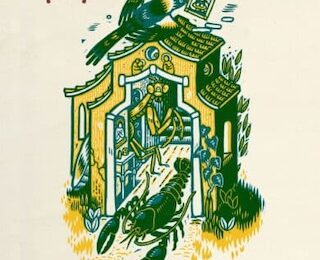
This week’s Read This Next title is Good Offices by Evelio Rosero, translated from the Spanish by Anne McLean and Anna Milsom, and coming out from New Directions next week.
Good Offices is the second novel by Evelio Rosero (after The Armies, 2009) to be published by New Directions. It’s also the first to be translated by Anne McLean in collaboration with Anna Milsom.
In Good Offices, we are released into the world of Tancredo, a hunchback who has a deep fear of becoming an animal. Tancredo, the sexton’s goddaughter (Sabina Cruz) and the three witchlike widows work for a corrupt priest providing charity meals for the local poor. Their endless labor has drained them of their humanity. Their daily routines are soon to be broken, however, with the arrival of a new priest: Father Matamoros, a drunkard with a beautiful voice whose sung mass is spellbinding to all. Under the magical and disillusioning presence of Father Matamoros, the women and Tancredo spill their confessions and turbulent stories.
Click here to read an extended preview, which has a pretty striking opening:
He has a terrible fear of being an animal, especially on Thursdays, at lunchtime. “I have this fear,” he says to himself, and glimpses his hump reflected in the window. His eyes wander over his eyes: he does not recognize himself. What an other! He thinks. What an other! And examines his face. “On Thursdays,” and then, “this Thursday, especially, when it’s the old people’s turn.” Tuesdays for the blind, Mondays for the whores, Fridays for families, Wednesdays for the street kids, Saturdays and Sundays for God, or so says the priest.
Additionally, we posted an interview between Dan Vitale and Anna Milsom, which is definitely worth reading in full:
DV: How did you discover the book?
AM: Well, I met Anne at the BCLT summer school too—it must be a decade or so ago. We had a lot of fun and have stayed in touch since. Two years ago I was running a literary translation evening class at London Metropolitan University where I now teach and I invited Anne to come in as a guest speaker. She had Los almuerzos in her bag and suggested we might see about doing the translation collaboratively—I leapt at the chance, as you may imagine. Anne had already translated Rosero’s The Armies and together they had won the UK’s Independent Foreign Fiction Prize, so it felt pretty amazing to be discussing the possibility of working with such a formidable team. I got hold of the book as quickly as I could and the first thing I did was fall for the swooping rush of the prose. The second thing was to wonder how on earth to render it in English. Or perhaps I did those two things simultaneously. Translators read in a very special and peculiar way, I think, taking in the words as both readers and writers at the same time. It becomes hard not to do this, even when you’re reading purely for pleasure.
Finally, here’s Dan’s review of the novel, which opens:
Evelio Rosero’s first novel to be translated into English since his award-winning The Armies takes place on a much smaller scale than that hallucinatory story about the damaging effects of civil war in Colombia. Good Offices, lighter in tone and slighter than The Armies, documents the events of a single day in a single location: a Catholic church in Bogotá. The tale is told through the eyes of Tancredo, a young man with a hunchback, who assists the priest of the church, Father Almida, as an occasional acolyte but mainly by running the daily free lunches the church offers to the city’s neediest residents: “Tuesdays for the blind, Mondays for the whores, Fridays for families, Wednesdays for the street kids, Saturdays and Sundays for God, or so says the priest.”
Click here to access all of these features and to find links where you can buy a copy of the book.
When I was about two-thirds of the way through Neuman’s very ambitious, very engrossing novel, Bromance Will Evans asked me what I thought the purpose the rapist had in this book. Not who the rapist was—something that’s held in suspense. . .
“At night Amarâq is coated with a darkness as viscous as unmixed colors, neither the fjord nor the mountains, valleys, lakes, or the river exist, there is only a black mass, a void that spreads across the landscape sporadically, pressing. . .
If you’ve been following any of the recent Antoine Volodine talk going around Three Percent—both on the blog or on the podcasts—and have heard his fans wax obsessive over all his alter author-egos, you’re probably starting to feel some Volodine. . .
Muireann Maguire’s Red Spectres is a stunning and engaging collection of eleven Russian gothic tales written by various authors during the early Soviet Era, all but two stories of which are featured in English for the first time ever. These. . .
“The small stone plaza was floating in the midday heat. The Christ of Elqui, kneeling on the ground, his gaze thrown back on high, the part in his hair dark under the Atacaman sun—he felt himself falling into an ecstasy.. . .
This slender, uncanny volume—the second, best-selling collection of stories by Russian author Ludmilla Petrushevskaya to appear in the U.S.—has already received considerable, well-deserved praise from many critics and high profile publications. Its seventeen short tales, averaging ten pages each, are. . .
The Urdu word basti refers to any space, intimate to worldly, and is often translated as “common place” or “a gathering place.” This book by Intizar Husain, who is widely regarded as one of the most important living Pakistani writers,. . .
The Whispering Muse, one of three books by Icelandic writer Sjón just published in North America, is nothing if not inventive. Stories within stories, shifting narration, leaps in time, and characters who transform from men to birds and back again—you’ve. . .
Luis Negrón’s debut collection Mundo Cruel is a journey through Puerto Rico’s gay world. Published in 2010, the book is already in its fifth Spanish edition. Here in the U.S., the collection has been published by Seven Stories Press and. . .
“South”
To have watched from one of your patios
the ancient stars
from the bank of shadow to have watched
the scattered lights
my ignorance has learned no names for
nor their places in constellations
to have heard the ring of. . .