
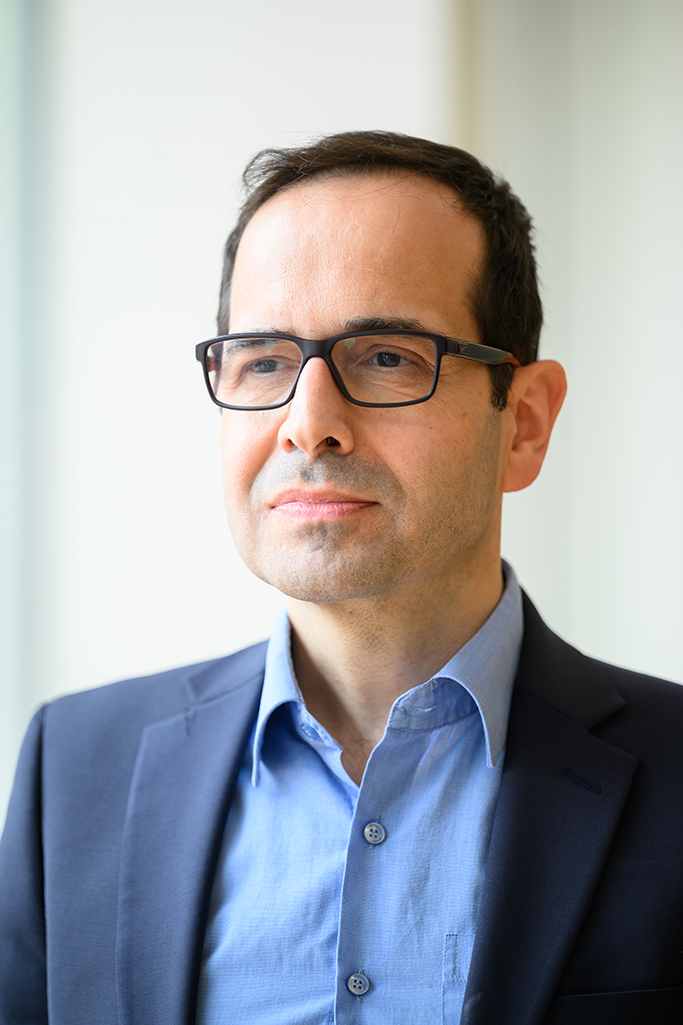
 The University of Rochester has named Mujdat Cetin as its inaugural associate vice president and vice provost for artificial intelligence (AI), a new University-wide leadership position charged with advancing URochester’s strategy for AI across research, education, workforce development, societal impact, and industry partnerships.
Cetin, a professor of electrical and computer engineering and computer science, currently serves as the Robin and Tim Wentworth Director of the Goergen Institute for Data Science and Artificial Intelligence. He will begin his new role on September 1.
As the University’s academic and strategic leader for AI, Cetin will report jointly to the provost and the vice president for research. He will lead the development and implementation of a University-wide AI strategy aligned with Boundless Possibility, Rochester’s 2030 strategic plan, and will help position the University as a national leader in AI-related and AI-enabled research, education, and innovation.
The new appointment will be structured as a 50:50 role, with Cetin devoting half of his effort to his responsibilities as associate vice president and vice provost for AI, and half to his continued leadership as director of the Goergen Institute.
“Artificial intelligence is rapidly changing how we teach, learn, conduct research, and engage with the world,” said Nicole S. Sampson, provost and URochester’s chief academic officer. “Mujdat brings the combination of scholarly expertise, collaborative leadership, and institutional perspective we need to bring together the extraordinary AI work already happening across the University and establish an ambitious vision for where we go next.”
In his new role, Cetin will work across the University’s schools and divisions to strengthen AI-related research and education, expand interdisciplinary collaboration, identify major funding and partnership opportunities, and help faculty, students, and staff build the knowledge and skills needed to use AI effectively and responsibly. He will also guide efforts to expand AI curricula, degree programs, certificates, and experiential learning opportunities and strengthen connections with regional employers and initiatives such as Empire AI.
Cetin will also play an important role in coordinating AI-enabled research and discovery across the University, including collaborations involving the Goergen Institute, the Laboratory for Laser Energetics, University of Rochester Medicine, the University’s Transdisciplinary Centers, and other research units. His other priorities will include working with University research leadership to identify emerging funding opportunities and bring together interdisciplinary faculty teams to pursue major collaborative initiatives.
“Rochester has tremendous expertise in artificial intelligence, data science, computing, medicine, engineering, the sciences, humanities, and many other areas that will shape how AI develops and how it affects society,” said Cetin. “I am excited by the opportunity to connect those strengths across the University and build on the outstanding work already underway. Our goal will be to create an environment in which AI accelerates discovery, enhances education, creates new opportunities for collaboration and innovation, and is developed and used thoughtfully and responsibly. I look forward to working with colleagues across Rochester to define what leadership in AI can look like for our University.”
Cetin will also provide leadership for University-wide AI governance. The University’s AI Council will report to him, with his leadership responsibilities including overseeing the development of University-wide policies, guidelines, and guardrails designed to balance responsible use with the flexibility necessary for innovation, while ensuring that Rochester’s approach evolves alongside the changing regulatory, legal, and ethical landscape.
“AI is already transforming the way research is conducted, opening new possibilities for discovery across virtually every field,” said Stephen Dewhurst, vice president for research at URochester. “Mujdat understands the extraordinary potential of these technologies and the importance of bringing researchers together across disciplines to realize that potential. He also has a strong grasp of the importance of making sure that AI works for everyone, and of the key role that academic institutions must play in ensuring that AI tools are developed and used in a responsible and ethical manner. His leadership will help us build the partnerships, infrastructure, and collaborative research environment needed to translate Rochester’s expertise into meaningful scientific, societal, and economic impact.”
As leader of the Goergen Institute, Cetin brings extensive experience in interdisciplinary research and academic leadership. His research spans data, signal, and imaging sciences, with particular emphasis on probabilistic and machine-learning methods for extracting information from complex data. His work includes computational sensing and imaging, biomedical image analysis, computer vision, and signal processing and machine learning for brain-computer and brain-machine interfaces.
Before joining Rochester, Cetin was a faculty member at Sabanci University in Istanbul and a research scientist at MIT and held visiting faculty appointments at MIT, Northeastern University, and Boston University. He earned his bachelor’s degree in electrical engineering from Bogazici University, a master’s degree in electrical engineering from the University of Salford, and a PhD in electrical engineering from Boston University.
The creation of the associate vice president and vice provost for artificial intelligence position reflects the University’s broader commitment to ensuring that advances in AI strengthen Rochester’s research enterprise, enrich teaching and learning, prepare students and the workforce for a rapidly changing environment, and contribute to economic and societal impact locally, nationally, and globally.